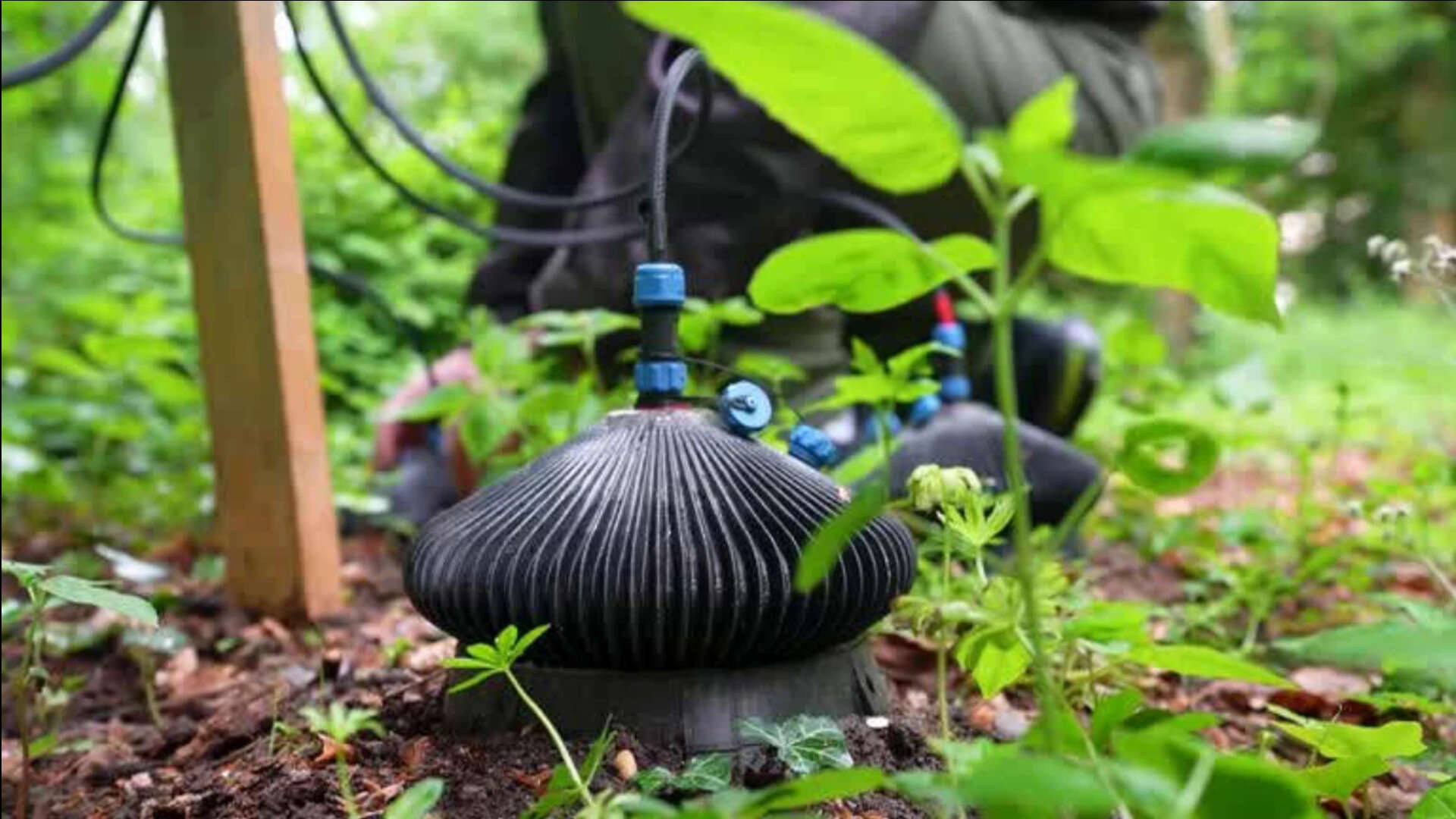
Tech investors love a good dirt-to-riches story. The latest media darling is the Microbial Fuel Cell (MFC), specifically the flavor packaged by startups promising to harvest electricity from garden soil to power the agricultural internet of things (IoT). The narrative is seductive: bury a bio-battery in a field, let native electrogenic bacteria munch on organic matter, and enjoy infinite, clean power for farm sensors. No batteries to replace. No solar panels to clean.
It sounds like a triumph of green engineering. It is actually a fundamental misunderstanding of thermodynamics and agricultural reality. Meanwhile, you can explore similar developments here: The Price of the Premium Life.
I have spent years evaluating hardware deployments in harsh environments, and I am telling you that the dream of widespread soil-powered electronics is a mirage. The physics do not scale, the biology is notoriously fickle, and the operational economics make traditional lithium batteries look like a bargain. We are throwing millions of dollars at dirt when we should be fixing the actual bottlenecks of rural connectivity.
The Low Voltage Lie
The marketing glossaries for soil-powered sensors focus entirely on the word "infinite." What they conveniently leave out is the word "infinitesimal." To explore the bigger picture, we recommend the recent report by Wired.
A standard soil microbial fuel cell relies on specific microbes, like Geobacter sulfurreducens, to transfer electrons to an anode during respiration. Under ideal laboratory conditions, a single MFC might generate an open-circuit voltage of 0.5 to 0.7 volts. Once you draw a continuous current, that voltage plummets due to internal resistance and mass transfer limitations.
To power a standard agricultural sensor node—say, a LoRaWAN moisture probe that requires a stable 3.3V to transmit data—you cannot just plug it into the mud. You need a specialized power management integrated circuit (PMIC) and a massive bank of supercapacitors to trickle-charge for hours, or even days, just to store enough energy for a single, brief data transmission burst.
Let us break down the energy math that the hype cycle ignores:
| Metric | Soil MFC (Per Square Meter) | Standard AA Lithium Battery | Small 5V Solar Panel (10x10 cm) |
|---|---|---|---|
| Power Density | ~10 to 40 $\mu$W | N/A (Stored Energy) | ~1,000,000 $\mu$W (Peak) |
| Usable Voltage | 0.2V - 0.4V (Under load) | 1.5V - 3.6V (Stable) | 5.0V (Regulated) |
| Reliability | Highly dependent on moisture | Predictable decay curve | Dependent on weather/debris |
| Form Factor | Bulky, buried footprint | Compact, internal | Compact, surface-mounted |
To get the same instantaneous power that a cheap, $2 lithium coin cell delivers instantly, you would need an MFC array that disrupts a significant patch of topsoil. You are not buying a elegant sensor; you are burying a plumbing project.
Biology Does Not Care About Your SLA
The second fatal flaw of the dirt battery is its absolute reliance on living organisms that refuse to follow a Service Level Agreement (SLA).
Electrogenic bacteria are not machines. They require specific moisture levels, precise pH ranges, and a steady diet of bioavailable organic carbon.
Imagine a real-world agricultural scenario: a severe drought hits the Central Valley of California. The topsoil dries out, turning to dust. As the water table drops, the microbial activity in the upper soil layers grinds to a halt. Your soil-powered sensor dies precisely when the farmer needs soil moisture data the most.
Conversely, consider a flash flood or over-irrigation. The soil becomes entirely anaerobic, shifting the microbial population dynamics. The specific strains of bacteria tailored for your anode are suddenly outcompeted by methanogens or other non-electrogenic species. Your voltage drops to zero.
The Environmental Irony: To keep a soil microbial fuel cell functioning at peak efficiency, you must actively maintain the soil conditions around the electrode. You end up needing to irrigate and fertilize the dirt that is supposed to be powering the sensor telling you when to irrigate and fertilize.
The True Cost of "Free" Energy
The pitch to venture capitalists always highlights the environmental cost of discarding lithium-ion batteries. "Think of the heavy metals!" they cry.
Fair enough. Electronic waste is a genuine crisis. But replacing a 10-gram lithium battery with a sprawling apparatus of carbon cloth anodes, precious-metal-coated or specialized alloy cathodes, proton exchange membranes, and plastic housing does not reduce a device's environmental footprint—it just shifts the metabolic bill to a different sector of manufacturing.
The capital expenditure (CapEx) of manufacturing a durable, corrosion-resistant MFC that can survive five years buried in acidic, microbial-rich soil is orders of magnitude higher than a standard sealed plastic enclosure housing a primary lithium thionyl chloride ($Li-SOCl_2$) battery.
A single $Li-SOCl_2$ battery can easily power a low-power LoRaWAN sensor for 10 years if the firmware is optimized correctly. It works in the freezing cold of a North Dakota winter and the scorching heat of an Arizona summer. It does not care if the soil is dry, wet, or treated with pesticides.
By choosing soil power, you are trading a solved engineering problem (low-power firmware optimization) for an unsolved materials science nightmare.
Dismantling the Smart Home Delusion
Some proponents are already moving the goalposts, suggesting that if agriculture is too tough, we should use these systems in "future homes" to power smart gardens or outdoor lighting.
This is even more absurd. The power requirements of modern smart home ecosystems (Zigbee, Thread, Wi-Fi) are far too demanding for the meager microwatts pulled from a backyard compost pile. A single smart LED bulb draws more power than an acre of microbial fuel cells could realistically provide without turning your entire lawn into a giant, wired swamp.
If a consumer wants sustainable outdoor power, a $15 monocrystalline solar panel paired with a small lifePO4 battery occupies a fraction of the space, installs in minutes, and provides thousands of times the energy density.
Stop Funding the Mud; Fix the Silicon
We are asking the wrong questions about agricultural IoT. The bottleneck has never been the inability to harvest energy; it is our inefficiency in using it.
Instead of subsidizing expensive biological experiments that fail the moment a tractor drives over them, the industry needs to focus on three distinct, unglamorous areas:
- Ultra-Low-Leakage Silicon: We need PMICs and microcontrollers that draw nano-amps in deep sleep mode. The energy stored in a basic industrial battery should last long enough for the mechanical chassis of the sensor to degrade before the chemical energy runs out.
- Passive, Ambient Harvesting: If we must harvest energy, look up, not down. Ambion solar, RF harvesting, and even thermal gradient harvesting do not require direct contact with corrosive, living ecosystems.
- Edge Compute Optimization: Stop transmitting raw data streams over power-hungry cellular networks. Process the data directly on the sensor using tinyML, and only transmit when an anomaly is detected.
We do not need to turn our farms into low-voltage power plants. Stop over-engineering the dirt. Optimize the silicon, seal the enclosure, and let the bacteria do what they do best: grow crops, not run microchips.