Analytical Blueprint
Headline coverage of settler violence disrupting the Palestinian olive harvest often treats episodic clashes as the sole driver of agricultural loss. That framing misses the compounding interaction between physical intimidation, prior-coordination rules, permit bottlenecks, and multi-year tree capital depletion.
To evaluate how harvest disruptions translate into household and sector-wide losses, this analysis separates observed reporting from analytical hypotheses and structures the problem across four mechanics:
- Physical Disruption and Security Friction: Direct assaults, theft, property damage, and contested presence of security forces during the autumn harvest window.
- Administrative Access Bottlenecks: Prior-coordination mandates, restricted harvesting windows, and low permit approval rates that compress available labor time.
- The Three-Tier Cost Function: Immediate crop and asset losses, unharvested yield value under access limits, and multi-year productivity losses from damaged or felled trees.
- Operational Mitigation Limits: Field monitoring, legal documentation, and market or processing support—alongside the structural constraints that prevent any single intervention from resolving land-access friction.
Deconstructing Standard Harvest Reporting
Standard event-driven reporting on the West Bank olive harvest typically centers on single-day incidents, injured individuals, damaged vehicles, or brief statements from military officials and advocacy groups. While useful for documenting occurrences, single-incident reporting obscures three structural dynamics:
- Time compression: Olives ripen within a seasonal window; delays caused by curfews, blocked roads, or denied entry windows can push picking past optimal timing, reducing yield quality or leaving fruit unharvested.
- Asymmetric enforcement and presence: Rights monitors and military authorities often offer conflicting accounts of force posture and incident scale—for example, groups such as Yesh Din have reported hundreds of harvest-related incidents and cases where security forces were present, whereas the Israel Defense Forces (IDF) has stated that forces were deployed to prevent violence and that attacks affected only a small minority of harvests.
- Stock versus flow effects: Losing one season's harvest is an income flow shock, whereas uprooting, burning, or snapping olive trees destroys a slow-growing capital asset whose replacement takes years.
Known Facts Versus Educated Hypotheses
Known facts rest on documented reports, administrative figures, and published assessments:
- Between October 1 and November 16, 2026, Yesh Din documented 446 harvest-related incidents across the West Bank, including 219 violent assaults and 209 cases of theft or property damage, with over 100 reported incidents occurring while security forces were present.
- Israeli military orders ahead of the 2026 harvest expanded land requiring prior coordination for Palestinian farmers to roughly 88,300 dunams—nearly 30 percent above 2025 levels—with more than 40 percent of the newly added area in the Jenin governorate alongside newly established outposts.
- Permit bottlenecks have been documented in specific districts; UN OCHA figures cited in November 2026 reporting indicate 1,750 of 4,000 permit applications approved in Qalqiliya and roughly 80 of 350 submitted names issued permits in Salfit.
- The Palestinian Ministry of Agriculture reported approximately 286,000 olive trees damaged in the West Bank between 2023 and the end of September 2026, alongside cumulative olive-crop losses exceeding US$157 million over that period.
Educated hypotheses extrapolate from these figures using economic and agronomic relationships where complete, audited census data is unavailable:
- Expanding prior-coordination zones and limiting entry days likely converts partial access delays into total unharvested acreage when military coordination windows do not match peak ripening or available household labor.
- Even when farmers hold permits or coordination approval, fear of recurring attacks or nearby clashes can depress labor hours per dunam, lowering effective harvest throughput below nominal permit counts.
- Unquantified damage to tractors, pressing equipment, irrigation lines, and rural roads likely magnifies per-kilogram production costs in adjacent groves that were not directly attacked.
The Four Mechanics of Harvest Disruption
1. Physical Disruption and Security Friction
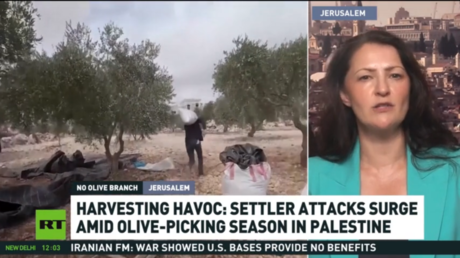
Direct disruption occurs through physical assaults on farmers, journalists, and solidarity visitors, alongside arson, stone-throwing, theft of harvested olives, and damage to vehicles and agricultural gear. When violence occurs near groves or access roads, the immediate operational effect is work stoppage: harvesters evacuate, ladders and sacks are left behind, and subsequent days require risk reassessment before teams return.
The presence or absence of Israeli forces shapes how incidents escalate and how they are contested afterward. Accounts from Palestinian farmers, activists, and rights organizations frequently describe security personnel failing to prevent attacks, dispersing Palestinian presence with tear gas or live fire, or arriving after perpetrators depart. Conversely, military statements emphasize troop deployments aimed at preventing friction and terrorism and contend that disruptions touch only a limited share of overall harvest activity.
In operational terms, this dispute creates a verification gap. Each actor measures a different denominator: incident monitors count discrete reported attacks and violations, while military assessments weigh those incidents against total territory or overall seasonal activity. Without standardized, jointly verified field logs, policy debates stall over scale rather than addressing ground-level bottlenecks.
2. Administrative Access Bottlenecks
Violence operates alongside bureaucratic and spatial friction. In areas requiring prior coordination or permits, farmers cannot simply mobilize family members on a clear morning; access depends on administrative approval, designated days, and set hours.
When prior-coordination zones expand—such as the jump to roughly 88,300 dunams ahead of the 2026 season—administrative processing becomes a binding constraint. Low approval ratios in districts like Qalqiliya and Salfit show how narrow the funnel can become when thousands of applications compete against tight seasonal schedules.
Two operational failure modes follow from these bottlenecks:
- Schedule mismatch: Approval granted late in the season or restricted to short windows forces rushed picking or leaves groves unharvested when rain or overripening intervenes.
- Spatial encirclement: Nearby outposts, road closures, and restricted agricultural zones raise transit time and exposure along connecting routes, turning nominally reachable plots into high-risk zones.
3. The Three-Tier Cost Function of Olive Sector Losses
Evaluating economic harm solely by counting stolen sacks or single-season crop value understates the sector's cost structure. A rigorous accounting model separates losses into three distinct tiers:
- Tier 1 — Direct Theft, Vandalism, and Asset Loss: Immediate losses from stolen harvested olives, burned or damaged vehicles, destroyed tools, and ruined local infrastructure. Scenario estimates for stolen olives alone have been placed in the tens to low hundreds of thousands of dollars, while machinery and infrastructure losses often remain uncounted for lack of verified replacement tallies.
- Tier 2 — Foregone Harvest Yield Under Access Limits: Output lost when groves are inaccessible, coordination is denied, or harvesting is cut short. Using a reference valuation of roughly US$8.33 per kilogram (derived from UN OCHA's 2023 assessment of over 1,200 tonnes of lost olive oil valued at about US$10 million), scenario modeling puts potential unharvested crop value between roughly US$20.6 million across the ~88,300 dunams under formal prior-coordination restrictions and over US$50 million under broader inaccessibility assumptions—depending on how many affected dunams actually go unpicked.
- Tier 3 — Multi-Year Capital Depletion from Tree Damage: Olive trees are long-lived productive assets, and their output naturally fluctuates due to alternate-year bearing cycles and rainfall. When hundreds of thousands of trees are burned, snapped, uprooted, or deprived of care, annual productive capacity drops across future seasons. Annualized production losses from damaged trees have been estimated in the single-digit millions of dollars per year, excluding full replanting, rehabilitation, and multi-year cumulative compounding.
Consider a village where 30 percent of households rely on a contested hillside grove. If access is blocked for three weeks during peak harvest, those families lose current-year cash income (Tier 2), incur extra transport or repair costs (Tier 1), and face lower yields next year if branches were broken or scorched during clashes (Tier 3).
4. Operational Mitigation and Its Structural Limits
Organizations supporting Palestinian farmers generally concentrate on four practical levers during harvest season:
- Protective Accompaniment and Rapid Reporting: Deploying observers, human rights monitors, diplomats, or protective presence in high-risk groves to deter attacks, document violations in real time, and speed emergency response.
- Legal and Administrative Advocacy: Challenging restrictive coordination orders, tracking permit backlogs, and pressing authorities for timely, predictable grove access.
- Tree Rehabilitation and Restocking: Replacing damaged saplings, pruning recoverable trees, and repairing soil and water access after the harvest window closes.
- Processing and Market Resilience: Supporting local olive presses, storage, and domestic or export channels so farmers retain more value from whatever volume they successfully harvest.
None of these measures is a silver bullet. Protective accompaniment reduces anonymity and improves documentation, yet attacks have still occurred in the presence of observers, journalists, diplomats, and security forces. Legal and administrative pushback rarely overturns security or coordination orders fast enough to save an active autumn harvest. Replanting trees restores long-term capital only gradually because young groves take years to reach full bearing, and market support cannot create revenue from olives that never leave the branch.
Strategic Play for Next Harvest Cycle
Humanitarian agencies, agricultural bodies, and policy actors preparing for the next olive harvest should shift from reactive incident tallying to pre-season access-window contracting and rapid-response verification. Before autumn picking begins, agricultural coordinators and legal monitors should map high-risk groves against prior-coordination zones and historical permit bottlenecks, publish district-level permit approval timelines early, and pre-position observer and medical teams in the highest-risk sub-districts rather than dispersing them ad hoc after clashes erupt. Pairing standardized, time-stamped incident verification with targeted post-harvest tree rehabilitation and pressing support will give vulnerable farming communities a more durable operational buffer—while keeping expectations realistic wherever physical access remains contested.