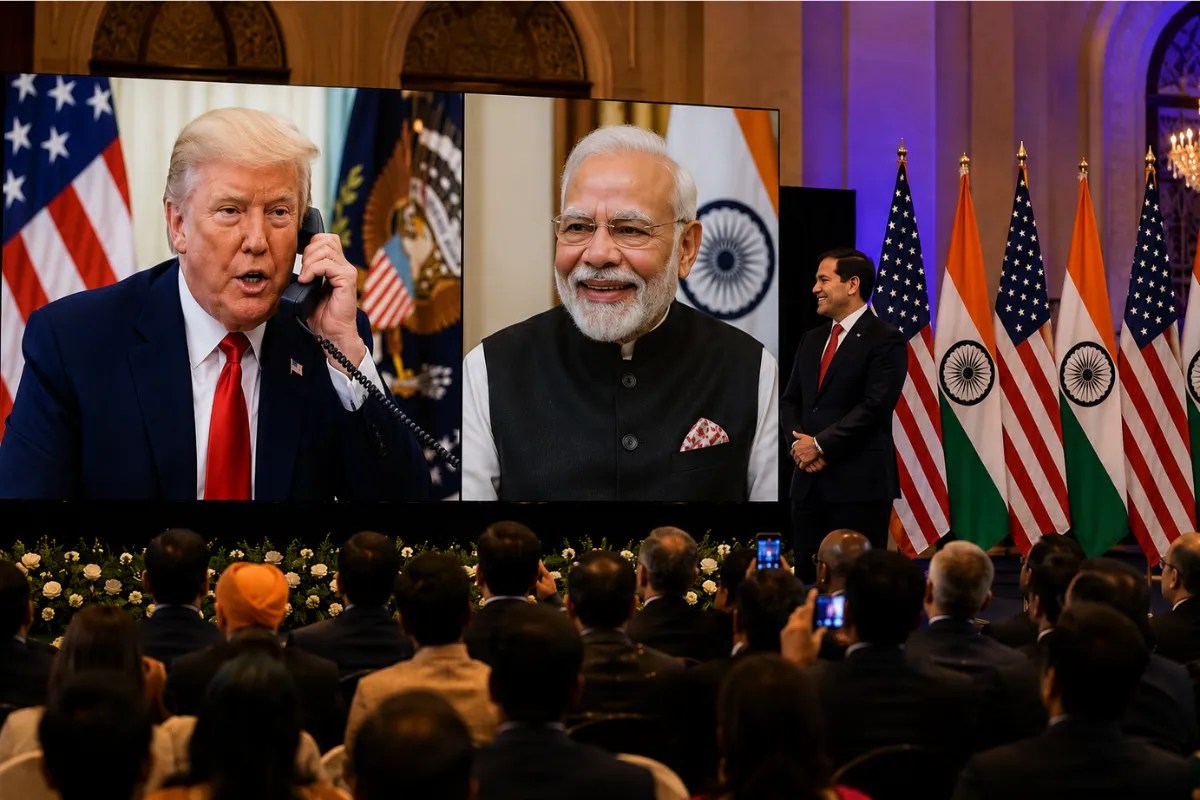
Donald Trump recently declared during a live phone call to a New Delhi event that India will get whatever it wants under his watch, while praising Prime Minister Narendra Modi as a dedicated friend. This direct statement immediately captured headlines across South Asia, promising a blank-check relationship between Washington and New Delhi. However, diplomatic reality rarely aligns with campaign-style rhetoric. The assertion that India will face no obstacles ignores a complex web of trade friction, immigration caps, and divergent geopolitical priorities that define actual US-India relations.
Behind the public display of warmth lies a transactional foreign policy framework that operates on strict reciprocity rather than sentiment.
The Friction Behind the Public Embraces
Geopolitical partnerships are built on mutual interest, not personal affection. While the public image of the US-India relationship features massive stadium rallies and enthusiastic phone calls, the economic foundation tells a different story. Trump has repeatedly labeled India a tariff king, frequently pointing to high import duties on American goods like motorcycles and medical devices.
During his previous administration, this dissatisfaction led to the revocation of India's Generalized System of Preferences status, which had allowed duty-free entry for billions of dollars of Indian exports. The core tension remains unchanged. Washington wants deeper market access for its agricultural and technology sectors, while New Delhi remains protective of its domestic industries and small-scale farmers.
A live phone call cannot erase these structural differences. When a leader promises that a foreign nation will get everything it desires, it usually signals the start of a tough negotiation rather than a period of unconditional generosity. American trade negotiators consistently demand concessions on intellectual property rights and data localization laws, areas where India has historically maintained a firm, sovereign stance.
The Immigration Bottleneck
Another critical area where rhetoric clashes with policy is human mobility. Indian professionals and technology firms rely heavily on the H-1B visa program to sustain operations in the United States. Previous policy shifts under Trump expanded administrative scrutiny, increased denial rates, and implemented stricter rules for these high-skill visas.
For India, seamless talent mobility is a non-negotiable economic driver. For a nationalist American platform, tightening borders and protecting domestic jobs are central promises. These two positions are fundamentally incompatible. Any future administration driven by protectionist economics will face immense domestic pressure to restrict the very visas that Indian technology conglomerates require to grow.
Strategic Alignment and the Limits of Autonomy
The strongest bond between Washington and New Delhi is their shared concern over China's growing influence in the Indo-Pacific region. This mutual anxiety has transformed the Quadrilateral Security Dialogue from a loose discussion group into a functional security framework. India needs advanced American military hardware and intelligence sharing to counter border threats, while the US needs a strong, independent India to anchor the southern flank of the Asian security architecture.
Yet, even this alignment has strict boundaries. India has long maintained a policy of strategic autonomy, refusing to enter formal military alliances that would dictate its foreign policy.
The Russian Dilemma
Nothing tests this strategic autonomy more than New Delhi's enduring relationship with Moscow. India continues to import significant quantities of Russian crude oil and relies heavily on Russian-made military hardware, such as the S-400 missile defense system.
Washington has frequently expressed discomfort with these ties, occasionally threatening sanctions under the Countering America's Adversaries Through Sanctions Act. India has successfully navigated these pressures so far, arguing that its energy security and defense readiness are paramount. But a transactional US leadership expects total alignment. A policy that demands nations to choose sides will eventually force a confrontation over India's multi-aligned foreign policy, regardless of personal friendships between top leaders.
Decoding the Transactional Diplomatic Style
To understand what India might actually receive, one must analyze the specific style of transaction favored by the former American president. Agreements are viewed as zero-sum interactions. If one side wins, the other must give up something of equal value.
Consider a hypothetical scenario where Washington offers India advanced drone technology or semiconductor manufacturing equipment. In a standard diplomatic channel, this would be viewed as a strategic investment to balance regional power. In a transactional framework, that technology transfer would likely be conditioned on India lowering tariffs on American dairy products or abandoning data localization laws that restrict US tech giants.
The Role of the Indian Diaspora
The political weight of the Indian diaspora in the United States cannot be overlooked in these public declarations. The community has grown into an influential economic and voting bloc, particularly in key swing states. Flattering the Indian leadership and promising historic concessions serves a dual purpose, acting as a foreign policy statement and a domestic political strategy designed to appeal to wealthy, influential immigrants who retain deep ties to their homeland.
This dual reality means that public pronouncements made during live broadcasts are often aimed at the voters watching the screen rather than the diplomats negotiating in the backrooms. The actual work of bilateral relations happens away from microphones, where career bureaucrats grind through thousands of pages of text regarding intellectual property, agricultural quotas, and defense interoperability protocols.
The Weaponization of Global Supply Chains
As multinational corporations look to diversify production away from China, India has positioned itself as the primary alternative. The concept of friend-shoring has become central to Washington's economic rhetoric, suggesting that democratic allies should build exclusive supply chains among themselves.
This shift presents a massive opportunity for New Delhi, but it also exposes the country to intense scrutiny. American labor unions and lawmakers frequently raise concerns about working conditions, environmental regulations, and bureaucratic red tape in partner nations. If India wants to capture the lion's share of American manufacturing investment, it must reform its internal infrastructure and legal frameworks to match global expectations. The US government can offer rhetorical encouragement, but it cannot force private capital to invest in regions where regulatory uncertainty persists.
The Currency and Trade Balance Friction
Washington also keeps a close eye on trade surpluses. When a trading partner exports significantly more to the US than it imports, it routinely draws scrutiny from economic advisers. India's trade surplus with the US has grown steadily over the past decade.
In a political environment that views trade deficits as a direct loss of national wealth, this imbalance acts as a permanent target for retaliatory measures. No amount of personal rapport between heads of state can alter the basic math of trade registries, which treasury officials review quarterly to determine whether a trading partner is manipulating its currency or engaging in unfair subsidies.
Evaluating the Defense Partnership
Defense cooperation has arguably seen the most concrete progress over the last ten years. The signing of foundational defense agreements has enabled unprecedented levels of military coordination and high-end technology sharing.
However, American defense sales come with significant strings attached. US law restricts the modification of exported military equipment and often prevents the technology from being shared with third parties. India, through its domestic manufacturing initiatives, demands the complete transfer of technology so it can build weapons at home. This creates a fundamental gridlock. American defense firms guard their proprietary technology as core corporate secrets, while the Indian defense ministry refuses to remain a mere buyer of foreign goods.
Resolving this deadlock requires structural compromises that a simple pledge of friendship cannot deliver. It demands a rewriting of export control regulations in Washington and a reassessment of procurement laws in New Delhi.
The Certainty of Uncertainty
Relying on personalized diplomacy introduces a high degree of volatility into international relations. When policies depend on the shifting moods and political fortunes of individual leaders rather than institutional agreements, stability is sacrificed. Institutional diplomacy is slow, bureaucratic, and tedious, but it provides predictability for businesses and military planners who must make decisions looking decades into the future.
A relationship built on live phone calls and public declarations can pivot instantly based on a single tweet or an unexpected trade report. For Indian policymakers, the challenge is to separate the theater of public praise from the hard reality of policy documents. Preparing for a relationship with a transactional superpower means anticipating the demands that will inevitably follow the compliments. New Delhi must identify exactly what it is willing to trade away before it sits down to collect on the promise of getting whatever it wants.