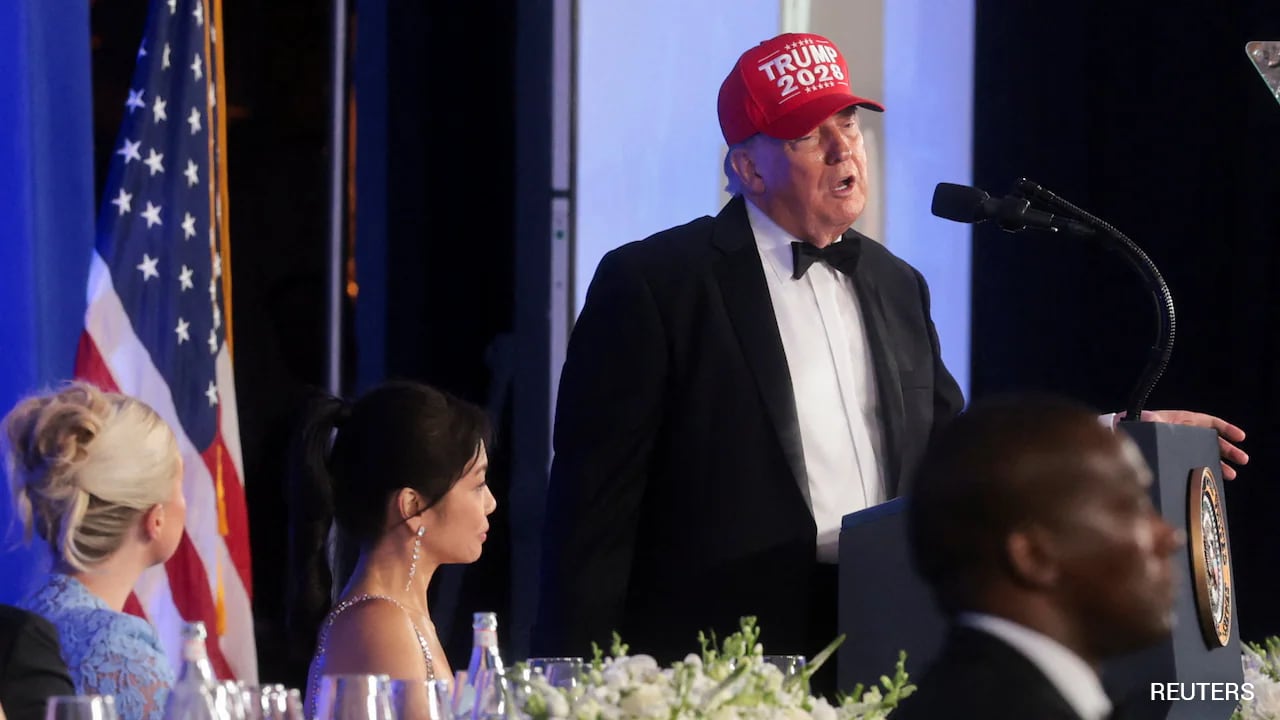
You can always count on Donald Trump to turn a formal establishment tradition into political theater. At the rescheduled White House Correspondents' Association dinner held at the Waldorf Astoria, the president decided to pull a stunt that instantly dominated morning headlines. Right at the tail end of a rambling, contentious speech, he reached for a red baseball cap and slapped it right onto his head.
The text emblazoned on the front was simple, bold, and entirely calculated: Trump 2028.
If you thought it was just a throwaway gag, you haven't been paying attention to how this administration operates. Trump loves testing boundaries in plain sight, wrapping constitutional provocations inside punchlines so his critics can't tell if he's serious or just trolling. But beneath the nervous laughter in that hotel ballroom lies a very real question about political longevity, media fatigue, and the absolute limits of presidential power.
The Backstory Behind The Rescheduled Gala
Context matters here. This wasn't even supposed to happen in July. The original black-tie dinner back in April had to be abruptly canceled and evacuated after a terrifying shooting incident near a security checkpoint outside the Washington Hilton. Secret Service officers, including agent Victor Gonzales, took fire while neutralizing a threat targeting the administration's inner circle.
Fast forward to the rescheduled rerun at a smaller, more secure venue. Outgoing WHCA President Weijia Jiang opened the night by vowing that journalists wouldn't be intimidated by violence. Then Trump took the stage, and instead of offering the standard self-deprecating humor expected from commanders-in-chief at these events, he launched into a fiery grievance-heavy address.
He complained about receiving ninety-three percent negative press coverage. He took direct potshots at reporters in the room. And then, he dropped the hammer with the hat.
The Third Term Tease Keeps Happening
This isn't the first time the 2028 branding has made a high-profile appearance. Back during a high-stakes government shutdown negotiation in the Oval Office, sharp-eyed photographers noticed identical "Trump 2028" caps sitting front and center on the resolute desk right next to congressional leadership.
Let's look at the legal reality. The Twenty-Second Amendment of the United States Constitution explicitly states that no person can be elected to the office of the President more than twice. It's cut and dry. Constitutional scholars don't lose sleep over loopholes here because the text leaves virtually no wiggle room.
Yet, Trump keeps dangling the idea anyway. During his speech at the gala, he leaned into the microphone and declared, "I'm pleased to announce my intention to run for a fourth term," backing up the claim with the assertion that he had already "won three times". It's a dual-layer wink: a nod to his persistent, unsubstantiated claims about the 2020 election coupled with a direct poke at term limits.
Why The Media Reaction Plays Right Into His Hands
The room full of reporters didn't know how to react. Some groaned. Some sat in stony silence. A few chuckled nervously.
That awkward silence is precisely what the strategy banks on. Trump treats the Washington press corps like a sparring partner. When he dons a 2028 hat at a press gala, he forces every major news outlet to spend the next forty-eight hours debating an impossibility. Cable news panels will argue about constitutional law. Opinion writers will type out frantic columns about authoritarianism.
Meanwhile, the narrative stays entirely fixed on him. He controls the oxygen in the room, shifting focus away from policy debates, legislative bottlenecks, or economic friction and locking it squarely onto his magnetic, polarizing persona.
Moving Past The Stunt
If you are trying to read the tea leaves of modern American politics, stop taking the bait at face value. Trump uses absurdity as a shield and a sword. Whether the 2028 hat is a joke about outlasting his critics or a calculated psychological nudge to keep his base energized for upcoming midterms, treating it as a literal constitutional crisis misses the forest for the trees.
Pay less attention to the hats on the desk or the props at the gala. Watch how the political machine reacts when the cameras turn off and the real work of governing actually resumes.