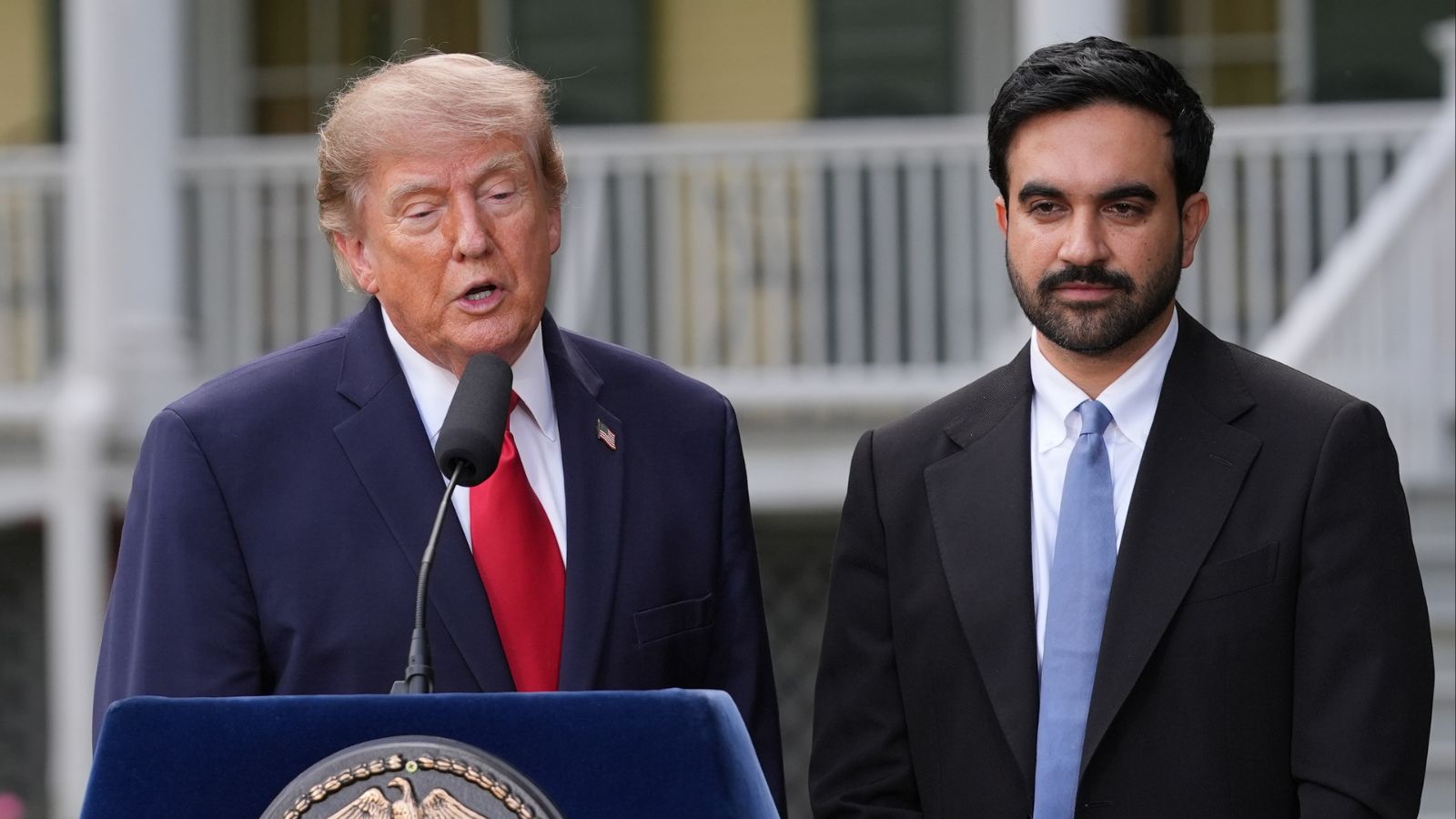
You cannot lock reporters out of the room and expect the rest of the media to just sit quietly in the hallway. Donald Trump just learned that lesson the hard way. When the White House decided to bar CNN, MS NOW, and Politico from executive grounds, it didn't just trigger a routine political spat. It detonated a constitutional crisis over who gets to cover the American presidency and what rules govern executive access.
Then came the twist that nobody saw coming. Standing right beside the former president in New York City, Mayor Zohran Mamdani openly objected to the bans. It was a masterclass in political friction. Two very different figures sharing a microphone while fundamentally disagreeing on the bedrock of democratic accountability. If you want to understand why this specific clash matters for the future of journalism, you have to look past the cable news shouting matches. You have to examine the legal filings, the silent protests inside the press room, and the dangerous precedent being set in real time.
The White House Ban and the National Security Defense
The escalation began when the administration slammed the door on three major journalistic institutions. The official rationale wasn't framed around petty grievances or critical editorial coverage. Instead, the administration dressed the restriction in the heavy armor of national security. Trump took to Truth Social to defend the move with characteristic defiance, claiming that outlets like CNN and Politico weren't just biased—they represented an active threat that had to be stopped immediately.
Critics and constitutional lawyers immediately recognized the smoke screen. Past administrations have certainly despised their coverage, but officially revoking access based on viewpoint discrimination crosses a very bright legal line. When a government official decides which reporters can ask questions based on whether they like the tone of the coverage, the press transforms from an independent check on power into a state-managed bulletin board.
Yet, the administration dug its heels in. They argued that the executive branch holds absolute discretion over who enters federal property and who receives press credentials. Legal scholars point out that while the White House does have broad security authority, weaponizing that authority to punish critical reporting violates core First Amendment protections. History shows us that previous attempts to strip credentials during Trump's first term ended up getting swatted down by federal judges. But this time, the administration decided to push the envelope much further, dragging multiple networks into an unprecedented institutional standoff.
Standing Right Beside Him: Mamdani Breaks Ranks
The drama reached a surreal fever pitch during a high-stakes meeting between Donald Trump and New York City Mayor Zohran Mamdani at Gracie Mansion. The optics were already jarring. Mamdani represents a progressive brand of municipal politics that stands miles away from Trump’s platform. But the real fireworks happened when reporters cornered them about the White House media ban.
Standing right next to Trump, Mamdani didn't mince words. He made it crystal clear that he fundamentally objected to the restrictions, stating openly that every member of the media deserved a seat at the table. Imagine the sheer awkwardness of that moment. You have the most polarizing figure in modern American politics standing shoulder-to-shoulder with a local executive who looks him in the eye and rejects his media blacklist on live television.
Mamdani’s public dissent wasn't just a local soundbite. It shifted the political gravity of the entire controversy. It proved that opposition to the media ban wasn't confined to left-leaning media pundits in Washington. Elected officials from different levels of government were starting to realize that normalizing press blackouts creates a slippery slope for local governance too. If the federal government can ban outlets it dislikes today, what stops city halls or state governors from doing the exact same thing tomorrow? That underlying fear is precisely why Mamdani’s quick intervention resonated so deeply across the political landscape.
The Legal Counterattack and Industry Solidarity
The targeted news organizations didn't spend weeks drafting polite letters of protest. They went straight to federal court. CNN, MS NOW, and Politico filed a joint federal lawsuit in Washington, D.C., demanding emergency injunctions to halt the ban and restore their constitutional right to cover the executive branch. Their legal argument rests on a simple, powerful premise: the government cannot pick and choose its watchdogs.
Behind the scenes, the rest of the media ecosystem did something remarkable. They showed actual solidarity. In professional journalism, rival networks usually fight tooth and nail for scoops and ratings. But when the administration barred specific outlets from fulfilling their assigned pool duties, other major broadcasters refused to act as willing accomplices. Rather than happily stepping in to take the vacant spots, networks pulled their pool coverage entirely. They left empty booths and silent cameras behind as a visible protest against government censorship.
This collective pushback broke the administration's playbook. Usually, when a politician attacks a single news organization, the rest of the press corps stays quiet out of self-preservation, hoping they won't be next. By turning this into an all-or-nothing fight, the administration accidentally forged a unified front. The lawsuit isn't just about badges and press passes anymore. It's a test of whether the judiciary will allow the executive branch to rewrite the ground rules of American democracy.
What This Means for the Future of Presidential Access
We are watching a slow-motion transformation of how political power communicates with the public. Traditional press briefings are slowly dying, replaced by social media monologues, friendly podcast appearances, and curated echo chambers where politicians never have to face a hostile or skeptical question. Banning mainstream outlets is just the logical extension of this strategy. If you can delegitimize the press corps as an existential threat, you don't have to answer for policy failures, scandals, or chaotic news cycles.
The danger here extends far beyond whether a reporter from Politico gets to stand in the briefing room. When access becomes a reward for compliance, investigative journalism dies a quiet death. Tough questions about foreign policy, economic inflation, and constitutional overreach get replaced by softball inquiries from state-approved influencers.
Think about the long-term cost. Once a president establishes the power to lock out dissenting voices, every future administration—regardless of party—inherits that exact tool. Power loves convenience. If Trump can legally bar CNN and MS NOW today, a future Democratic president can easily bar conservative outlets tomorrow under the exact same national security pretexts. That is why this legal battle in federal court is so monumentally important. It isn't about defending any single media conglomerate's profit margin. It's about drawing a hard line in the sand to protect the structural integrity of the free press.
Controlling the room does not mean controlling the narrative. When you lock journalists out, you don't silence the story—you just guarantee that it gets told with a fierce, burning anger that is much harder to contain. The courts will ultimately decide the legal boundaries of this executive order, but the political fallout has already rewritten the relationship between the modern presidency and the people whose job it is to watch it.
Watch the press conference clip on YouTube
This video captures the exact moment reporters questioned New York City Mayor Zohran Mamdani about the media ban right while standing alongside Donald Trump.


