Military analysts love a good "failure of imagination" story. They claim the West was "blinded" by a focus on high-end stealth fighters and hypersonic missiles, allowing Tehran to build a low-tech swarm of suicide drones under our noses. This narrative is comfortable. It implies a mistake that can be corrected with better funding and new procurement cycles.
It is also a lie.
The rise of the Shahed-136 was not a failure of intelligence. It was a calculated acceptance of a new economic reality that the Pentagon and its European counterparts are still too proud to admit. We did not ignore the threat. We simply could not figure out how to stop a $20,000 lawnmower with wings without bankrupting our own defense budgets.
The "neglect" wasn't an oversight. It was a mathematical defeat.
The Asymmetry Trap
Most commentary focuses on the "innovation" of the Iranian drone program. Let's be precise: there is nothing innovative about the technology. A Shahed-136 is essentially a 1970s target drone fitted with a GPS receiver and a moped engine. It uses off-the-shelf components you can find on Alibaba or inside a DJI hobbyist kit.
The genius isn't the engineering; it’s the cost-to-kill ratio.
I have watched defense contractors pitch $2 million interceptor missiles to shoot down these $20,000 "flying Chihuahuas." That is not a defense strategy. That is a wealth transfer from the taxpayer to the military-industrial complex. If the enemy launches 100 drones and you shoot every single one down using traditional surface-to-air missiles (SAMs), you have still lost the engagement. You are down $200 million; they are out $2 million. Do that ten times, and your air defense umbrella is depleted while their factory in Isfahan hasn't even hit its second shift.
The West didn't "miss" the threat. We were paralyzed by the fact that our entire defensive architecture is built to fight a Soviet ghost that no longer exists. We built Ferraris to win a race against a thousand bicycles.
Stop Calling It High-Tech
The media treats "Loitering Munitions" like some mysterious alien tech. This is a categorization error that keeps us from solving the problem.
- Precision is now a commodity. In the 1990s, hitting a building from 500 miles away required a Tomahawk missile. Today, it requires a smartphone chip and some basic flight control software.
- Speed is overrated. We obsessed over intercepting Mach 3 threats. The Shahed crawls at 115 mph. It is so slow that some automated radar systems filtered it out as "bird clutter" or "weather."
- The supply chain is unkillable. You cannot sanction a moped engine. You cannot embargo a plywood wing.
The "insider" consensus says we need more electronic warfare (EW) to jam these things. That is a pipe dream. Modern iterations are moving toward optical navigation—using a camera to "see" the ground and compare it to satellite maps—making them immune to GPS jamming. When the drone doesn't need a signal to know where it is, your multi-million dollar jammer becomes a very expensive paperweight.
The Myth of the Intelligence Failure
Why did we let this happen? Critics point to the JCPOA or shifting geopolitical focuses. Those are excuses for the bureaucrats.
The real reason is that admitting the Iranian drone threat was real meant admitting that the F-35—the most expensive weapon system in history—is largely irrelevant in a localized swarm conflict. If you are a General whose career is staked on the procurement of 6th-generation fighters, you do not want to hear that a guy in a garage with a 3D printer can bypass your entire multi-billion dollar stealth network.
We saw the drones in Yemen in 2019. We saw them hitting Saudi oil facilities at Abqaiq. The data was there. The "neglect" was a deliberate institutional refusal to pivot because pivoting meant admitting our current arsenal is priced out of the modern battlefield.
The Irony of Western Components
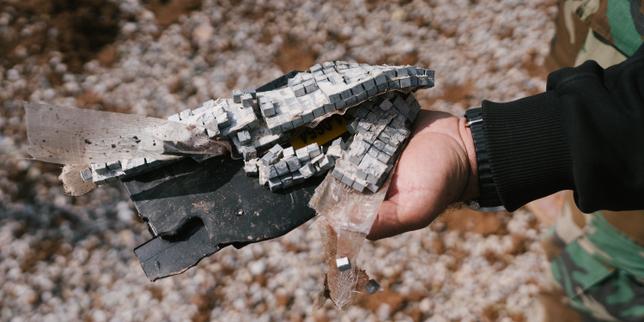
If you crack open a downed Iranian drone today, you will find "Made in USA" and "Made in Europe" stamped on the circuit boards.
We are literally the ones who built the Iranian threat. Not through malice, but through the inevitable democratization of hardware. Microcontrollers from Texas Instruments and inertial measurement units from Bosch are the lifeblood of these weapons.
The contrarian truth? You cannot stop the proliferation of these drones without shutting down the global consumer electronics market. Export controls are a sieve. A front company in Dubai buys 5,000 chips for "smart washing machines," and three months later, those chips are steering a warhead into a power grid.
Trying to stop drone production through sanctions is like trying to stop people from making fire by banning matches. They will just rub two sticks together.
The False Hope of Lasers
"Just use Directed Energy Weapons (DEWs)," the armchair generals shout.
Yes, lasers have a low cost-per-shot. But they also have massive power requirements, they don't work in heavy fog or rain, and they can only target one thing at a time. A swarm of 50 drones arriving simultaneously will overwhelm a laser system in seconds.
The solution isn't a "silver bullet" technology. It’s a total shift in how we value human life versus hardware. We are currently unwilling to trade cheap hardware for cheap hardware. We insist on protecting cheap targets with expensive shields.
Until we develop our own "trash" tech—cheap, disposable, mass-produced interceptors that cost $5,000—we will continue to be "surprised" by every minor power that realizes they can buy a cruise missile capability for the price of a used Honda Civic.
The Brutal Reality of the Near Term
The Iranians didn't "innovate" their way to the top. They simply looked at the global economy and realized that mass has a quality of its own. While the West was busy debating the ethics of AI and the aesthetics of stealth, Tehran was building a logistical pipeline for the democratization of destruction.
If you want to know why we "neglected" this, look at the balance sheets of the major defense contractors. There is no profit in a $10,000 interceptor. There is no prestige in building a "good enough" drone.
We are losing the drone war not because we lack the brains, but because we lack the courage to build something cheap.
Stop looking for the "intelligence failure." Start looking at the invoice.
Build 10,000 cheap interceptors today or prepare to lose the next ten years to anyone with a soldering iron and a grudge.