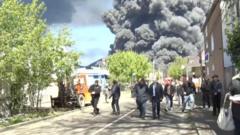
The headlines scream about precision strikes on Russian oil infrastructure. Analysts talk about crippling the Kremlin’s war chest by pinching their refined product output. They claim that drones hitting distillation columns represent a masterclass in asymmetrical warfare.
They are wrong.
Watching these operations from the inside, the media narrative is stuck in a dangerous fallacy. They treat oil refining like a simple plumbing system where you poke a hole in the pipe and the flow stops. It is not. The reality of modern energy logistics is far more resilient, and this fixation on tactical strikes on refineries is a distraction that ignores the structural durability of the Russian energy machine.
The Myth of Tactical Attrition
The standard take is that damaging a distillation unit at a facility like Tuapse or Ryazan forces a systemic collapse in production. This assumes that Russia has no redundancy. It assumes that central planners are blind to the vulnerability of their own nodes.
Here is the truth: these refineries are sprawling, massive, and modular. A strike on a primary distillation unit causes a temporary hiccup in throughput, not a terminal event. I have watched energy conglomerates across the globe absorb far worse from natural disasters and technical failures. Russian state operators have decades of experience keeping aging Soviet-era iron running under duress. When a column is hit, they shift the burden to secondary or tertiary sites. They draw down strategic reserves. They shuffle exports.
The market has priced in these disruptions with the speed of a day trader. The moment a drone impact is confirmed, the volatility spikes, only to settle within hours once the real data—the actual volume of lost capacity—is calculated. The impact on the global price of Brent crude is negligible. If the goal is to starve the Russian military of fuel, this strategy has failed. A tactical strike on a refinery is a loud noise. It is not a decisive blow.
The Geometry of Energy Resilience
Let us break down the mechanics. A refinery is not a fragile lightbulb. It is a series of interconnected heat exchangers, pumps, and reactors designed to operate under immense pressure and thermal stress. The most critical components, the ones that take months to manufacture, are often protected by thick steel and concrete, or they are located deep within the complex.
Hitting a storage tank is optics. It looks great on a drone feed. It creates a massive fireball. But storage tanks are the easiest thing in the world to bypass. They represent a buffer, not the engine itself.
Imagine a scenario where a state actor completely shuts down ten percent of a nation’s refining capacity. The common logic says that nation loses ten percent of its capability. In reality, they lose zero percent of their ability to project power because they prioritize internal consumption over commercial export. They tighten the belt on the civilian market to ensure the frontline remains fueled. You aren't hurting the war effort; you are making the local population wait longer at the gas pump while the tankers keep rolling toward the conflict zone.
Why the Analysts Keep Getting it Wrong
The obsession with these strikes comes from a desire for clear, quantifiable victories in a conflict that is defined by murky, grinding attrition. Journalists love a target they can point to on a map. They love the visual of a smoke plume. It makes for a compelling story about vulnerability.
But this ignores the geography of the supply chain. Russia is a massive energy exporter. They have an infrastructure network designed for continental scales. If you take out a refinery in one region, the domestic rail network—the heartbeat of the Russian interior—simply reroutes product from elsewhere. The cost of logistics increases, yes. The efficiency drops. But the fuel reaches its destination.
I have seen companies blow millions trying to model the collapse of Russian production based on these localized strikes. The models always break because they fail to account for the sheer depth of the existing inventory and the willingness of the state to force domestic austerity. You cannot out-think a command economy that is willing to sacrifice consumer convenience to sustain its strategic priorities.
Moving Beyond the Tactical Distraction
If the strategy is to disrupt, the target is wrong. The bottleneck in the Russian energy sector is not the refinery; it is the specialized technology required to maintain the high-complexity downstream facilities.
These plants rely on proprietary catalysts, software controllers, and high-spec valve components that are difficult to manufacture domestically. Sanctions have already made these parts harder to source. If you want to talk about true strategic impact, stop looking at drones and start looking at supply chain interdiction. The real damage is occurring in the silent, invisible degradation of maintenance cycles over the next three to five years.
By focusing on the flashy, cinematic drone strikes, you are giving the opposition a roadmap to fix their vulnerabilities. You are highlighting exactly where they need to deploy their air defense assets. Every time a strike is successful, it forces them to reinforce that specific site, making it even harder to hit the next time. It is a game of diminishing returns where the defender has the home-field advantage and the benefit of internal lines of communication.
The Cost of Short-Term Optics
The danger in this strategy is the false sense of progress it creates. Policy makers see these strikes and assume the pressure is working. They believe the regime is on the ropes. This leads to strategic complacency. It encourages them to lean into a low-impact, high-visibility approach rather than focusing on the long-term, structural pressures that actually drain a state's capacity to wage war.
True disruption requires patience. It requires the boring, invisible work of tracking financial flows and supply chains for critical maintenance hardware. It requires waiting for the cumulative effect of technical decay rather than expecting a single explosion to change the map.
You want to see how this ends? It ends not with a dramatic collapse of a refinery, but with a slow, agonizing realization that the machinery of the state has become too costly, too inefficient, and too unreliable to support the ambitions of its leaders. That isn't a headline. It's a calculation.
Stop cheering for the fireball and start measuring the depreciation. The fire is a symptom. The decay is the disease. You are currently fighting the symptoms while the patient continues to operate exactly as they intended. If you want to win, stop being an observer of the spectacle and start looking at the ledger. The real war is being fought in the maintenance reports you never read, not the burning tanks you can’t stop watching.
The drones are winning the news cycle but losing the logistics war. It is time to stop playing the game the way they want you to see it.