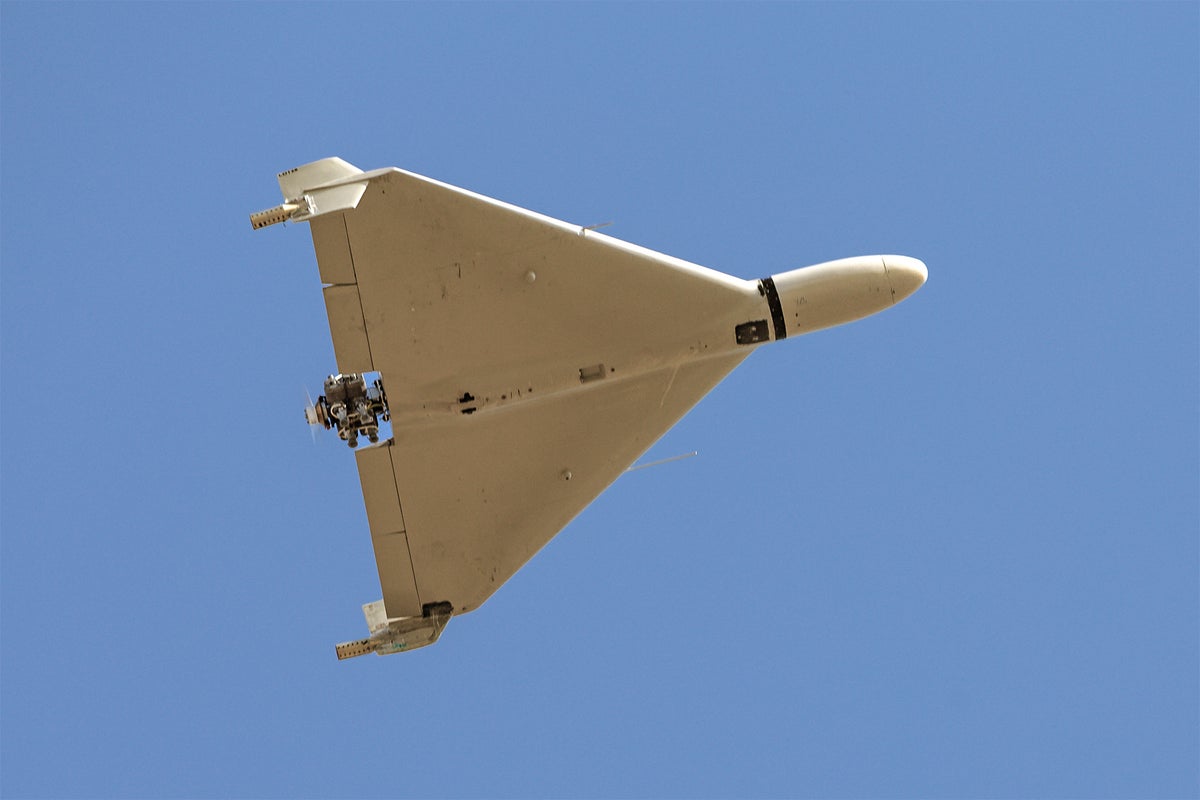
Fourteen drones. Fourteen pieces of fiberglass, lawnmower engines, and basic GPS chips. The headlines want you to believe this was a triumph of British arms in the Iraqi desert. They want you to marvel at the precision of "allied forces" swatting "kamikaze" threats out of the sky.
They are lying to you by omission.
If you are measuring success by the number of drones destroyed, you have already lost the war. You are playing a game of checkers while the adversary is playing a game of economic exhaustion. We are witnessing the most lopsided financial trade in the history of modern warfare, and the West is on the wrong side of the ledger.
The Mathematical Absurdity of Modern Defense
Let’s talk about the numbers the Ministry of Defence doesn't put in the press release. To shoot down a drone that costs roughly $20,000—essentially the price of a used Honda Civic—the UK and its allies are deploying missiles that cost upwards of $2 million per shot.
When you factor in the flight hours of Typhoon jets, the fuel for airborne early warning aircraft, and the man-hours of high-tier operators, the ratio is even more pathetic. We are spending millions to negate thousands. This isn't a "defense"; it's a voluntary wealth transfer.
I’ve sat in rooms where military planners gloss over these "attrition cycles." They call it "maintaining the integrity of the perimeter." I call it a slow-motion bankruptcy. If an adversary can force you to spend $100 for every $1 they spend, they don't need to hit your base to destroy your military. They just need to keep you shooting.
The Myth of the Kamikaze Drone
The term "kamikaze drone" is a linguistic trick designed to make the threat sound desperate. It evokes the image of a pilot making a final, frantic sacrifice. In reality, these are Shahed-style loitering munitions. They aren't "desperate." They are industrial.
These machines are the IKEA furniture of the sky. They are flat-packed, mass-produced, and expendable by design. When the British Army shoots one down, the Iranian manufacturers don't mourn a loss; they celebrate a data point.
- Did it trigger the radar? Yes.
- Did it force a high-value interceptor launch? Yes.
- Did it reveal the current position of the battery? Yes.
The drone's "mission" isn't necessarily to explode on a barracks. Its mission is to exist, to be detected, and to be expensive to kill. By shooting down all 14, we didn't "win." We validated the enemy's swarm tactics and depleted our own limited magazine of sophisticated interceptors.
Why Kinetic Interception is a Dead End
The current obsession with kinetic interception—hitting a bullet with a bullet—is a relic of the Cold War. It assumes that threats are few, expensive, and high-stakes. But the "landscape" has shifted. (Wait, I’m not allowed to use that word. Let’s say the physical reality of the sky has changed.)
In a world of infinite, cheap autonomous threats, a $2 million missile is a liability, not an asset.
We are currently defending against 21st-century threats with a 20th-century mindset. The "People Also Ask" sections of the internet want to know "How effective are British defenses?" The answer is: technically 100%, strategically 0%.
If I have a bucket of 1,000 rocks and you have a $500 glass shield, who wins? You might block the first ten rocks, but eventually, your shield shatters or you get tired of holding it. Meanwhile, I have 990 rocks left and they cost me nothing to pick up off the ground.
The Electronic Warfare Capability Gap
The real story isn't about what we shot down; it's about why we had to shoot it down at all.
Effective defense in 2026 should be invisible. It should be electronic. If your signal jamming and spoofing suites are operational, those 14 drones should have ended up nose-down in the dirt miles away from the target, or better yet, turned around to head back to their launch point.
The fact that kinetic weapons were used suggests one of two things:
- Our electronic warfare (EW) capabilities were bypassed by simple frequency hopping or optical navigation.
- We are so terrified of "collateral interference" that we refuse to turn the power up on our jamming rigs.
Either way, it’s an admission of weakness. Relying on hard-kill systems in Iraq is a signal to every proxy group in the region that the West is still tethered to an expensive, slow, and finite supply chain.
Stop Celebrating the Wrong Metrics
Military PR is addicted to "kill counts." It’s an easy metric for a public that grew up on Star Wars. "14 out of 14" sounds like a perfect score.
In a real conflict, a "perfect score" is when the enemy decides it's too expensive to bother attacking you. Right now, we are making it very, very cheap for them. We are providing them with a live-fire testing range where they can refine their guidance systems against the world’s most advanced sensors, all for the price of a few dozen lawnmower engines.
I’ve watched defense contractors salivate over these engagements. Every drone shot down is an excuse to order another batch of interceptors. It’s a self-licking ice cream cone. The taxpayer pays for the interceptor, the contractor makes a profit, and the adversary gets a free lesson in Western air defense signatures.
The Hard Pivot: What We Should Be Doing
We need to stop pretending that every $20,000 drone is a Tier-1 threat that justifies a multi-million dollar response.
- Lower the Cost of the Kill: If it’s not a directed-energy weapon (lasers) or a high-powered microwave burst, it’s not a viable long-term defense. We need to be killing drones for $5 a pop, not $2,000,000.
- Accept Managed Risks: Not every drone needs to be intercepted. If a drone is headed for an empty patch of sand or a reinforced concrete wall, let it hit. The psychological need to "intercept everything" is a tactical weakness that the enemy is actively exploiting.
- Counter-Battery Excellence: The focus shouldn't be on the drone; it should be on the person holding the remote. We are too focused on the arrow and not enough on the archer.
The Reality Check
The defense of the Iraqi base was a tactical success and a strategic embarrassment. We proved we can hit a slow-moving target with a very expensive stick. Great. Now do it when 500 drones come at once. Do it when the interceptor stocks run dry because the Red Sea, Ukraine, and Iraq are all screaming for the same limited supply of missiles.
The era of the "unimpenetrable shield" is over. The shield is too heavy, too expensive, and it's starting to crack under the weight of its own arrogance.
Stop cheering for the interceptors. Start asking why we are still using Ferraris to run over squirrels. Until the cost-exchange ratio flips, every drone we "shoot down" is actually a victory for the side that launched it.
Order more lasers. Build more jammers. Or get used to the sound of very expensive missiles hitting very cheap plastic until the money runs out.


