For decades, oceanographers wrestled with an embarrassing blind spot. We knew that cold, dense water sinks from the polar regions down into the abyss, forming the driving engine of global ocean circulation. Yet, basic physics created a frustrating paradox. If that water sinks, it has to come back up somewhere. For years, standard global calculations assumed this upwelling was a sluggish, uniform crawl of roughly one centimeter per day.
That number felt wrong. Open-ocean mixing was simply too weak to account for the massive return of deep water required to keep Earth's climate engine running. Researchers suspected the action wasn't happening in the quiet middle of the sea, but they lacked direct proof.
Then came an ingenious field test nearly two kilometers beneath the North Atlantic.
Tracking the Invisible Abyss with Fluorescent Tracer
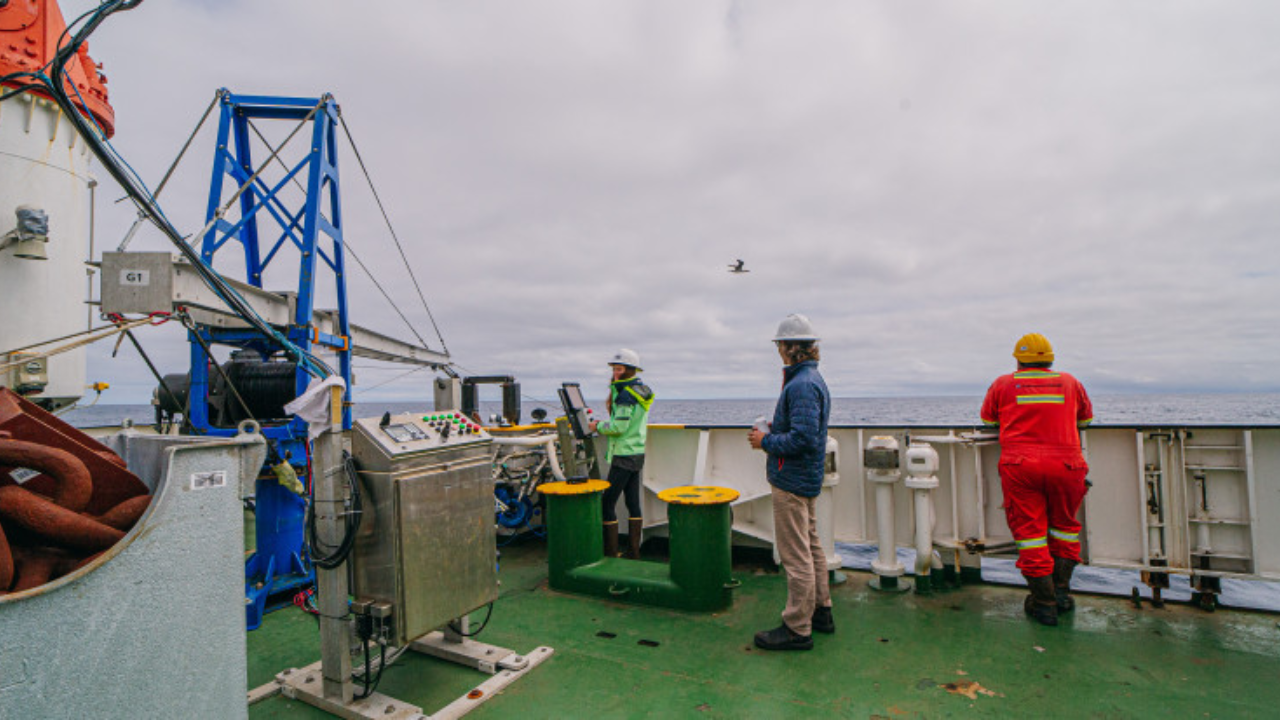
To solve the puzzle, a team led by oceanographers from Scripps Institution of Oceanography packed a research vessel with fifty-five gallons of non-toxic fluorescent dye. They descended to a depth of 1,870 meters inside a steep submarine canyon. There, in pitch darkness and immense pressure, they released the tracer right above the seafloor.
They didn't just watch a colorful plume drift. They deployed specialized high-speed winches and sensitive fluorometers capable of detecting concentrations of less than one part per billion. By tracking how the dye moved alongside temperature and turbulence sensors, the crew measured the physical heartbeat of the deep slope.
The results shattered old assumptions.
Instead of creeping upward at a sluggish, theoretical pace, the dyed water shot skyward at an astonishing rate of about 100 meters a day. That velocity clocked in at roughly 10,000 times faster than the traditional global average.
Why Submarine Canyons Act as Ocean Highways
This discovery changes how we look at underwater topography. The open ocean acts like a massive thermal barrier, but rugged seafloor features behave entirely differently. Underwater canyons, ridges, and steep continental slopes create intense friction and turbulent mixing.
Think of it like a rapid mountain stream meeting a series of boulders. The rough geography generates intense localized energy. In these steep submarine canyons, that turbulence doesn't just push water around; it acts like a high-speed elevator. Cold, nutrient-rich water gets caught in the turbulent machinery of the slope and rockets upward far quicker than anyone predicted.
Oceanographers call these locations upwelling hotspots. Because the planet's seafloor is littered with thousands of similar underwater canyons, current climate and circulation models might be severely underestimating how fast heat, carbon, and nutrients cycle through the marine environment.
Reshaping Global Climate Models
Accurate climate forecasting depends heavily on understanding the ocean's overturning circulation. If scientists rely on outdated calculations that treat upwelling as a uniform, gentle drift, their long-term predictions about heat absorption and carbon storage will miss the mark.
Catching this rapid vertical transport in action proves that localized physical features dictate global realities. Small-scale turbulence inside a single canyon has massive ripple effects for the entire marine ecosystem.
Next time you look at a map of the blue ocean, remember that the most critical action isn't happening on the surface waves. It is happening silently along rugged underwater walls, thousands of meters down, where a bit of fluorescent dye finally proved how fast the deep sea breathes.