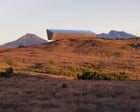
Activists and marketing executives are currently celebrating a steel monolith in Tasmania designed to outlive civilization. They call it "Earth’s Black Box." Built to record temperature rises, ocean acidification, and political inaction, the structure is being marketed as an uncorruptible ledger of our climate demise. If society collapses, the narrative goes, some future intelligence will find this box, download its data, and understand exactly how we failed.
It is a beautiful story. It is also an expensive, technologically illiterate gimmick. For an alternative look, check out: this related article.
The project assumes that a post-apocalyptic survivor or an alien explorer will have the precise hardware, software, and linguistic capabilities to read high-tech storage drives, while simultaneously lacking the basic intelligence to notice that the planet's surface is scorched. It is the ultimate manifestation of climate doom-porn: a half-million-dollar monument built not to solve a problem, but to say "I told you so" to a vacant universe.
We need to stop funding performative obituaries and start interrogation of the actual mechanics of data preservation and climate mitigation. Similar insight on this matter has been published by Mashable.
The Fatal Flaw of the Cosmic Hard Drive
The premise of Earth’s Black Box relies on a massive contradiction. Its creators—marketing firm Clemenger BBDO, the University of Tasmania, and various artists—have built a steel structure packed with storage drives powered by solar panels. It constantly scrapes climate data from the internet.
Consider the logistical reality. I have spent two decades managing data infrastructure and auditing enterprise systems. I know how fast hardware degrades. The creators boast that the box will last for decades. In geological or apocalyptic terms, "decades" is a blink.
Solid-state drives (SSDs) and traditional magnetic hard drives are notoriously fragile. They do not tolerate extreme temperature swings without power. If the solar panels are covered by volcanic ash, dust storms, or overgrown vegetation, the power shuts down.
When an SSD sits without power, it suffers from data rot. The electrical charge trapped in the drive's NAND flash memory cells slowly leaks away. Within a few years of total power loss, the data becomes completely unreadable.
Even if the power stays on, hardware fails. Silicon degrades. Solar inverter capacitors blow out. The box is an unmaintained server room in the middle of a desert. To believe it will cleanly output pristine CSV files of global temperatures to a nomadic scavenger in the year 2150 is pure fantasy.
The Rosetta Stone Delusion
Imagine a scenario where the hardware miraculously survives intact for three centuries. A survivor stumbles across the monolith.
How do they interface with it?
The box does not have a giant brass crank and a viewing screen. It contains digital storage media. To extract the data, our hypothetical survivor needs:
- An understanding of USB, PCIe, or SATA interfaces.
- A compatible computing architecture (likely x86 or ARM).
- The correct software drivers to read the file systems (like NTFS or ext4).
- A deep comprehension of 21st-century English and scientific notation.
If a civilization possesses the advanced semiconductor manufacturing capabilities required to build a computer that can read a corrupted SSD, they do not need a steel box to tell them the climate changed. They would already have satellite arrays, atmospheric sensors, and ice-core drills. They would know more about the planet's history than the box could ever tell them.
We are leaving a high-tech note for an audience that either won't be able to read it, or won't need to.
The Lazy Consensus of Climate Symbolism
The media coverage surrounding this project reveals a deeper, more corrosive trend in modern environmentalism: the substitution of symbolic tech for actual utility.
People ask: "How else will future generations know what we did?"
The question itself is broken. It assumes our civilization will leave no other footprint. If industrial society collapses tomorrow, our legacy will not be hidden in a steel box in Tasmania. It will be written in the literal strata of the planet.
+-------------------------+---------------------------------------------------------+
| Legitimate Global Mark  | Duration / Visibility to Future Civilizations           |
+-------------------------+---------------------------------------------------------+
| Plastic Strata          | Millions of years; microplastics embedded in sedimentary rock|
| Radionuclide Signatures | Tens of thousands of years from nuclear testing remnants|
| Fossil Record Shift     | Permanent extinction markers and billions of chicken bones |
| Atmospheric Carbon      | Thousands of years of elevated CO2 signatures in ice    |
+-------------------------+---------------------------------------------------------+
Geologists call this the Anthropocene. Our black box is the earth itself. We are writing our history into the oceans, the soil, and the glaciers every single day. A tiny bank of hard drives in an airfield adds nothing to that record. It merely shrinks a global reality down into a digestible, marketable product.
Actionable Preservation: How to Actually Leave a Message
If the goal is genuine historical preservation rather than securing a design award, we have known how to do this for thousands of years. The solutions are low-tech, high-durability, and require zero electricity.
1. Optical Archiving on Quartz
If you must use tech, use passive tech. Companies like Microsoft, through Project Silica, have experimented with storing data in quartz glass using femtosecond lasers. A piece of quartz glass can withstand extreme heat, water, and electromagnetic pulses. It can be read using a basic optical microscope and a light source. No operating system required.
2. Analog Microform
Human readable analog text scaled down to microscopic sizes on archival nickel plates can last for thousands of years. Organizations like the Long Now Foundation use this for the Rosetta Project. You do not need a computer to read it—just a magnifying lens.
3. Structural Geoglyphs
The ancient Egyptians didn't leave a hard drive explaining the Old Kingdom. They built the Pyramids. If you want to warn the future about climate tipping points, carve the data into granite mountainsides in multiple linguistic families and pictograms.
The Tasmanian box chooses none of these. It chooses the most fragile, ephemeral medium available—consumer-grade digital storage—because it looks modern and generates headlines today.
The True Cost of Performance Environmentalism
Every dollar spent on building a steel sarcophagus for data we already possess is a dollar diverted from actual mitigation. The project is a monument to cynicism. It assumes defeat. It says, "We can't fix this, so let's make sure we look smart when everything burns."
The hard truth is that building a black box is easy. It requires some steel welding, a few solar panels, a basic script to pull data from NOAA, and a public relations team.
What is difficult is upgrading electrical grids to handle renewable loads. What is difficult is investing in deep-tech decarbonization, scaling carbon capture that actually works, and redesigning global supply chains. Those tasks do not fit neatly into a viral press release. They require grueling political, economic, and engineering work.
Earth’s Black Box is not a tool for the future. It is a mirror for the present, reflecting our obsession with optics over substance. It treats the end of human civilization as a design challenge.
If we collapse, the box will die quietly alongside us, its solar panels covered in dirt, its drives rotting away in silence. If we survive, it will stand as an embarrassing reminder of a time when we were more interested in recording our descent than changing our trajectory.
Stop cheering for the monument. Turn off the cameras, dismantle the box, and put the steel toward something that actually plugs a smokestack.