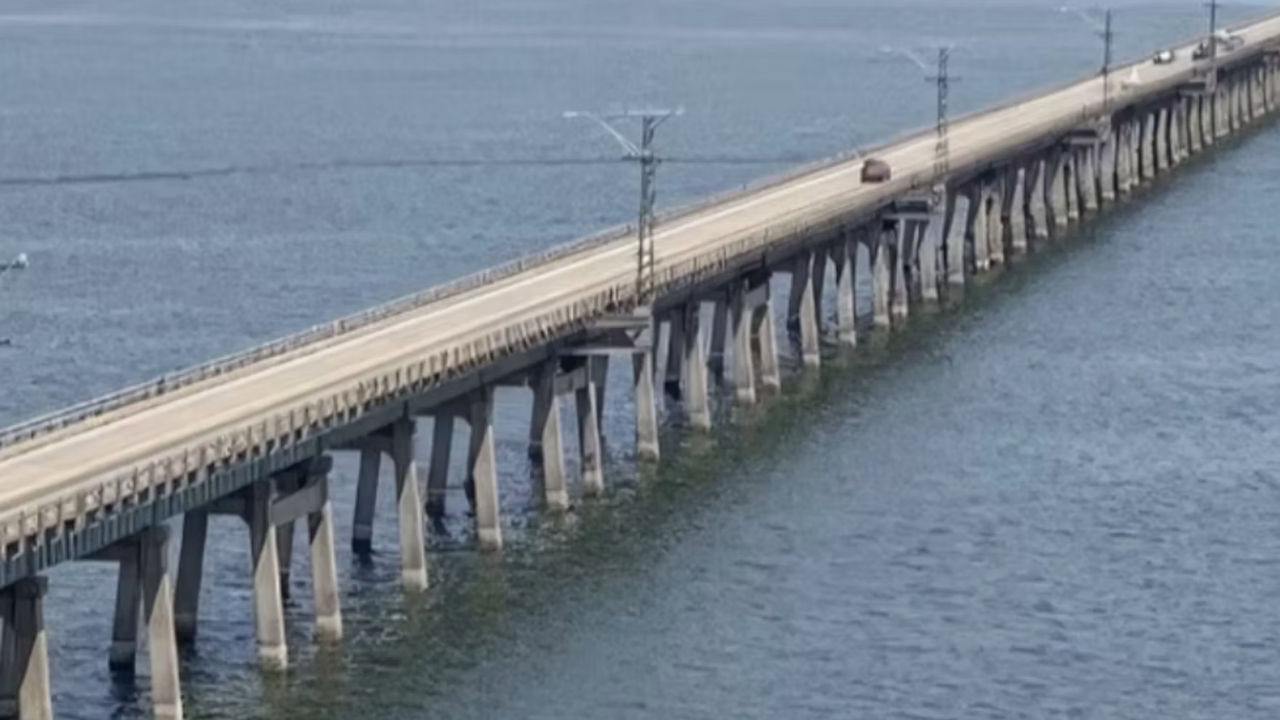
Aging regional corridors present a complex operational problem for state transportation agencies: how to execute a massive capital replacement without severing the economic lifelines tied to the existing route. The launch of the $408.4 million project to replace the 80-year-old US-70 Roosevelt Memorial Bridge over Lake Texoma offers a clear case study in modern project delivery, federal funding structures, and supply chain continuity. Managed by the Oklahoma Department of Transportation alongside design-build partners Zachry Construction and Traylor Bros., the initiative targets a critical artery connecting Bryan and Marshall counties, facilitating regional commerce between southern Oklahoma, northern Texas, and Arkansas.
The Capital Allocation and Funding Architecture
Large-scale public works projects require multi-tiered capital stacks to mitigate local tax burdens and insulate state agencies from inflationary cost overruns. The Roosevelt Bridge replacement carries a total price tag exceeding $408 million, underpinned by a $124 million federal grant secured through the Bridge Investment Program administered by the Federal Highway Administration.
This federal injection covers approximately 30 percent of the baseline capital expenditure, reducing the exposure of state transportation funds. When analyzing infrastructure investments of this magnitude, the primary financial metric is lifecycle cost minimization. An eighty-year-old structure operating past its original design life incurs escalating maintenance liabilities, frequent load-rating restrictions, and heightened risks of unscheduled closures. By replacing the narrow, shoulder-less 1942 structure with a modern four-lane configuration complete with full shoulders and enhanced vertical clearance, the agency shifts from a reactive maintenance expenditure curve to a predictable, low-maintenance operational phase.
Project Delivery Mechanics and Risk Mitigation
Traditional design-bid-build delivery methods often foster adversarial relationships between project owners and contractors, frequently resulting in change orders, schedule slippage, and budget inflation. To counter these systemic inefficiencies, ODOT adopted a modified progressive design-build model for this corridor.
This procurement strategy alters the risk allocation matrix between the public agency and the private joint venture. Under a progressive framework, the owner selects a contractor based on qualifications rather than a fully realized design, allowing both parties to collaborate during preliminary engineering, target price setting, and constructability reviews. This approach yields several operational advantages:
- Early identification of subsurface geotechnical anomalies in the Lake Texoma bed before final structural load calculations are locked.
- Collaborative value engineering that optimizes material sourcing and staging logistics.
- Streamlined environmental coordination with regulatory bodies, such as the U.S. Army Corps of Engineers, to manage shoreline impacts and permitting milestones.
Continuity of Corridor Operations
The operational constraint defining this project is the requirement to maintain uninterrupted traffic flow on the existing US-70 alignment while constructing the new parallel bridge. With traffic volumes on the broader corridor exceeding 11,000 vehicles daily—and long-term projections pointing toward substantial regional growth—a total closure or extended detour would impose severe economic friction on freight operators, agricultural transit, and local commuters.
Detouring traffic around Lake Texoma would introduce massive circuity costs, forcing commercial trucks and passenger vehicles onto alternative crossings dozens of miles away. This would drive up fuel consumption, inflate logistics costs for regional businesses, and degrade emergency response times across county lines. By building the new alignment offline or adjacent to the existing span before shifting traffic, the project team internalizes the disruption cost, preserving network redundancy and regional gross domestic product output throughout the multi-year construction window spanning from 2026 to the anticipated completion in fall 2029.
Long-Term Structural Resiliency and Regional Economics
Infrastructure serves as a foundational input for regional economic productivity. The legacy Roosevelt Bridge, measuring nearly 4,943 feet with two narrow lanes and zero shoulders, represented a physical bottleneck that restricted wide agricultural transport and slowed emergency vehicle throughput.
The new asset addresses these capacity constraints by integrating modern design standards:
- Four distinct lanes that separate directional traffic and eliminate head-on collision risks common on undivided historic spans.
- Full shoulders that provide a refuge zone for disabled commercial vehicles, preventing total lane blockages and secondary bottlenecks.
- Integrated pedestrian infrastructure, expanding recreational access and linking local tourism nodes around Lake Texoma State Park safely.
The strategic deployment of capital into the US-70 crossing guarantees that southern Oklahoma’s freight and tourism sectors will not face structural capacity limits over the next several decades. Transportation planners must monitor the pace of utility relocation and right-of-way management through the upcoming phases to ensure the critical path schedule remains anchored to the 2029 target.