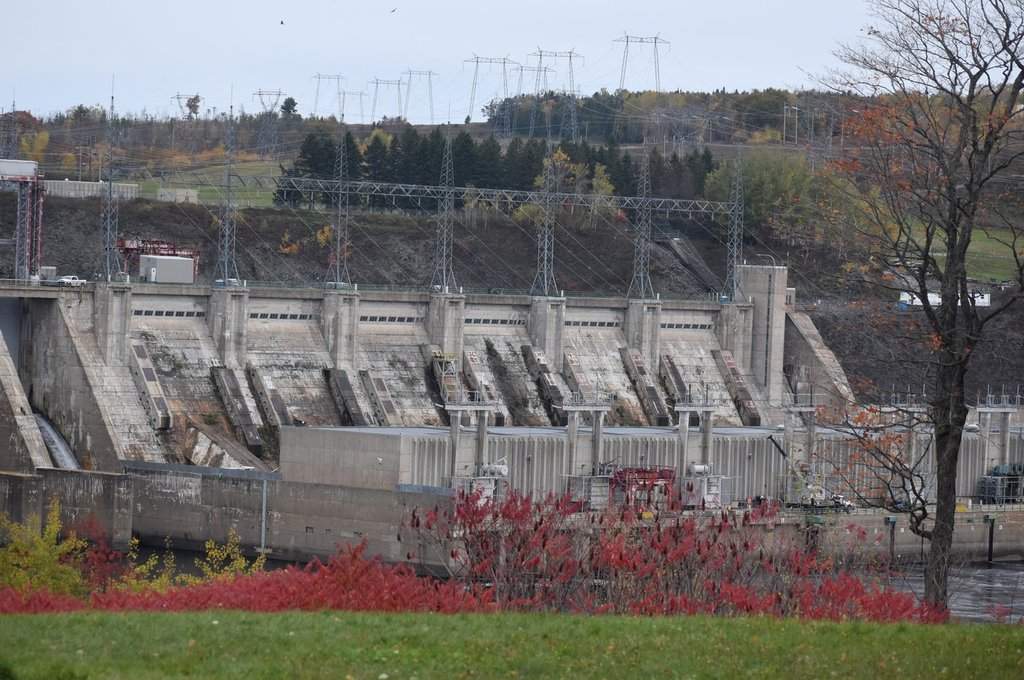
Large-scale public infrastructure financing operates on strict amortization cycles, risk-transfer mechanics, and capital efficiency curves. When the Canada Infrastructure Bank extends a $219 million loan to New Brunswick Power for the early development phase of the Mactaquac Life Achievement Project, the transaction reveals the underlying cost structures required to maintain aging baseload renewable assets. The macro problem is straightforward: how to preserve essential generation capacity without destabilizing provincial debt service ratios or inducing severe rate shocks for industrial and residential consumers.
The transaction requires analyzing the financial architecture, the engineering constraints of alkali-aggregate reaction in concrete infrastructure, and the strategic positioning of Atlantic Canada's regional energy grid. Discover more on a connected issue: this related article.
The Cost Function of Mega-Scale Hydroelectric Rehabilitation
The financial exposure for the Mactaquac Generating Station sits near a projected $9 billion total capital envelope. Capital projects of this magnitude cannot be absorbed by a regional utility's balance sheet without threatening insolvency or immediate, dramatic tariff increases.
The $219 million allocation from the Canada Infrastructure Bank does not fund physical concrete pouring or turbine replacement. Instead, it covers pre-development expenditures: Further analysis by Financial Times highlights comparable perspectives on the subject.
- Comprehensive technical engineering studies
- Rigorous environmental and regulatory reviews
- Indigenous engagement and partnership frameworks
- Risk modeling for structural remediation
By isolating pre-development capital via a low-cost federal financing vehicle, NB Power shifts the highest-risk phase of the capital allocation lifecycle away from commercial debt markets. Pre-development phases carry maximum uncertainty regarding regulatory delays and scope creep. Public-backed institutional debt absorbs this variance, preventing early-stage cost overruns from compounding the eventual commercial borrowing rate.
Structural Pathology and Asset Life Extension Mechanics
The core operational driver behind the Mactaquac overhaul is an accelerated alkali-aggregate reaction within the dam's concrete structures. This chemical phenomenon, often referred to as concrete cancer, causes the aggregate and the alkali-rich cement paste to react over decades, producing an expansive gel that cracks and deforms the structure.
Operating a 672-megawatt facility facing structural expansion requires a deterministic choice between two vectors: total decommissioning or life-extension engineering. Total decommissioning would eliminate approximately 30 percent of New Brunswick's legislated renewable energy requirements and roughly 20 percent of peak electrical capacity needs. Replacing that baseline capacity through alternative greenfield generation within the same timeframe would introduce prohibitive capital intensity and severe supply-chain friction.
The engineering objective of the life-achievement strategy is pushing the structural horizon to 2068. Achieving this requires stabilizing the shifting concrete masses through post-tensioned anchoring, precision cutting of expansion joints to relieve internal shear stress, and continuous monitoring telemetry.
Grid Topology and Transmission Bottlenecks
Capital injection into generation assets is economically inefficient if transmission infrastructure cannot handle localized shifts in load distribution. To mitigate this systemic risk, the federal framework includes a concurrent $50 million grant directed toward the Salisbury Terminal substation near Moncton.
The Salisbury Terminal functions as a primary transmission node governing power flow across the southern New Brunswick grid. Modernizing this substation addresses a different part of the capital expenditure equation: transmission congestion and line loss minimization. As intermittent renewable inputs scale and baseload assets undergo staggered rehabilitation phases, dynamic voltage support becomes mandatory to prevent localized brownouts and maintain regional grid synchronization with Nova Scotia and Prince Edward Island.
Private Sector Partnership Models and Fiscal Exposure
Because the total project cost approaches $9 billion, public financing alone is structurally insufficient. The provincial utility is actively positioning the initiative to attract private-sector capital partners.
This hybrid financing structure shifts operational risk profiles:
- Public Capital: Absorbs pre-development uncertainty, regulatory hurdles, and indigenous equity partnerships.
- Private Capital: Enters post-de-risking, demanding predictable yield structures tied to long-term power purchase agreements (PPAs).
The challenge for utility executives is balancing private return-on-equity requirements against public affordability mandates. If private capital demands a high hurdle rate to offset construction risk, consumer electricity tariffs face upward pressure. Conversely, if public entities retain too much risk, taxpayers absorb cost overruns.
Strategic Execution Playbook
- Ring-Fence Pre-Development Outlays: Utilize the CIB facility exclusively for geotechnical verification, environmental baselining, and legal agreements to prevent capital leakage into unapproved operational scopes.
- Execute Stage-Gate Engineering Milestones: Tie subsequent tranches of funding to hard engineering sign-offs on the alkali-aggregate reaction mitigation techniques before committing to primary construction contracts.
- Optimize Transmission Interconnects Prior to Outages: Complete the Salisbury Terminal upgrades before offline rehabilitation phases at Mactaquac to ensure baseline energy routing remains unimpeded during localized generation deficits.