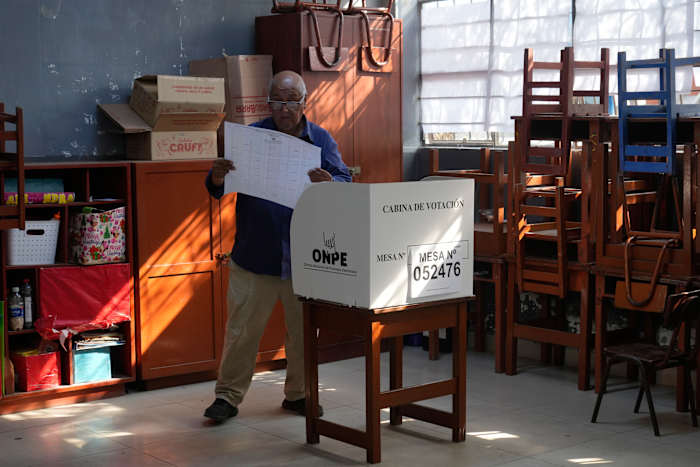
Mainstream media outlets love a "chaos in the tropics" narrative. When the Peruvian National Office of Electoral Processes (ONPE) announced a one-day extension for thousands of voters, the predictable headlines followed. They painted a picture of administrative failure, technical incompetence, and a nation teetering on the edge of a constitutional crisis.
They’re dead wrong.
What the headlines call "delay," a seasoned observer calls "rigor." The obsession with instant results is a modern pathology that is currently eating global democracy from the inside out. We have been conditioned by high-speed trading and on-demand streaming to believe that speed equals quality. In the delicate, high-stakes architecture of a South American election, speed is actually the primary vector for fraud and instability.
The Myth of the Seamless Election
The lazy consensus suggests that a functional democracy should run like an Amazon warehouse. If the results aren't in by midnight, the system is broken. This ignores the physical reality of Peru’s geography and the socio-political reality of its electorate.
Peru isn't a flat, hyper-connected digital grid. It is a vertical labyrinth of Andean peaks, Amazonian basin, and dense urban sprawl. When you provide a voting extension, you aren't "failing to manage a schedule." You are accounting for the friction of reality. In previous cycles, I’ve seen observers scream about "irregularities" simply because a mule carrying ballot boxes was delayed by a mudslide in the Apurímac region.
If the ONPE forced a hard cutoff, they would effectively disenfranchise the very populations that the "pro-democracy" pundits claim to care about. An extension is a pressure valve. It prevents the explosion of civil unrest that occurs when a specific demographic feels their voice was silenced by a stopwatch.
Why Real-Time Results are Poison
Let’s look at the mechanics of the "count." The competitor's article implies that a delay creates a vacuum for corruption.
Imagine a scenario where the preliminary count is released at 95% completion, showing a razor-thin margin. The final 5%—the delayed votes—then flip the result. In the hyper-polarized environment of Lima or Cusco, that "flip" is a match in a powder keg.
By delaying the announcement to ensure every outlier vote is integrated, the ONPE isn't inviting fraud; they are neutralizing the narrative of the "stolen" election. Real-time data in elections doesn't inform the public; it arms the mob. When we demand instant gratification in the ballot count, we are prioritizing our own dopamine loops over the stability of the state.
The High Cost of the Digital Shortcut
There is a loud contingent of tech-evangelists who argue that blockchain or remote digital voting would solve this. This is the ultimate "silver bullet" fallacy.
Digital voting in a country with Peru’s digital divide is an invitation to a different, more sophisticated kind of disenfranchisement. A physical ballot, hand-marked and transported under guard, is a primitive technology with one massive advantage: it has a physical trail.
When you extend the voting window for physical ballots, you are doubling down on the audit trail. You are saying that the physical presence of the voter is more important than the convenience of the poll worker. Most critics of the extension are actually arguing for "process over people." They want the spreadsheet to be clean at 9:00 PM, even if it means 50,000 rural voters never get to the booth.
The Geometry of Disenfranchisement
The "People Also Ask" section of your brain is probably wondering: Doesn't a delay give the incumbents time to fix the numbers?
Actually, the opposite is true. Rapid reporting favors the establishment. Incumbents usually have the infrastructure to get their urban strongholds counted and reported first. They set the "momentum." The delayed votes—the ones requiring extensions—are almost always from the fringes, the marginalized, and the anti-establishment blocks.
If you want a fair election in a developing economy, you should want it to be slow.
The Logistics of the Extension
Let’s talk about the actual "One-Day Extension."
- Staffing Fatigue: People forget that poll workers are humans. A 24-hour extension allows for a shift in personnel that reduces errors in the tallying phase. Most election "fraud" is actually just a tired person misreading a smudge on a paper.
- Logistical Re-routing: In regions like Loreto, logistics are dictated by river levels and weather. A rigid window is a death sentence for participation.
- Verification: The delay allows for the "Actas Impugnadas" (challenged tallies) to be addressed in the context of the full vote, rather than being discarded in a rush to hit a news cycle deadline.
The cost of this delay is a few days of market jitters and some spicy tweets. The cost of not delaying—of cutting off those voters—is a lost generation of trust in the democratic process.
Stop Fixing the Wrong Problems
The international community needs to stop lecturing emerging democracies on "efficiency." Efficiency is for factories. Democracy is about participation, and participation is messy, slow, and frequently runs late.
The Peruvian ONPE’s decision to extend the vote wasn't a sign of a failing state. It was a sign of a system that understands its own limitations and values the integrity of the count over the speed of the broadcast.
If you can’t wait 48 hours for the future of a nation, you don’t actually care about the nation. You just care about the news.
Quit checking the live map. Let the mules climb the mountains. Let the boats cross the river. The delay isn't a bug; it's the most important feature the system has left.