The lights in the Gasthaus near Ramstein Air Base don't flicker because of bad wiring. They flicker because the heavy transport planes taking off for the east shake the very foundation of the valley. For decades, that rumble was the sound of a paycheck, a shield, and a neighbor. But lately, the silence between the takeoffs has become much louder than the engines themselves.
In Washington and Berlin, the talk is of "troop levels" and "strategic repositioning." It is the language of spreadsheets. In the small towns of Rhineland-Palatinate and Bavaria, the talk is about whether the local bakery will survive when 5,000 sets of combat boots stop walking through the door.
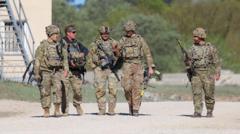
The decision to pull 5,000 American service members out of Germany didn't happen in a vacuum. It happened in the heat of a friction-filled dialogue between President Trump and German Chancellor Friedrich Merz. On paper, it is a disagreement over defense spending and the Nord Stream pipeline's lingering ghosts. In reality, it is the messy, public breaking of a lease that has defined the post-war world.
The Math of Friendship
Imagine a marriage where one partner keeps the ledger on the refrigerator door. Every time a bill comes, they point to the other's smaller contribution. This is the current state of the NATO alliance. The United States has long insisted that Germany meet the 2% GDP spending target for defense. Chancellor Merz, inheriting a complex economic engine and a pacifist-leaning electorate, has moved toward that goal, but not fast enough for a White House that views foreign policy through the lens of a balance sheet.
When the announcement came that 5,000 troops would be redirected—some back to the U.S., others closer to the Russian border in Poland—it was framed as a logistical necessity. But the timing told a different story. It was a cold shoulder delivered in the form of a troop transport.
The numbers are staggering when you look past the uniforms. Those 5,000 soldiers represent roughly 12,000 people when you count spouses and children. That is an entire city's worth of consumers, renters, and friends vanishing from the German economy. They buy cars. They rent apartments. They eat Schnitzel and drink Helles at the local festivals. When they leave, they take more than just security with them; they take the oxygen out of the local economy.
A Tale of Two Cities
Consider a hypothetical town—let’s call it Birkendorf. For seventy years, Birkendorf has lived in the shadow of a U.S. garrison. The local mayor speaks English with a slight Georgia accent because he grew up playing baseball with the colonel’s kids. The hardware store stocks American-sized wrenches. The grocery store has a dedicated aisle for peanut butter and root beer.
Now, imagine the Mayor of Birkendorf watching the news. He isn't thinking about the "geopolitical pivot to the Indo-Pacific." He is thinking about the three apartment complexes currently under construction that were designed specifically for American families. He is thinking about the school district that will lose its international flair and, more importantly, its funding.
To the planners in the Pentagon, 5,000 is a rounded number, a minor adjustment in a global force of hundreds of thousands. To Birkendorf, it is the end of an era. The "spat" between Trump and Merz isn't a headline to the people here; it is a structural failure.
The Invisible Shield
We often mistake "defense" for the act of fighting. In Germany, defense has always been the act of being. The presence of American troops wasn't just about stopping a hypothetical tank division from rolling through the Fulda Gap; it was a psychological anchor. It signaled to the rest of Europe—and to Moscow—that the Atlantic was not an ocean, but a bridge.
By pulling these troops during a diplomatic disagreement, the message changes. The bridge starts to look like a drawbridge.
Critics of the move argue that it weakens the very alliance it claims to be "reforming." If troop movements are used as a punitive tool for trade disagreements or personal slights between leaders, the security of half a billion people becomes a variable in a personality clash. The uncertainty this creates is a currency that our adversaries are all too happy to spend.
Chancellor Merz faces a brutal dilemma. If he bows to the pressure and hikes spending immediately, he looks like a vassal to his domestic critics. If he stands his ground, he watches the security architecture of his country erode. It is a game of high-stakes chicken where the "chickens" are young men and women in camouflage who just want to know where they are going to be living next month.
The Logistics of Departure
Moving 5,000 troops is not as simple as booking a flight. It is a massive, grinding gears-of-war operation.
- Housing Contracts: Thousands of private leases in German towns will be broken, leading to a glut of empty properties and a sharp decline in local real estate value.
- Education: Department of Defense Education Activity (DoDEA) schools will see classrooms emptied, teachers laid off, and sports programs canceled.
- Security Infrastructure: Millions of dollars spent on base improvements—gyms, hangars, secure communication lines—become "sunk costs" that may never be recovered.
This isn't just a relocation; it’s a controlled demolition of a community. The irony is that moving these troops often costs more in the short term than keeping them in place. Building new barracks in Poland or expanding facilities in the United States requires billions in taxpayer dollars. We are paying a premium to leave a place that was already built to host us.
The Human Toll
Think of Sergeant Miller. He’s on his third tour in Germany. His daughter is fluent in German and plays for a local soccer club. His wife works at the base hospital. They’ve spent their weekends exploring the Alps and the Rhine. To them, Germany isn't a "strategic theater." It’s home.
Suddenly, because of a "spat" over a pipeline and a percentage point of GDP, Sergeant Miller gets a set of orders. He has ninety days to pack a life. He has to tell his daughter she’s leaving her team. He has to tell his German neighbors, who invited him to their Christmas markets and taught him how to brew proper coffee, that the Americans are leaving because the bosses aren't getting along.
That loss of "soft power"—the friendships, the cultural exchange, the shared history—cannot be measured in a budget report. It is the glue that holds the West together. When you dissolve the glue, the pieces don't just sit there; they start to drift.
The New Frontier
The redirect toward Poland is the most telling part of the story. Warsaw has been vocal about its desire for a "Fort Trump" and a permanent U.S. presence. They are willing to pay for it. They see the threat from the east as existential, not theoretical. By moving troops from Germany to Poland, the U.S. is essentially moving its "customer base" to a more willing buyer.
But this shift creates a new, jagged edge in Europe. It creates a hierarchy of allies: those who pay and those who pray. It suggests that American protection is a subscription service rather than a fundamental pillar of the international order.
Chancellor Merz is now forced to lead a Germany that must contemplate a future where it is the "old frontier." The vibrant, bustling hub of the Cold War and the post-unification era is being told it is no longer the center of the map.
The Resonance of Silence
The debate will continue in the press rooms of the White House and the Chancellery. There will be talk of "burden sharing" and "strategic autonomy." Experts will debate whether 5,000 is enough to make a difference or if it’s just a symbolic slap.
But the real story is found in the quiet moments. It’s in the German landlord who suddenly has five empty apartments and a mortgage to pay. It’s in the American teenager sitting in a terminal at Frankfurt Airport, looking out the window at the rolling green hills of a country they thought they’d have another year to explore.
It’s in the realization that the world we built after 1945—a world of permanent alliances and shared destinies—is being traded for a world of temporary arrangements and transactional loyalty.
When the last of those 5,000 troops boards the plane, there won't be a parade. There will just be a set of keys turned in a lock. The barracks will be dark. The bakeries will have fewer loaves on the shelves. And the wind blowing through the Black Forest will carry a new, colder sound: the sound of a superpower packing its bags and moving down the road, leaving its oldest friends to wonder what, exactly, they did wrong.
The planes will still take off. But for those left on the ground, the vibration feels less like strength and more like a warning.