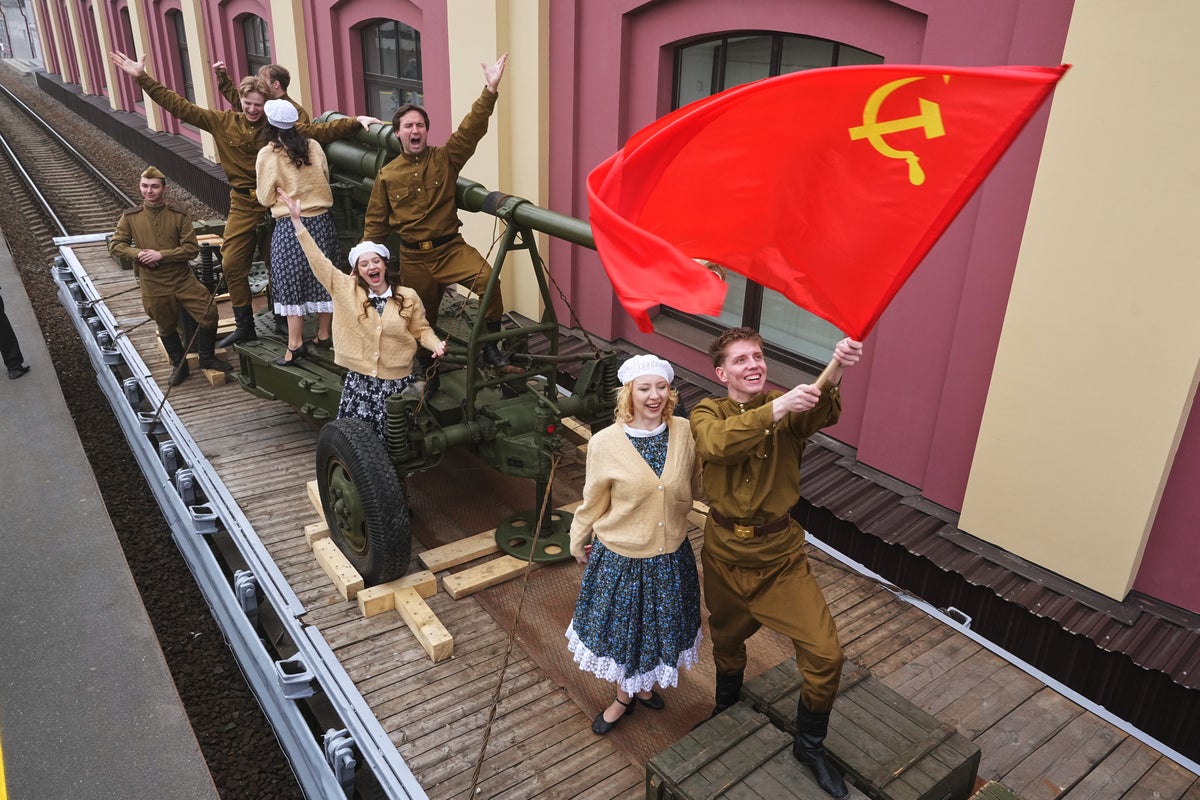
The cobblestones of Red Square usually vibrate with a specific, bone-shaking frequency every May. It is the rhythmic thud of thousands of boots and the low, guttural roar of T-34 tanks—the metal ghosts of 1945—reclaiming the heart of Moscow. For decades, Victory Day has been more than a holiday. It was the secular religion of a nation, a day when the air tasted of diesel fumes, lilacs, and the collective memory of a triumph that cost 27 million lives.
But this year, the silence is what carries the weight.
The grand stands are still there, draped in the orange-and-black stripes of the Ribbon of St. George. The speeches still echo off the red brick walls of the Kremlin. Yet, if you look closely at the edges of the frame, the grandeur has frayed. The usual swarm of modern hardware—the high-tech armor that usually signals Russia’s "rebirth"—has been replaced by a conspicuous absence. In many cities across the vast expanse of the eleven time zones, the parades didn't happen at all.
Security concerns, the government says.
The truth is heavier. You can’t parade a tank through a city square when that tank is currently a charred skeleton in a sunflower field near Kharkiv. You can't celebrate a historic victory with full-throated joy when the current "special military operation" has turned into a grinding, generational trauma that refuses to end.
The Ghost of the Immortal Regiment
Consider a woman named Elena. She is a hypothetical composite of the thousands of mothers who, in years past, would join the "Immortal Regiment." This was the most human part of the day. Millions of ordinary Russians would walk the streets holding black-and-white photographs of their grandfathers and great-uncles who fought the Nazis. It was a sea of the dead, kept alive by the hands of the living.
This year, the Immortal Regiment was canceled in its traditional form.
Officials cited the risk of "provocations." But there is a deeper, more tectonic fear at play. If the state allows thousands of people to gather with photos of their war heroes, what happens when people start showing up with photos of the men who died last week? What happens when the black-and-white portraits of 1943 are outnumbered by the high-definition, color snapshots of 2026?
The narrative of Victory Day depends on the distance of time. It relies on the "Great Patriotic War" being a closed chapter of mythic heroism. When you blur the lines between the triumph of the past and the ambiguity of the present, the myth starts to bleed. Elena stays home. She watches the shortened parade on a television screen, the flickering light reflecting off a glass of vodka left untouched on the table. The stakes are no longer about a distant history; they are sitting in her living room, in the form of an empty chair.
The Mathematics of a Muted Triumph
The logistical reality of this year’s celebrations is a study in subtraction. In 2020, even during a global pandemic, the display of might was intended to be breathtaking. Fast forward to the present, and the numbers tell a story of redirected resources.
The Hardware Deficit: Foreign observers noted that in several regional parades, the only tank present was a single, vintage T-34. It is a potent symbol of heritage, but a lonely one. The modern T-14 Armata tanks and the sophisticated air defense systems that usually serve as the centerpiece of Russian exports are conspicuously absent. They are needed at the front. Or, more likely, they are being held back to guard against the very real threat of drone strikes that have recently reached as far as the Kremlin domes themselves.
The Borderline Silence: In cities like Belgorod and Kursk, which sit in the shadow of the Ukrainian border, the silence is absolute. There are no fireworks. Fireworks sound too much like incoming artillery. The psychological toll of living in a "victory culture" while hearing the echoes of a current conflict creates a jarring cognitive dissonance.
The Diplomatic Island: Look at the VIP stands. In the mid-2000s, Red Square hosted world leaders from the United States, France, and Germany. They sat shoulder-to-shoulder with Vladimir Putin to honor the alliance that broke the Third Reich. This year, the guest list is a thinning Rolodex of Central Asian leaders and a few remaining allies. The isolation isn't just political; it’s physical. The world that Russia helped save in 1945 has, in the eyes of the Kremlin, become the very monster they are now fighting.
The Weight of the Lilacs
There is a specific smell to Victory Day in Russia: the scent of lilacs. They bloom just in time for the ninth of May. Veterans, their chests heavy with medals that jingle like wind chimes, are traditionally handed bouquets by smiling children.
But the veterans of 1945 are almost all gone. The men who actually saw Berlin fall are in their late nineties or have passed into the earth. The "living memory" has become "institutional memory." This transition is dangerous for a state. As long as the survivors were alive, the day was about the horror of war and the relief of peace. Without them, the day is easily hijacked. It becomes a tool for mobilization, a way to convince a new generation that their turn in the trenches is a sacred duty rather than a tragic necessity.
The "muted" nature of the celebrations this year isn't just about a lack of tanks. It's about a lack of breath. The country is holding its breath.
The rhetoric has shifted from "never again" to "we can do it again." This subtle change in grammar is the pivot point of the modern Russian soul. By framing the war in Ukraine as a direct sequel to the fight against Nazism, the state has upped the stakes to an existential level. If this is a sequel, then anything less than total victory is seen as a betrayal of the grandfathers in the black-and-white photos.
The Invisible Stakes
Why does it matter if a parade is smaller? Why do we care if the fireworks are cancelled?
Because symbols are the currency of power in Moscow. The parade is the annual performance of the social contract: You give us your sons and your silence, and we will give you glory and security.
When the parade shrinks, the contract is being renegotiated in real-time. The citizens see the gaps in the formation. They notice the nervousness in the security cordons. They feel the absence of the "Immortal Regiment" as a subtraction of their own right to mourn.
The human element of this story isn't found in the televised speeches. It’s found in the quiet kitchen conversations in Omsk, Vladivostok, and St. Petersburg. It’s found in the way people look at the sky when they hear a loud noise. The war has moved from the television screen to the doorstep, and no amount of military marches can drown out that reality.
The victory of 1945 was earned with a terrible, singular focus. The current conflict is a fractured, messy shadow of that unity. By trying to wrap the current war in the flag of the old one, the state risks fraying the original fabric.
As the sun sets over the Moskva River, the red stars on the Kremlin towers begin to glow. They have seen everything: the czars, the revolutionaries, the ecstatic crowds of 1945, and the long, gray winters of the Cold War. They see the square tonight, emptier than usual, haunted by the ghosts of a victory that used to feel like an ending, but now feels like an unanswered question.
The lilacs will bloom again next year. The cobblestones will still be there. But the people walking on them are beginning to realize that you cannot march toward a future while you are buried in the rituals of a past that no longer fits the present. The silence in Red Square isn't just a lack of noise. It is the sound of a nation waiting for a version of peace that no one seems able to define.