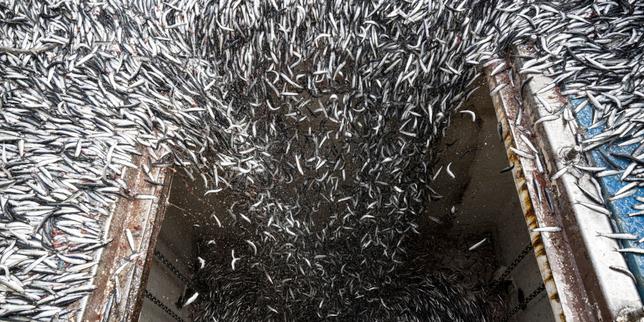
Morning on the coast of Senegal does not arrive with a whisper. It hits the shore like a low, heavy drumbeat. The Atlantic rolls in, dark and cold, slapping against wooden pirogues painted in bright stripes of yellow, green, and blue. For generations, these boats were the lifeblood of coastal communities. Men pushed them into the surf before dawn, trusting the ocean to provide. They returned with holds overflowing with silver sardines and glistening mackerel—fish that fed families, fueled local markets, and sustained entire economies from Mauritania down to Ghana.
Today, those wooden boats often return empty. You might also find this similar coverage insightful: Why Brazil Is Not Falling Into Dictatorship But Replaying Its Favorite Political Loop.
The nets come up light, tangled only with seaweed and frustration. It is not because the sea has suddenly grown tired. It is because something massive, invisible, and ravenous is at work just beyond the horizon.
Consider what happens when local fishermen cast their lines. They pull up enough to feed a village. But look further out, past the line where the sea meets the sky. There, industrial trawlers sit like floating fortresses. They fly flags from distant continents. They drag nets wide enough to swallow cathedrals. These ships do not fish for dinner; they fish for profit on a global scale. As reported in latest articles by The Guardian, the implications are widespread.
The mechanics of this modern disappearance are rooted in an industrial hunger thousands of miles away. In massive processing plants across Europe and Asia, consumer demand for cheap animal feed and aquaculture products has skyrocketed. Farmed salmon need to eat. Pigs and poultry need protein. The solution? Scoop up millions of tons of wild-caught fish off the coast of West Africa, grind them down into fishmeal and fish oil, and ship them across oceans.
Imagine taking enough protein to nourish millions of human beings, boiling it down into a brown powder, and feeding it to livestock. That is the quiet tragedy unfolding off the coast.
Local fishermen watch the factory ships with a mixture of anger and despair. They cannot compete with vessels equipped with sonar and satellite navigation. When the industrial fleets sweep through, they leave a biological desert in their wake. The fish stocks collapse. The breeding grounds are pulverized.
The ripple effects touch every corner of daily life. When the fish disappear, the local women who smoke, salt, and sell the catch find their livelihoods evaporating. These women are the backbone of the coastal economy. Without fish, they cannot earn an income. Without an income, they cannot pay school fees or buy medicine.
Hunger creeps in where abundance once lived.
Governments in the region often sign access agreements with foreign fishing nations, trading short-term cash injections for long-term ecological ruin. The money rarely trickles down to the villages that bear the cost. Instead, it vanishes into bureaucratic channels, leaving behind depleted waters and broken communities.
Desperation changes people. When the sea no longer provides, young men look toward the horizon for a different reason. They pack onto rickety boats, not to catch fish, but to risk their lives crossing the Mediterranean toward Europe. The destruction of local fisheries is a primary, unspoken engine of modern migration. We break the ecosystem at home, and then wonder why people leave.
Yet, resilience runs deep in these coastal towns. Communities are organizing. Local activists are demanding transparency from their governments. They are patrolling the waters themselves, documenting illegal incursions by foreign trawlers, and fighting for exclusive zones reserved for artisanal fishers. They know that if the ocean dies, their culture dies with it.
The sea remembers what it used to be. It remembers schools of fish so dense they darkened the water. It waits to see if we have the courage to step back, quiet the industrial engines, and let the waters heal.
Until then, the wooden pirogues will push off into the dark, chasing a vanishing horizon.