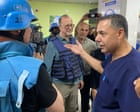
A man sits behind a partition in a room beneath the earth. He cannot hold his back straight. His spine curves under some invisible, crushing weight, his chest heaving with shallow, jagged breaths. When he tries to speak, the words fragment, dissolved by a lack of oxygen and sheer exhaustion. Every few moments, his eyelids flutter and drop, his body threatening to slip into unconsciousness.
Nasser Odeh, a lawyer accustomed to the grim realities of the legal system, stared at this broken figure on July 2, 2026. He was looking directly at his client, yet he could barely recognize him.
The man in the chair was Dr Hussam Abu Safiya.
Not long ago, Abu Safiya was the director of Kamal Adwan hospital in northern Gaza. He was a pediatrician, a man whose hands were built for the delicate task of keeping newborns alive amid the ruins of war. He was the public face of a collapsing healthcare system, frequently seen on international news feeds standing in blood-stained scrubs, calmly organizing chaotic emergency rooms under bombardment.
Now, he is a ghost of that memory. Held for 18 months without charge, without a trial, and without an expiration date, his body has become a ledger of state-sanctioned violence.
"They brought me here to kill me," Abu Safiya whispered to his lawyer, his voice trembling in the dim light of Rakefet prison. "I don't see myself surviving. This is the end."
The Underground Tomb
To understand how a prominent medical professional vanishes into a living skeleton, one must look at geography. Abu Safiya is currently held in Rakefet, a notorious underground facility built in the 1980s. Originally designed to hold high-level organized crime figures, it was eventually shut down because human rights authorities deemed its subterranean, windowless environment inherently inhumane.
It did not stay closed. Under the direction of Israel's far-right National Security Minister, Itamar Ben-Gvir, the underground cells were reopened.
In Rakefet, daylight does not exist. The air is thick, hot, and unventilated. Former detainees describe a perpetual state of semi-suffocation, where even completely healthy individuals gasp for air in the overcrowded blocks. For a man with severe, unaddressed chest injuries, the air inside Rakefet is its own form of torture.
Abu Safiya’s descent into this subterranean facility followed a distinct pattern of escalation. In late May, after his legal team filed a Supreme Court appeal challenging the legality of his indefinite detention, authorities transferred him from Ketziot prison to the Ganot complex. There, he was placed in solitary confinement.
Shortly after he appeared via video link to look his captors in the eye during that court hearing, the retaliation arrived. Abu Safiya told his lawyer that guards entered his isolation cell armed with batons and hammers. The beating was systematic.
By the time he was moved to Rakefet on June 24, the damage was absolute. He now faces daily beatings, routinely losing consciousness before the guards walk out of his cell.
The Israeli Prison Service issued a boilerplate response, calling the allegations "false and entirely without factual basis," while simultaneously refusing to comment on Abu Safiya's physical condition, citing privacy concerns. The irony is bitter. A state cites the privacy rights of a man it has stripped of every fundamental human right, including the right to know why he is imprisoned.
The Systemic Dismantling of Care
It is easy to view Abu Safiya’s plight as an isolated horror story, a case of a single prisoner falling through the cracks of a brutal wartime bureaucracy. But human rights organizations warn against this comfort. The erasure of Gaza’s doctors is not a byproduct of the conflict; it is a strategy.
Consider a parallel tragedy that unfolded on a dirt road in the West Bank just days ago.
A four-month-old infant named Ahmad Maarouf Zaid fell critically ill. He needed oxygen immediately. His parents rushed him toward Ramallah, where hospitals possessed the technology to save him. But at the Ein Ayoub checkpoint, Israeli soldiers blocked their path. The soldiers fired tear gas into the area, ignoring the parents' screams and the sight of a suffocating baby.
Turned away from the asphalt highway, the desperate family tried to bypass the blockade, driving their car over treacherous, unpaved mountain paths. The detour cost them over an hour.
Baby Ahmad died in his father's arms before they reached the clinic.
"There are no words to describe the pain of watching your own child die in your arms while knowing there is nothing you can do to save him," said Arafat Ahmad Zaid, the infant's uncle. "That is the ultimate suffering. That is the ultimate humiliation."
When Milena Ansari, the director for Physicians for Human Rights Israel (PHRI), looks at these two events—a pediatrician beaten with hammers in an underground cell and a newborn dying for lack of oxygen on a mountain road—she sees the exact same mechanism at work.
"They reflect a broader pattern," Ansari stated firmly. "The conditions necessary to realize Palestinians' right to health are being systematically undermined."
Medical infrastructure is more than concrete walls, clean linens, and operating tables. It is a network of human expertise and accessible pathways. When you arrest the directors of hospitals, place surgeons in solitary confinement, and block ambulances at gunpoint, you dissolve the concept of medicine itself. You turn manageable illnesses into execution sentences.
A Missing Prescription
The legal team fighting for Abu Safiya is not asking for a miracle. They are asking for an independent medical examination. They are asking for a trial, or a release.
During earlier stages of his 18-month captivity, his lawyers managed to note smaller, quieter indignities that painted a picture of calculated neglect. Abu Safiya suffers from a pre-existing heart condition. For long stretches, his prescribed medication was withheld. He was denied his prescription eyeglasses, forcing a man who spent his life analyzing subtle clinical symptoms to live in a perpetual, terrifying blur.
Now, even the blur is fading into darkness.
The human body can withstand immense pressure, but it requires a baseline of oxygen, rest, and hope to repair itself. Abu Safiya has none of these. His lawyer’s latest testimony describes a man whose psychological defense mechanisms are failing alongside his physical organs. The once-confident physician is now visibly terrified, looking around the room, reluctant to speak, fearing that every word uttered to his counsel will be answered with a hammer in the dark.
We are witnessing the slow, deliberate reduction of a human being who dedicated his life to healing others. If Abu Safiya dies inside the unventilated concrete of Rakefet, it will not be because his heart simply stopped. It will be because a system decided that a doctor who stayed with his patients under siege was too dangerous to be allowed to look at the sun.
The partition in the visiting room remains. The lawyer goes back to the outside world to file paperwork that will likely be ignored. And beneath the earth, a pediatrician closes his eyes, wondering if the next breath he takes will be his last.