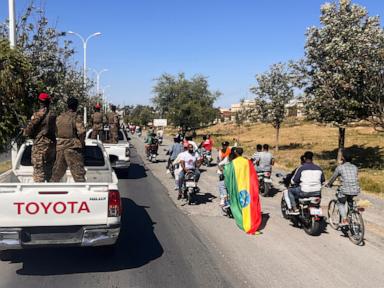
Diplomatic calls for restraint rarely stop an armed confrontation once border deployments, proxy offensives, and non-combatant strikes begin reinforcing one another. When U.S. Secretary of State Marco Rubio urges restraint amid renewed Ethiopia–Eritrea tensions and reports of civilians killed, the core analytical question is not whether Washington prefers calm—it is why diplomatic signaling alone struggles to alter incentives when two states view each other through a security-dilemma lens.
A standard breaking-news report treats diplomatic appeals, troop movements, and civilian casualties as separate updates on a single timeline. That approach misses the structural link between them. Renewed fighting in northern Ethiopia's Tigray region, troop buildups near contested border zones such as Badme, mutual accusations of territorial occupation and external meddling, and strikes hitting civilians form an interconnected escalation loop. Understanding that loop requires separating verified facts from working hypotheses, mapping the strategic incentives of each actor, and identifying where diplomatic leverage actually has traction.
Deconstructing Conventional Crisis Reporting
Conventional headlines on Ethiopia–Eritrea friction typically rely on a familiar sequence: a diplomatic statement from Washington or the United Nations, a summary of recent clashes or reported civilian deaths, and a brief nod to past hostilities. As an initial briefing, that structure establishes urgency. As an analytical model, it has three clear blind spots.
The first blind spot is treating diplomatic rhetoric as an independent brake on military action. Verbal appeals for restraint carry low cost for the sender and low enforcement credibility unless tied to material leverage, verification mechanisms, or credible commitments. When leaders in Addis Ababa and Asmara perceive existential threats to regime security or territorial integrity, a call to stand down without addressing underlying grievances can be discounted as noise.
The second blind spot is flattening distinct conflict dynamics into a single bilateral quarrel. Friction between Ethiopia and Eritrea interacts directly with internal Ethiopian security struggles—particularly in Tigray, as well as pressures elsewhere in the country—and with wider regional rivalries involving neighboring states and Red Sea actors. Treating the border standoff in isolation obscures how domestic insurgents and external backers can serve as multipliers.
The third blind spot is reporting civilian casualties as tragic background noise rather than a structural byproduct of how modern asymmetric and conventional campaigns are fought. Shelling and air or drone strikes in contested or poorly monitored areas generate severe human harm while complicating verification and hardening local grievances.
Fact Versus Hypothesis in a Contested Information Environment
Rigorous analysis starts by drawing a hard line between established facts, public claims, and analytical hypotheses. Conflict zones in the Horn of Africa frequently experience communications restrictions, limited independent access, and competing narratives from belligerents.
Known facts include the broader historical arc of strained relations, the 2018 rapprochement, the 2020–2022 Tigray war, and the November 2022 Pretoria agreement—alongside the reality that peace between the former allies has severely eroded, accompanied by renewed clashes in Tigray, troop movements near the border, rights-group reporting on civilians killed and injured in shelling or strikes, and diplomatic calls for restraint.
Contested claims and allegations include specific battlefield attributions, exact casualty tolls, and accusations regarding cross-border troop presence or external backing for armed factions. When governments exchange accusations of occupation, war footing, or covert support for rival groups, those statements are strategic data points about intent and threat perception, not self-proving facts.
Educated hypotheses explain causal mechanisms where granular data is incomplete. For example, one working hypothesis is that border force concentrations operate as both defensive insurance and coercive signaling—raising the risk of accidental engagement even if neither side's leadership desires a full-scale war on day one. Another hypothesis is that continued civilian harm in contested areas deepens local distrust toward state and foreign forces alike, creating fertile recruitment conditions for armed actors that prolong instability.
The Four Pillars of Escalation
To move beyond headline summaries, the crisis can be organized into four structural pillars that govern whether tensions cool or spiral.
1. The Security Dilemma and Commitment Credibility
In international relations theory, the security dilemma describes a situation where measures taken by one state to increase its security—such as mobilizing forces, fortifying border sectors, or acquiring heavier weaponry—decrease the security of a rival, prompting counter-mobilization. Once trust between Addis Ababa and Asmara fractured after the post-2018 alignment and the 2022 peace framework, each side's defensive preparation looks like offensive preparation to the other.
Commitment problems compound this dynamic. Even when leaders recognize the catastrophic cost of a major war, neither side may trust the other to honor a verbal pause unless backed by verifiable disengagement or third-party monitoring.
2. Proxy Entanglement and Multi-Front Spillover
Direct state-on-state war is expensive and visible, which makes indirect pressure and alignment with local or regional actors attractive. Tensions involving Ethiopia and Eritrea intersect with unresolved disputes inside Ethiopia—including fighting involving Tigrayan forces—as well as broader regional rivalries across the Horn of Africa and the Red Sea arena.
The main operational risk here is entanglement. A localized clash involving an armed faction or a border skirmish can pull regular forces into wider engagements faster than diplomats can convene talks. External actors pursuing their own strategic interests in the region can widen the conflict further by supplying materiel, intelligence, or diplomatic cover.
3. The Cost Function of Civilian Harm
Every military campaign operates under a cost function where tactical objectives are weighed against political, humanitarian, and strategic costs. When shelling or aerial and drone strikes kill or injure civilians, the immediate toll falls on non-combatants and local infrastructure.
Strategically, high civilian harm alters the conflict's trajectory in three ways:
- Verification friction: Blackouts and restricted access slow independent investigation, leaving rival narratives to fill the vacuum and eroding baseline trust.
- Reputational and diplomatic drag: Civilian deaths intensify international scrutiny, complicate external partnerships, and harden domestic positions on all sides.
- Grievance compounding: Communities caught between rival forces face displacement and loss of livelihood, increasing long-term volatility even if conventional front lines shift.
4. Asymmetry of Diplomatic Leverage
Washington and multilateral institutions can press for restraint, yet external leverage is rarely symmetrical across all parties. A state with deep economic, financial, or security ties to outside powers faces different incentives than a more diplomatically or economically isolated state.
When external pressure is applied unevenly—or perceived as one-sided—the targeted actor may dig in to demonstrate sovereignty, while the favored actor may still prioritize domestic survival or regional security goals over diplomatic preferences. Calling for restraint without linking it to concrete incentives or de-escalation steps leaves the underlying calculus intact.
How Common Questions Map to Strategic Reality
Observers following the standoff typically ask a few recurring questions that expose how the crisis works in practice.
Why do tensions flare despite prior peace agreements? Agreements end active combat or reset diplomatic ties at a specific moment, but they do not automatically resolve underlying disputes over borders, security guarantees, political grievances, or regional influence. When implementation stalls or new security threats emerge, old suspicions return quickly.
How does a border standoff turn into a broader regional crisis? A crisis broadens through linkage. If border friction merges with internal insurgencies and competing interests among neighboring or Red Sea states, a single flashpoint can ignite multiple fronts simultaneously, making containment far harder.
What makes civilian protection so difficult once fighting resumes? High-tempo operations—especially artillery, air power, and unmanned strikes—carry severe risks to civilians when fighting occurs near populated areas or when target identification fails. Once civilian casualties occur, mutual blame rises, humanitarian access shrinks, and confidence in any ceasefire drops.
Operationalizing De-Escalation and Its Limits
If policymakers or analysts want to evaluate whether de-escalation is realistic, they should look at concrete operational mechanisms rather than press statements. A practical de-escalation sequence involves four steps:
- Establish a verifiable pause in offensive operations and shelling: A credible halt requires clear definitions of what is prohibited—such as cross-border strikes, offensive maneuvers, and attacks affecting civilian areas—paired with a timeline that both sides can test without losing face.
- Pull back forward deployments from high-friction zones: Separating forces along sensitive border stretches reduces the probability of miscalculation or accidental fire while talks proceed.
- Create an objective monitoring and humanitarian channel: Independent reporting, unimpeded humanitarian corridors, and clear communication channels help verify compliance and reduce information distortion.
- Pair crisis management with a structured political track: Short-term truces collapse if core grievances over security, border administration, and internal stability remain unaddressed.
Every diplomatic and operational tool has real limitations. Verification is difficult in rugged terrain with restricted access; mediators face skepticism when actors suspect bias; and leaders facing intense domestic pressures may view concessions as political suicide. No single diplomatic appeal or confidence-building measure guarantees stability on its own.
Strategic Recommendation
External actors seeking to prevent a wider war should shift from generic calls for restraint to conditional, verifiable de-escalation tied to civilian protection and force separation. Specifically, diplomatic engagement should condition positive incentives and regional crisis support on three observable benchmarks: an immediate halt to strikes affecting civilians and populated areas, measurable pullback or freeze of forward troop concentrations along flashpoint sectors, and a verifiable commitment to stop backing armed proxies across neighboring borders. Without tying diplomacy to enforceable verification and a credible off-ramp for core security fears, statements of concern will remain commentary on an escalation already in motion.