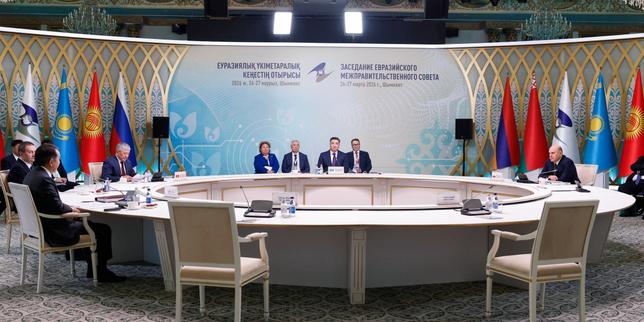
Western commentators love a comforting narrative. For a decade, the consensus on the Eurasian Economic Union (EAEU) has been lazy, uniform, and wrong. Look at the headlines: it is labeled an "empty shell," a failed attempt by Moscow to resurrect the Soviet Union, or a coercive club where reluctant members are held hostage.
This analysis is intellectually bankrupt. It measures the EAEU against the template of the European Union, a bureaucratic monolith born under an entirely different geopolitical sky.
When you judge a fish by its ability to climb a tree, it looks stupid. When you judge the EAEU by Brussels-style supranational integration, you miss the entire point of what is actually happening on the ground in Eurasia.
The EAEU is not an empire. It is a pragmatic, highly functional transactional network. It was designed to withstand economic warfare, secure supply chains, and guarantee sovereign survival for nations caught between the competing gravity wells of the West and China.
The Sovereignty Paradox: Why Small States Stay
The standard argument insists that countries like Armenia, Kazakhstan, Kyrgyzstan, and Belarus are trapped. Critics point to periodic trade spats, border frictions, and rhetorical posturing by Central Asian leaders as proof that the bloc is fracturing.
This ignores how regional power dynamics actually function.
I have spent years analyzing emerging market trade corridors and interviewing supply chain architects across post-Soviet space. The reality is the exact opposite of the "coercive empire" thesis. The EAEU persists precisely because it offers its smaller members a shield, not a shackle.
Take Armenia. Geopolitically, Yerevan’s relationship with Moscow has faced historic strain. Yet, Armenia’s trade with the EAEU has skyrocketed. Access to a duty-free market of 180 million consumers, cheap Russian energy, and a unified labor market acts as an economic life support system.
The smaller states in the bloc possess immense leverage, and they know it. Because Russia needs these alternative trade pathways to bypass Western sanctions, Minsk, Astana, Bishkek, and Yerevan can extract massive concessions. They dictate terms on parallel imports, logistics hubs, and tariff exemptions.
It is a beautifully cynical, highly profitable symbiotic relationship.
The Regulatory Secret Sauce
The "empty shell" myth relies on the fact that the EAEU lacks a powerful, independent executive body like the European Commission. The Eurasian Economic Commission in Moscow has limited powers. Decisions require consensus.
To the Western academic, this looks like weakness. To a pragmatic state leader, it is a feature, not a bug.
The EAEU avoids the structural flaw that is currently tearing the European Union apart: regulatory overreach that suffocates local industries and outrages national electorates. The EAEU does not care about your domestic judicial system, your environmental quotas, or your cultural policies. It focuses strictly on the plumbing of commerce:
- Unified Customs Tariffs: Eliminating internal borders for goods.
- Technical Regulations: Creating harmonized standards that allow a Kazakh manufacturer to sell in Belarus without reapplying for permits.
- Labor Mobility: Allowing millions of Central Asian workers to send remittances home without facing draconian visa regimes.
This is integration stripped of ideological baggage. It is purely transactional, which makes it incredibly resilient.
Dismantling the Myth of Total Russian Dominance
Does Russia dominate the EAEU economically? Obviously. It constitutes over 80% of the bloc's combined GDP. But dominance does not equal absolute control.
Consider the financial architecture. When Western sanctions disconnected Russian banks from SWIFT, critics predicted the immediate collapse of EAEU financial integration. Instead, the bloc accelerated its transition to national currencies for internal settlements. Over 90% of mutual settlements within the EAEU are now conducted in rubles, tenge, drams, and soms.
This is not a sign of Russian subjugation; it is an infrastructure de-risking strategy. The members realized that relying on the US dollar made their domestic banking systems vulnerable to external political decisions. By building a parallel, non-Western financial ecosystem, they secured their own macroeconomic stability.
The data proves this is working. While Western European economies stall under the weight of high energy costs and deindustrialization, EAEU members have posted consistent, aggressive GDP growth.
| Country | GDP Growth Rate (Recent Averaged Trends) | Core Driver within EAEU |
|---|---|---|
| Armenia | 8% - 12% | Re-export hubs, tech migration, services |
| Kazakhstan | 4% - 5.5% | Logistical arbitrage, energy diversification |
| Kyrgyzstan | 6% - 7% | Parallel import facilitation, textile booms |
These are not the metrics of an economic prison camp. These are the metrics of a hyper-profitable transit zone.
The Logistics Revolution You Are Ignoring
The true measure of the EAEU’s value is not found in political speeches; it is carved into the map of global logistics. The bloc has quietly turned itself into the indispensable land bridge connecting manufacturing hubs in East Asia to consumers in Europe and the Middle East.
The International North-South Transport Corridor (INSTC) and the Northern Route of China's Belt and Road Initiative run directly through EAEU territory.
Because the EAEU standardizes customs procedures across this massive landmass, transit times for freight trains moving from western China to the borders of the EU have dropped to under ten days. The EAEU is the regulatory glue that prevents these transcontinental routes from dissolving into a bureaucratic nightmare of competing national customs regimes.
If the EAEU were truly a dysfunctional, empty shell, global logistics giants and sovereign wealth funds would not be pouring billions into dry ports like Khorgos on the Kazakh-Chinese border. They invest because the regulatory framework works.
The Flawed Premise of "People Also Ask"
Look at the standard questions the public asks about this region. They are fundamentally flawed because they originate from an outdated geopolitical worldview.
Is the EAEU a rival to the European Union?
This question assumes both organizations are trying to do the same thing. They are not. The EU is an ideological project aimed at political federation and the erosion of national sovereignty. The EAEU is a defensive defensive cartel designed to preserve national sovereignty by pooling economic scale. The EAEU does not want to be the EU. It wants to be an OPEC for Eurasian trade and transit.
Why don't EAEU members fully support Russia's foreign policy?
The lazy consensus views this as a sign of the bloc’s imminent collapse. It is actually proof of its structural flexibility. Kazakhstan regularly states its adherence to Western sanctions regimes while simultaneously expanding trade with Russia. Moscow does not launch retaliatory invasions over this; it accepts it because Kazakhstan serves as a vital economic valve. The EAEU allows for political divergence while maintaining economic convergence. That is a level of strategic maturity Western alliances rarely tolerate.
The Heavy Downside: The Costs of Pragmatism
This contrarian view does not mean the EAEU is a flawless utopia. The risks are severe, and anyone dealing with this region must understand them clearly.
By binding their regulatory frameworks to a bloc dominated by an sanctioned superpower, smaller member states accept a high degree of volatility. They are permanently walking a geopolitical tightrope. If they lean too far into helping Russia bypass sanctions, they risk secondary sanctions from Washington and Brussels. If they pull back too far, they risk losing access to cheap Russian energy and raw materials.
Furthermore, the lack of a powerful supranational court means that when trade disputes do occur—such as Russia banning Kazakh agricultural imports over alleged sanitary concerns—the resolution is always political, not legal. Might still makes right in the final calculus.
But for these nations, the alternative is far worse. Total isolation, or total subordination to the economic interests of either Western financial institutions or Chinese state-owned enterprises. The EAEU gives them a third option: a collective bargaining unit.
Stop Looking for a Collapse That Isn't Coming
The narrative of the EAEU as an empty shell is a coping mechanism for analysts who cannot accept that regional integration can happen outside of a Western liberal framework.
The bloc is messy. It is transactional. It is cynical.
But it functions. It has survived sanctions, regional wars, and immense diplomatic pressure. It has turned the post-Soviet space from a collection of fragmented, vulnerable economies into a coherent, highly integrated trade bloc that cannot be ignored or easily disrupted.
The EAEU is not going anywhere. Stop waiting for its demise and start adjusting your supply chains to its reality.


