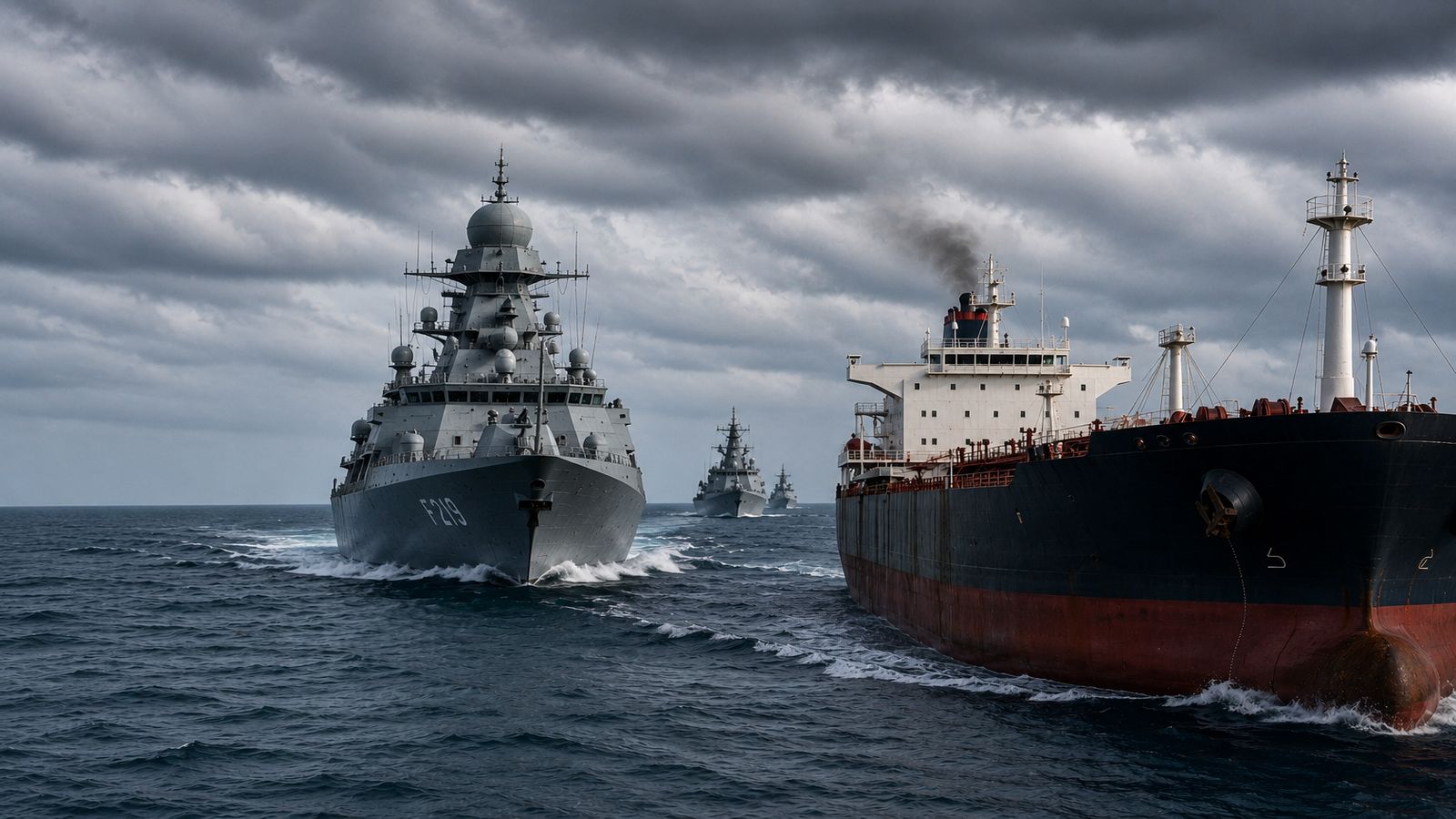
Sending warships to police the Mediterranean is a masterclass in geopolitical theater. The European Union’s proposed naval blockade of Russia’s "shadow fleet" is not a masterstroke of economic warfare; it is a fundamental misunderstanding of global maritime logistics that will likely backfire on the Western economies holding the match.
The mainstream media frame is predictable: Russia uses a rogue armada of decrepit, uninsured tankers to bypass G7 price caps, and Europe is finally getting tough by threatening to deploy naval assets. Moscow, predictably, condemns the move as a violation of international law. Both sides are playing their parts in a scripted drama, but the underlying mechanics of global trade tell a completely different story.
The Western policy establishment is attacking the symptom while actively reinforcing the cause. The shadow fleet is not an illegal aberration. It is a highly rational, hyper-efficient market response to poorly constructed economic sanctions. Trying to stop it with a few frigates is like trying to plug a burst dam with a handful of corks.
The Mirage of Maritime Enforcement
Let us correct a fundamental misunderstanding about maritime law right now. The United Nations Convention on the Law of the Sea (UNCLOS) guarantees freedom of navigation. A warship cannot just board a foreign-flagged vessel on the high seas because it suspects the owner is selling oil above an arbitrary price cap.
Unless a vessel is flying the flag of the state doing the intercepting, or falls under very specific exceptions like piracy or slave trading, boarding it in international waters is an act of aggression. The EU knows this.
So what is the actual plan? The proposed strategy relies on exploiting environmental regulations and coastal state rights within Exclusive Economic Zones (EEZs). The argument is that these aging tankers pose an imminent ecological threat to European coastlines.
I have spent two decades analyzing commodity flows and maritime supply chains. I can tell you that using environmental pretexts to enforce geopolitical pricing mechanisms is a dangerous precedent. It weaponizes the safety mechanisms of global shipping. If Europe starts detaining ships based on arbitrary definitions of "substandard" risk, the legal frameworks that have protected global trade since World War II will begin to unravel.
The Arithmetic of the Shadow Fleet
The mainstream narrative screams that these vessels are ticking ecological time bombs. We are told they are uninsured, uninspected, and operated by ghost crews.
Let’s look at the actual data. The vessels making up this parallel fleet are largely older hulls, yes—often between 15 and 20 years old. In the pre-2022 shipping market, many would be nearing the scrapyard. But they are not derelict ghost ships.
The capital flowing into this sector is immense. When a standard Aframax tanker that should be worth $20 million suddenly commands $40 million on the secondary market, it is not because it is junk. It is because the premium for sanctions-busting liquidity is astronomical. The new owners—frequently obscured behind shell companies in Dubai, Hong Kong, or Mumbai—have every financial incentive to keep these assets operational. A single successful voyage can pay off the entire acquisition cost of the vessel.
Furthermore, they are not completely uninsured. They are simply insured outside the Western cartel. For decades, the International Group of P&I Clubs, based mostly in Europe and the UK, held a near-monopoly, insuring around 90% of global shipping. The G7 weaponized this monopoly by banning these clubs from insuring ships carrying Russian oil priced above $60 a barrel.
The predictable result? Russia and its buyers built their own insurance infrastructure. State-backed entities like the Russian National Reinsurance Company stepped in. Sovereign guarantees from major importing nations filled the gaps. By forcing the creation of a parallel, non-Western maritime services ecosystem, the West did not kill the trade. It permanently eroded its own leverage over global shipping.
Dismantling the Premier Myths of the Oil Cap
People looking at this conflict frequently ask: "Why doesn't the West just block the Danish Straits or the Strait of Gibraltar?"
The premise of the question is completely flawed. It assumes that international straits can be closed at will without triggering a global economic collapse or a shooting war.
If Denmark or Spain attempts to physically bar Russian-linked tankers from passing through these vital choke points, they are effectively imposing a blockade. Under international law, a blockade is an act of war. Russia has already signaled that any naval interference with its commercial shipping will be met with a symmetrical response. Are EU member states genuinely prepared to exchange fire in the Baltic or the Mediterranean over a cargo of Urals crude?
Let's address another common question: "Is the price cap working to starve Moscow of revenue?"
The brutal, honest answer is no. It is merely changing the routing and increasing the friction costs. Western analysts point to periods where Russian oil trades below the cap as proof of success. That is a misinterpretation of market dynamics.
Russia is not selling less oil; it is selling it differently. The oil is loaded onto shadow tankers in Primorsk or Novorossiysk, transferred ship-to-ship off the coast of Greece or Ceuta, blended, and shipped to refineries in India, China, and Turkey. Once refined, that exact same Russian oil is legal. It flows right back into Europe as diesel and jet fuel. Europe is paying a premium to Indian refiners to buy its own banned energy supply, while Russia continues to produce at near-capacity.
The Dark Side of the Escalation Strategy
Every contrarian strategy has an upside and a downside. It is critical to acknowledge the real risks of the current reality. The shadow fleet does increase operational risk on the water.
When you push a massive segment of the global shipping industry into the shadows, you lose visibility. Satellite transponders (AIS) are routinely turned off. Ship-to-ship transfers occur in rough open waters rather than protected ports. If an oil spill occurs in the Mediterranean involving a vessel wrapped in five layers of anonymous corporate ownership, holding anyone accountable will be nearly impossible.
That is a legitimate danger. But the EU’s proposed solution—deploying warships—does absolutely nothing to mitigate that risk. In fact, it increases it.
Imagine a scenario where a Spanish frigate attempts to halt an elderly, shadow-fleet Suezmax tanker off the coast of North Africa. The captain of the tanker, acting under orders from an unidentifiable owner, refuses to stop. Do the naval forces open fire? Do they attempt a hostile boarding?
Any physical altercation risks creating the exact environmental catastrophe the policy claims to prevent. A disabled, drifting tanker laden with one million barrels of crude oil in the middle of a heavily trafficked Mediterranean shipping lane is far more dangerous than that same tanker quietly sailing to its destination.
The Real Winner of the Shadow War
The great irony of the Western attempt to police global energy flows is that it strengthens the very actors it seeks to marginalize.
By forcing the trade out of London, Geneva, and Athens, the West has handed a multi-billion-dollar gift to alternative financial hubs. Dubai and Hong Kong have become the capital capitals of the shadow trade. New trading houses have emerged overnight, operating entirely in non-dollar currencies like the Chinese Yuan, the UAE Dirham, and the Indian Rupee.
The financial infrastructure built to move Russian oil is now a permanent fixture of global commerce. It is completely insulated from Western regulatory overreach. Tomorrow, that same infrastructure can be used by Iran, Venezuela, or any other nation that finds itself on the wrong side of Washington or Brussels.
By threatening to use warships to enforce an unworkable economic policy, the EU is admitting its financial tools have failed. When the treasury department loses its teeth, the navy is called in. But gunboat diplomacy does not work against a decentralized, liquid, global commodity market.
Stop looking at the Mediterranean as a theater for military dominance. It is a market. And in a market where demand remains constant, supply will always find a way through. If Europe deploys its navies to intercept these ships, the trade will simply shift to even more obscure routes, use even more clandestine methods, and become even harder to monitor. The warships will find themselves chasing ghosts, while the rest of the world continues to buy the oil.