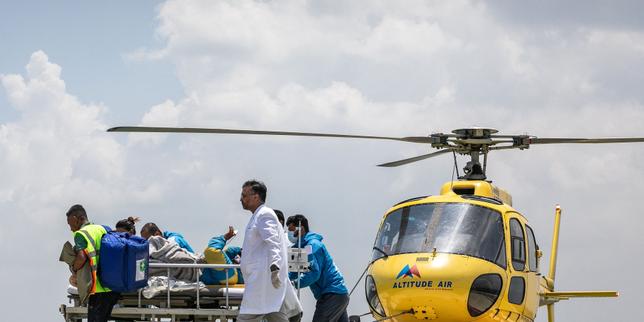
The international media loves a miracle. When a Nepalese guide defies a six-day disappearance in the death zone of Mount Everest and walks down alive, the global press triggers a predictable wave of emotional copy. They call it a triumph of the human spirit. They spin tales of inexplicable survival. They paint the Himalayas as a backdrop for divine intervention and heroic endurance.
It is a comforting narrative. It is also completely wrong, dangerous, and deeply disrespectful to the actual mechanics of high-altitude physiology and mountain logistics. Learn more on a similar subject: this related article.
Miracles do not happen at 8,000 meters. What happens is a brutal, calculated intersection of atmospheric pressure, metabolic luck, and the unacknowledged labor of rescue teams. By framing survival as an emotional victory rather than a systemic anomaly, the adventure travel industry hides a darker reality about modern mountaineering. We are not witnessing triumphs. We are witnessing statistical outliers in a broken system that trades human lives for bucket-list validation.
The Myth of the Six-Day Miracle
Let us dissect the physics of the human body above the tree line. The mainstream narrative suggests that sheer willpower can sustain a human being trapped in extreme altitude for nearly a week. This ignores basic human biology. Further reporting by National Geographic Travel highlights related views on this issue.
At the summit ridge of Everest, the effective oxygen level is roughly one-third of what it is at sea level. The human brain begins to deteriorate within hours without supplemental oxygen. Hypoxia induces severe cognitive decline, hallucinations, and a profound lack of motor control. Then comes High Altitude Cerebral Edema (HACE) and High Altitude Pulmonary Edema (HAPE). Your lungs fill with fluid; your brain swells against your skull.
When someone survives six days in these conditions, it is not because they "wanted it more" than the thousands who died in identical spots.
Survival in these extreme scenarios comes down to three deeply unromantic variables:
- Microclimates and Wind Shielding: The luck of collapsing into a crevasse or a rock depression that creates a temporary windbreak, dropping the ambient windchill by crucial degrees.
- Metabolic Depressed States: A rare physiological response where severe hypothermia slows the metabolic demand for oxygen, accidentally protecting vital organs from total failure—a phenomenon well-documented by high-altitude medical researchers but impossible to predict or replicate.
- The Unsung Rescue Grid: The reality that "found alive" usually means a localized team of Sherpas tracked, risked their own lives, and physically dragged a comatose body down to an altitude where a helicopter could risk a high-density altitude hover.
To call this a miracle is to absolve the commercial climbing industry of its structural failures. It turns a systemic near-miss into a marketing brochure for human resilience.
The Perverse Incentives of Commercialized Guiding
The narrative of the heroic, independent guide surviving against all odds masks a highly transactional, hyper-commercialized ecosystem. The real story on Everest is not the survival of one man; it is the commodification of the mountain that puts hundreds of under-prepared people there in the first place.
I have spent decades watching western clients shell out $50,000 to $110,000 to be escorted up a fixed line. They buy the illusion of adventure, but what they actually purchase is the exploitation of local labor. The guides and support staff bear 90% of the objective hazard. They carry the tents, the oxygen bottles, the food, and the ropes. They pass through the Khumbu Icefall dozens of times per season while the client does it twice.
When a guide goes missing, it is frequently the result of pushing beyond reasonable safety margins to secure a client's summit success. The client's success is the guide's bonus and future livelihood. The industry forces a choice between immediate economic survival and long-term physical survival.
The Breakdown of the Safety Margin
In traditional alpine climbing, a safety margin is a sacred calculation. You assess the weather, your physical reserves, your equipment, and the time of day. If any variable blinks red, you turn around.
Commercialization has rewritten that equation. The presence of massive infrastructure—kilometers of fixed ropes, hundreds of oxygen bottles cached at high camps, and a small army of rescue-ready climbers—gives clients a false sense of security. They believe the environment has been tampered with enough to make it safe.
It has not. The environment remains completely indifferent to human technology. When overcrowding causes a bottleneck at the Hillary Step, or an unexpected storm seals the South Col, that infrastructure fails instantly. The survival of a missing guide is an exception that proves the rule: the system operates on the absolute razor edge of disaster every single day of the climbing season.
Dismantling the False Premise of Everest Tourism
The public constantly asks the wrong questions about mountain rescues. Go to any forum or comment section and you will see variations of the same query: How can we improve rescue technology to ensure no one is left behind on Everest?
This question assumes that Everest should be accessible to anyone who can afford it, provided we have a good enough safety net. It is a flawed premise built on a foundation of entitlement.
The honest, brutal answer is that we should not be trying to make the death zone safe. The very concept is a contradiction in terms. The moment you attempt to build a foolproof rescue system at 8,000 meters, you encourage even more reckless behavior. It is the classic economic principle of moral hazard: when you insulate individuals from the consequences of risk, they take bigger risks.
Imagine a scenario where heavy-lift helicopters could reliably pick up distressed climbers from the very summit of Everest. The immediate result would not be fewer deaths; it would be a massive influx of even less-qualified climbers pushing themselves to total collapse, confident that a flying ambulance is just a radio call away.
The Real Cost of Survival
Every rescue mission above Camp 2 is a calculated gamble with human lives. To save one person who made a bad call or suffered a streak of bad luck, three to four other people must enter the identical danger zone under extreme duress. They must carry a heavy, unresponsive human body through technical terrain, in the dark, while their own oxygen supplies dwindle.
We need to stop celebrating these survival stories without looking at the cost sheet. Who paid for the rescue? Who risked their fingers and toes to frostbite to get that person down? Who was pushed further down the priority list because resources were diverted to a high-profile rescue?
True sustainability in adventure travel requires admitting a harsh truth: some places are meant to be dangerous. If you step onto the upper slopes of an 8,000-meter peak, you must accept that your survival is entirely your own responsibility. If you cannot accept the reality of being left behind, you have no business being on the mountain.
Moving Beyond the Romantic Narrative
The contrarian approach to high-altitude tourism requires a complete rejection of the romantic, nationalistic rhetoric that surrounds Everest. We must stop treating the mountain as a stage for human drama and start viewing it as a high-risk industrial workplace.
If we want to prevent the situations that lead to people going missing for six days, the solutions are organizational and regulatory, not emotional:
- Strict Experience Caps: Government agencies must require a verified resume of technical, high-altitude peaks before granting an Everest permit. Climbing a commercialized peak like Manaslu with maximum support should not count as valid preparation.
- Liability and Insurance Overhauls: Force commercial operators to hold massive, realistic bonds that cover the true cost of high-altitude extraction and provide multi-generational financial security for the families of local guides who are injured or killed.
- Mandatory Tracking Technologies: If you step above Base Camp, you should be legally required to carry independent, active GPS telemetry that cannot be turned off to save battery. The era of "disappearing" on a highly monitored trade route is an administrative failure, not an epic mystery.
This approach will undoubtedly reduce the number of permits issued. It will shrink the profits of guiding agencies. It will ruin the dreams of wealthy hobbyists who want a quick shortcut to global prestige.
Good. The mountain does not care about your dreams. It cares about atmospheric pressure, gravity, and the rate at which your tissue freezes.
Stop reading the survival stories as inspirational parables. They are warnings. Every single person who walks out of the death zone after six days is a statistical anomaly that the mountain allowed to slip by through sheer, random variance. The next person will not be so lucky, and the industry that cheered for the miracle will be entirely responsible for the funeral that follows.