Archaeologists love counting things that survived four ice ages. Give them a few hundred Clovis and Cumberland spear points, and they will spend a decade measuring micro-fractures, edge angles, and resharpening sequences to tell you how ancient hunter-gatherers managed their toolkits. The latest academic consensus loves to point out that Clovis hunters resharpened their gear much more aggressively than Cumberland toolmakers, treating it as a profound behavioral divergence in resource management and mobility.
It is a neat story. It is also completely backwards.
When you look at stone tools through the sterile lens of typological classification, you miss the brutal, messy reality of Pleistocene survival. The lazy consensus assumes that high resharpening rates mean thriftiness, scarcity management, or superior planning depth. Let us dismantle that myth right now. Heavy resharpening is not a badge of clever adaptation. It is often a sign of logistic failure, logistical bottlenecks, and a desperate tether to dwindling quarries.
The Flawed Logic of the Flint Knapper
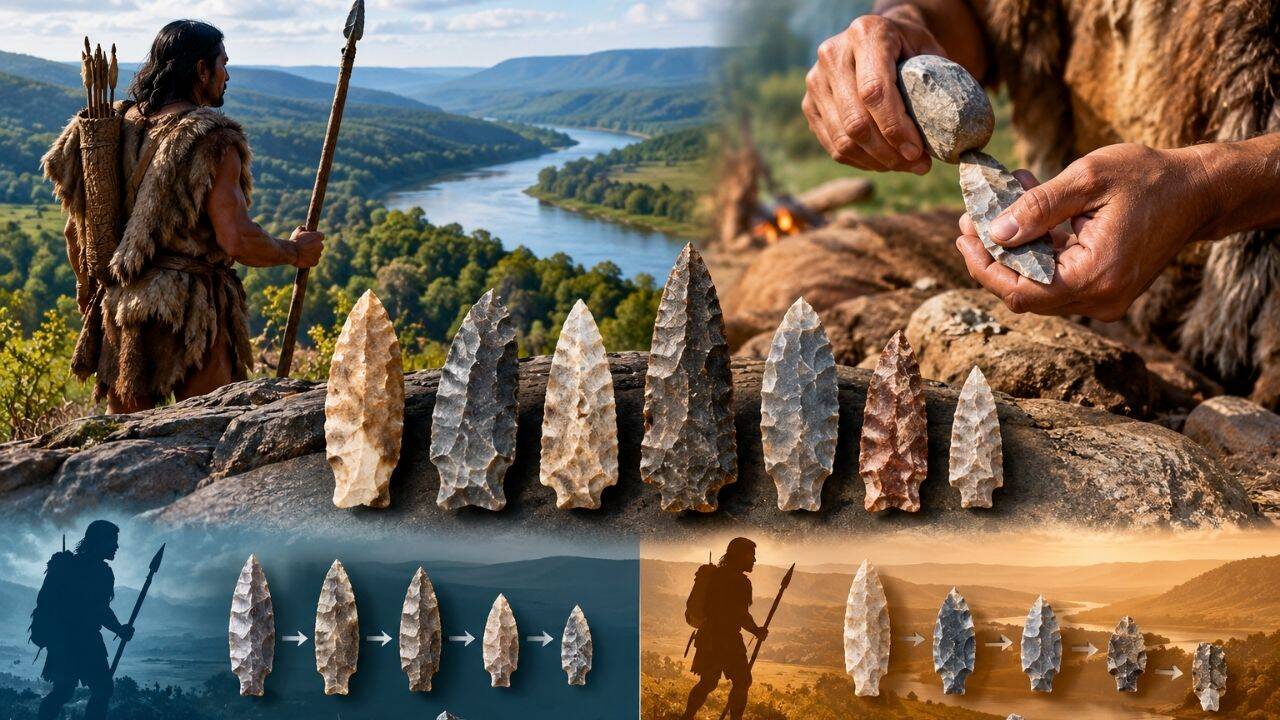
Let us look at the mechanics. A Clovis point is iconic. It features that sweeping, fluted channel designed to seat securely into a heavy haft. When a hunter breaks the tip or dulls the edge on a mammoth hide or a stubborn bone, the stone gets worked down. It becomes shorter, narrower, and morphs from a majestic projectile tip into a utility knife.
The traditional narrative frames this as tactical genius. The argument goes that Clovis groups traveled massive distances across North America, so they conserved high-grade lithic material by wringing every millimeter of utility out of a single piece of chert.
Now look at Cumberland points. They are narrower, deeply fluted, hyper-specialized lanceolate forms often found in the American Southeast. Researchers point out that Cumberland points show different wear patterns and lower volumetric reduction through resharpening compared to their Clovis predecessors. The academic conclusion? Cumberland makers were less efficient, or perhaps they enjoyed a more abundant landscape where raw material was cheap enough to discard rather than retool.
Both assumptions are built on sand.
Material Reality Versus Typological Fantasy
I have spent enough time digging through lithic scatters and talking to experimental knappers to know one fundamental truth: nobody resharpened a spear point because they enjoyed sitting by a campfire grinding chert with an antler tine. They did it because they were out of options.
High resharpening frequencies do not prove that a group was forward-thinking. They prove that the group was trapped between an immediate hunting need and a deficient supply chain. If you are recycling a broken point down to a stubby nub instead of dropping it for a fresh one, your access to high-grade cryptocrystalline silicates is compromised. You are economizing because you have to, not because you chose to.
Conversely, lower resharpening rates in Cumberland assemblages do not automatically signal wasteful luxury. They often point to localized settlement stabilization, predictable quarry access, or distinct functional deployments where the projectile was engineered for a single, high-velocity terminal impact rather than multi-use maintenance.
We are trying to map modern corporate lean-management philosophies onto mobile Pleistocene foragers. We see high utilization rates and call it efficiency. The Pleistocene hunter saw a failing supply line and cursed the stone.
The Cost of Our Own Blind Spots
The real danger in this research is the Teleological Trap. We look at the archaeological record as a progressive script where ancient humans optimize every behavior to perfection. We forget that evolution and human history are messy, improvisational, and often desperate.
When researchers obsess over whether Clovis or Cumberland groups squeezed five extra percent of life out of a biface, they distract themselves from the ecological pressures that actually drove technological change. Climate volatility during the Younger Dryas was not a spreadsheet problem. It was a chaotic, ecosystem-collapsing nightmare where herds vanished, forests shifted overnight, and human bands fractured into smaller, isolated pockets.
If a group was resharpening their points into oblivion, look at their landscape. Look at the distance to the nearest high-grade chert source. Look at the mobility constraints imposed by shifting wetlands and encroaching boreal forests. The stone tells a story of constraints, not choices.
Stop Counting Scars and Start Reading the Stress
If we want to understand how Ice Age hunters survived, we need to stop treating lithic artifacts like accounting ledgers. A resharpened point is a scar tissue of the Pleistocene economy. It tells you where a group ran out of time, where they ran out of material, and where their logistics broke down under pressure.
Next time you read a study celebrating the micro-economics of Paleoindian tool maintenance, ask yourself what the hunters wished they had instead of that grinding stone. They did not want to conserve their gear. They wanted a fresh piece of stone and a clear horizon. They settled for what was left. So should our theories.