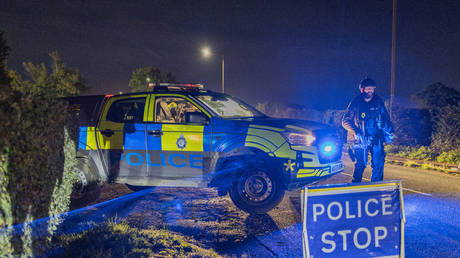
Another week brings another sensational headline about a suspicious incident at a British military installation, instantly met with predictable outrage from Tehran and frantic threat inflation in Western newsrooms. The lazy consensus feeds you a clean narrative. A shadowy terror plot, foreign operatives probing critical defense infrastructure, and a regime screaming unfair persecution while pulling strings behind the scenes.
It is a comforting script. It gives intelligence agencies a clear villain, politicians a convenient distraction, and media outlets an endless loop of panic porn.
It is also largely nonsense.
When a mysterious security breach hits an airbase, the automatic default is to weaponize the ambiguity. We are told to tremble at the sophistication of hostile state actors. We are lectured about the urgent necessity of expanding surveillance powers and boosting defense spending. Nobody stops to examine the mechanics of the event itself, the astonishing frequency of perimeter alarms at major military sites, or the deep institutional incentives that turn mundane security anomalies into international crises.
Let us strip away the theater and look at what is actually happening.
The Manufacturing of Immediate Panic
Every single time a perimeter sensor trips or an unauthorized drone drifts too close to a sensitive fence line, a well-oiled machine swings into motion. Security officials brief select journalists on background, dropping tantalizing hints of state-sponsored espionage. The phrase state-backed actor gets tossed around like confetti.
Within hours, the incident is divorced from reality and elevated to the status of an existential threat.
I have spent years watching defense bureaucracies operate. When you run a multi-billion-dollar military installation, perimeter anomalies happen with numbing regularity. Local trespassers, confused teenagers, mentally unstable individuals, wildlife, and amateur drone hobbyists constantly test the edges of military zones. The vast majority of these events are mundane, chaotic, and entirely devoid of grand geopolitical design.
Yet, when a particular geopolitical tension is running hot, every stray pigeon near a runway becomes an Iranian intelligence asset.
The media loves it because fear sells clicks. Defense contractors love it because budget allocations depend on perceived peril. Intelligence agencies love it because a vague, spooky threat justifies expanded mandates with zero accountability.
When Tehran issues its predictable denunciation of Iranophobia, it plays its assigned role in the kabuki play. Iranian state media frames every legitimate security concern or overblown media report as malicious bigotry designed to demonize the nation. They use the rhetoric of victimhood to deflect from actual destabilizing activities across the region, turning a localized security headache into a grand ideological crusade.
Both sides benefit from the escalation. Both sides rely on the cartoonish simplification of a complex geopolitical landscape.
Dissecting the Airbase Incident Anatomy
Let us examine what actually occurs during one of these mysterious airbase events.
A fence alarm sounds at a facility shared by Allied forces. Security patrols sweep the perimeter. They find footprints, perhaps a discarded piece of equipment, or a drone camera feed captured on a low-end consumer device. Immediately, the threat assessment jumps from local trespass to transnational terror plot.
Why? Because caution dictates worst-case assumptions. In the immediate aftermath of a security breach, no commander wants to risk under-reacting. They brief superiors using cautious, speculative language. Those speculative notes leak to reporters who strip away the caveats.
By the time the story hits the morning papers, speculation has hardened into certified fact.
The public is fed a narrative of high-stakes espionage. We hear about probing attacks designed to test reaction times. We hear about sleeper cells activating in the heart of Europe.
Where is the hard evidence? More often than not, the trail goes cold within forty-eight hours. The suspect turns out to be a local thrill-seeker looking for drone footage for social media, or an erratic vagrant who wandered through a gap in the chain link. But by the time the mundane truth emerges, the news cycle has already moved on. The initial panic has already done its work. The budget is secured. The narrative is locked in.
This is not intelligence analysis. This is public relations management disguised as national security.
The Economics of Permanent Threat Inflation
You cannot understand modern defense politics without understanding the balance sheet.
Peace does not pay well in Washington, London, or Tehran. A quiet geopolitical climate leads to budget cuts, staff reductions, and a loss of institutional urgency. When threat levels drop, agencies struggle to justify their massive overheads.
Therefore, maintaining a steady baseline of ambient anxiety is an operational necessity.
When an incident occurs near a British airbase, the institutional reflex is to maximize its value. Every detail is framed through the lens of maximum danger. If an Iranian official protests against this framing by shouting about Western prejudice, it provides convenient proof to Western hawks that the regime is defensive, aggressive, and hiding something sinister.
It is a closed loop of mutual validation.
Think about the sheer absurdity of the mechanics. We are asked to believe that a major regional power conducts its most sensitive sabotage operations through amateurish perimeter probes that trigger local base alarms within minutes. That is not espionage. That is amateur hour. Real state-backed sabotage relies on cyber intrusions, deep financial networks, and untraceable supply chain vulnerabilities. It does not look like someone rattling a chain-link fence at three in the morning.
Yet, we fixate on the fence rattler because it is tangible, theatrical, and easy to televise.
The Weaponization of Cultural Grievance
On the other side of the equation, the concept of Iranophobia gets deployed with surgical precision to shut down legitimate scrutiny.
Whenever international watchdogs or Western governments point out the malign activities of the Islamic Revolutionary Guard Corps, state mouthpieces immediately cry foul, labeling any criticism as irrational bigotry against Iranian culture and people.
This is a dangerous rhetorical trick. It conflates the actions of a brutal, authoritarian government with the identity of an entire civilization.
True Iranophobia—prejudice against ordinary Iranian people—is a real and deplorable phenomenon. Millions of Iranians inside and outside the country suffer under the regime's repression while also facing unfair discrimination abroad. But the regime in Tehran weaponizes that very real prejudice as a shield to deflect from its own aggressive foreign policy.
When a mysterious security incident happens near a Western military base, and officials investigate potential state links, screaming bigotry is a defensive reflex. It is designed to silence foreign investigators and rally domestic hardliners. It tells the local population that the outside world is inherently hostile, justifying internal crackdowns and economic sacrifices.
We must hold two truths simultaneously without collapsing them into mush. First, the Iranian people deserve respect, autonomy, and freedom from xenophobia. Second, the ruling elite in Tehran engage in aggressive regional proxy warfare, cyberattacks, and covert operations that merit rigorous, hard-headed security scrutiny.
Conflating the two is either lazy thinking or deliberate propaganda.
The Real Vulnerabilities We Ignore
While cable news anchors hyperventilate over mysterious drones and fence-jumpers, real security vulnerabilities go completely unnoticed.
The true threats to critical defense infrastructure do not march up to the front gate wearing tactical gear or fly consumer quadcopters over runways. They operate in the shadows of software supply chains, in the unmonitored maintenance contracts outsourced to third-party vendors, and in the sprawling, porous network of digital connectivity that underpins modern military logistics.
A hostile intelligence service does not need to send an operative to rattle a fence at an airbase to gather intelligence. They buy commercial satellite data, hack poorly secured contractor databases, or exploit zero-day vulnerabilities in administrative networks from thousands of miles away.
Focusing public attention on theatrical perimeter incidents serves as a brilliant smoke screen. It reassures the public that the threat is physical, visible, and being actively managed by men in uniforms with rifles. It distracts from the quiet, unglamorous failure of digital defense and cyber hygiene.
When governments hype up physical security breaches while underfunding systemic cyber resilience, they are fighting the last war. They are playing to the cameras while leaving the back door wide open.
Breaking the Cycle of Manufactured Crisis
How do we break out of this stupid loop?
It requires a radical shift in how we process security news. The next time a breathless bulletin flashes across your screen about a mysterious drone sighting or an alleged terror plot near a sensitive installation, withhold your judgment. Ask yourself who benefits from the leak. Look for the actual evidence behind the sensational adjectives.
Demand substance from journalists who treat every anonymous intelligence leak as gospel truth. Demand accountability from politicians who use perimeter anomalies to justify sweeping emergency powers or bloated defense appropriations.
And on the international stage, we must stop falling for the trap of theatrical outrage. When Tehran screams persecution over routine security investigations, call the bluff without escalating into hysterical xenophobia. Treat state actors like the cold, calculating strategists they are, rather than caricatures in a melodrama.
The world is dangerous enough without us inventing extra monsters to populate the shadows. Security should be about protecting citizens through rigorous competence, not manipulating public fear to serve institutional budgets.
Until we demand sobriety from our media and honesty from our security apparatus, we will remain trapped in this endless cycle of phantom threats and performative outrage.
Next time the fence rattles, look past the flashing lights. That is just the theater playing its opening act.