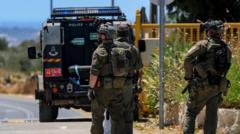
The media apparatus has a default script for whenever blood is spilled in the narrow corridor between Netanya and the West Bank. They inventory the dead, catalog the wounded, and project a predictable anxiety about external infiltration. When a gunman opened fire across Kochav Ya'ir, Tzur Yitzhak, and Tzur Natan, killing a 35-year-old man and leaving five others injured, mainstream outlets instantly reflexively looked east toward the security barrier. They assumed the threat had breached the concrete wall.
They were wrong. The systemic failure documented by this tragedy isn't about an incomplete wall or a lax checkpoint. The shooter, Omar Yassin, did not slip through a hidden gap in the fence from Qalqilya or Tulkarm. He was an Israeli citizen driving a car with Israeli license plates, hailing from Tayibe—a town located squarely inside the sovereign borders of the state.
This distinction invalidates the entire premise of the modern border defense strategy. For decades, the political establishment has sold the public a grand illusion: that security is an engineering problem solved by pouring concrete, installing motion sensors, and deploying biometric cameras along an arbitrary demographic divide. But when the threat holds a blue identity card, speaks fluent Hebrew, and operates out of a municipality mere minutes from Tel Aviv, the entire concept of a hard border collapses.
The defense apparatus cannot build a wall down the middle of a shared highway.
The Myth of the Hard Border
Consider the sheer mechanics of the attack. The gunman managed to execute a multi-site shooting spree from inside a moving vehicle, striking targets at a gas station and community entrances across several towns within minutes before being neutralized. Security officials immediately flooded the zone with soldiers, cordoned off West Bank crossings, and placed surrounding Palestinian villages under lockdown.
This reaction is standard tactical theatre. It satisfies a political urge to look decisive, but it misdiagnoses the vector of the threat. Sealing off a crossing into the West Bank does absolutely nothing to neutralize an adversary who begins their journey inside the domestic perimeter.
I have watched defense ministries spend billions on border infrastructure only to discover that concrete is entirely porous to ideology and internal friction. The security establishment suffers from an acute case of strategic myopia, treating internal asymmetric threats as if they were conventional armies waiting at the gate.
To understand the systemic breakdown, we must look at the specific weapon used: a "Carlo" submachine gun. This is not a military-grade firearm smuggled across an international border or stolen from an army base. It is a crude, improvised weapon fabricated in clandestine workshops out of water pipes, scrap metal, and modified machinery parts. It is cheap to produce, impossible to track via conventional supply-chain intelligence, and highly volatile.
The reliance on these crude tools reveals a brutal reality. The state can monitor high-tech supply chains and track sophisticated ordnance, but it cannot regulate basic industrial tools or the human intent to weaponize them. The presence of a home-brewed submachine gun inside an Israeli Arab city proves that the internal arms market operates entirely independent of the defensive barriers erected to keep the outside world at bay.
The False Security of Local Armed Response
In the immediate aftermath of the shooting, regional council leaders and local politicians predictably demanded more defense funding, more local security guards, and fewer restrictions on civilian firearms. The rhetoric from public security officials always follows the same playbook: arm the populace, turn every citizen into a first responder, and celebrate the quick elimination of the threat as a triumph of systemic readiness.
This framework is flawed. While a local security chief at the nearby West Bank settlement of Sal'it did trade fire with the gunman and force him to flee, the broader truth is that civilian armaments are a bandage on a severed artery.
Relying on armed civilians or localized security details to halt an active shooter in a vehicle shifting rapidly between towns is a tactical crapshoot. It shifts the burden of national defense onto gas station attendants, municipal guards, and bypassers. It assumes that more guns in public spaces will neatly cancel out the chaos of an asymmetric attack, ignoring the immense risk of crossfire, misidentification, and the normalization of low-level urban warfare.
When security policy reduces itself to hoping a bystander is quick on the draw at a McDonald's or a gas station, the state has already abdicated its foundational duty. The celebration of a quick neutralisation obscures the reality that the attack happened in the first place, completely unhindered by the most sophisticated intelligence apparatus on earth.
The Failure of the Domestic Integration Model
The uncomfortable truth that politicians avoid addressing is that the current domestic security framework is entirely unequipped to handle threats originating from within its own citizen population. The knee-breaker raids on family homes in Tayibe after the fact do not reflect a proactive strategy; they are a sign of institutional blindness.
When the Shin Bet and the police are forced to launch retroactive dragnets inside Arab-Israeli towns to figure out how a local resident acquired a weapon and an accomplice, it demonstrates a complete lack of granular visibility where it matters most.
The status quo relies on a fragile double-game:
- Maintain total military dominance over the external territories.
- Assume the internal Arab sector can be managed through economic incentives and surface-level policing.
This attack shatters that logic. You cannot isolate communities geographically while leaving them totally integrated logistically, economically, and legally, and then expect a hard wall to protect you from the resulting friction.
The shooter utilized the exact same infrastructure that powers the modern state—the highways, the commercial gas stations, the freedom of movement granted by domestic license plates—to turn an entire region into a kill zone. The system provided the very mobility that allowed him to outrun the initial police response.
The Dead End of Strategic Paralysis
The predictable response to this breakdown will be more of the same failed medicine. Expect to see calls for increased surveillance inside Israeli Arab municipalities, harsher checkpoints along domestic routes, and a further expansion of civilian gun permits.
These measures will fail. They fail because they operate on the assumption that an asymmetric internal threat can be suppressed by adding more friction to daily life. Every extra layer of internal surveillance and domestic policing only deepens the alienation, accelerates the radicalization cycle, and ensures that the next attacker will simply find a more creative way to exploit the blind spots of the security apparatus.
The hard reality is that the security state has reached its structural limit. Concrete walls cannot protect a society from internal fragmentation. High-tech sensors cannot read the intent of a driver holding a blue ID card. Until the state recognizes that domestic security cannot be engineered through segregation and tactical armor alone, the towns along the Green Line will remain permanently vulnerable to the cheap, low-tech, and completely unpredictable violence of the lone gunman.
The concrete wall didn't fail. The entire philosophy behind it did.