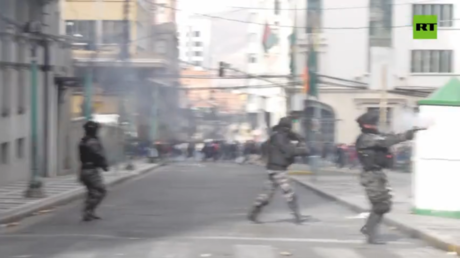
The international press is recycling the same tired footage. Thousands of workers marching through the thin air of La Paz. Miners detonating small sticks of dynamite outside the presidential palace. Truckers abandoning their rigs to block dozens of major highways, bleeding $50 million a day from a gasping economy.
The mainstream media framing is predictable: a classic, tragic "cost-of-living crisis" brought to a boiling point by a right-wing outsider, President Rodrigo Paz, who took office in late 2025 and immediately set fire to national subsidies.
It is a neat, emotionally manipulative narrative. It is also completely wrong.
What is happening on the streets of Bolivia right now is not a spontaneous eruption of regular citizens starved by inflation. It is the violent death rattle of a massive, twenty-year economic illusion. The current administration did not create this structural collapse; they simply turned on the lights and revealed that the house had already burned down. The media wants you to look at the fire in the streets, but the real explosion happened years ago in the balance sheets of the central bank.
The Myth of the Populist Subsidy
For nearly two decades under the Movement Toward Socialism (MAS), first commanded by Evo Morales and later by his technocratic economy minister turned president, Luis Arce, Bolivia was celebrated as a "socialist miracle." The formula was deceptively simple: nationalize natural gas, ride the global commodity boom, and use the cash to aggressively subsidize domestic life.
The state fixed the exchange rate of the boliviano to the U.S. dollar at a rigid 6.96. It paid the difference on every single gallon of gasoline and diesel imported into the country. To the casual observer, inflation looked miraculously low.
But I have watched states attempt this exact parlor trick from Sub-Saharan Africa to Eastern Europe, and the math always wins. A price control is not an economic policy; it is an unhedged short position against reality.
Bolivia did not eliminate inflation. It merely put it on the government's credit card.
Bolivian Natural Gas Model:
[High Global Gas Prices] -> [Massive State Revenues] -> [Cheap Subsidized Fuel & Fixed Currency] -> [Artificial Stability]
When the natural gas fields began drying up due to a total lack of foreign investment and systemic mismanagement, the state revenues evaporated. Yet, the subsidies remained. The country transitioned from a net energy exporter to an economy importing roughly 86 percent of its diesel and 54 percent of its gasoline.
To maintain the illusion of a cheap cost of living, the state began burning through its foreign exchange reserves. Hard currency cash reserves plummeted from a peak of over $15 billion down to a microscopic $47 million.
When you run out of dollars, you cannot import fuel. When you cannot import fuel, the gas stations run empty. It does not matter if a gallon of gasoline is legally mandated to cost pennies if there is literally no gasoline at the pump.
The Parallel Market Always Wins
The international press coverage loves to highlight the outrage over President Paz’s attempts to lift fuel subsidies via supreme decrees or his recent, aborted attempt to reform land mortgage laws. They frame the protests as a defense of the working class against austerity.
This ignores the fundamental law of monetary economics: you cannot decree the value of money.
While the official statistics claimed Bolivia had the lowest inflation in South America, a brutal parallel black market emerged. On the street, the boliviano did not trade at 6.96 to the dollar; it collapsed by over 40 percent. The monthly minimum wage of 2,500 bolivianos, nominally worth roughly $360, collapsed in real purchasing power to less than $200.
The Real Purchasing Power Collapse:
Official Rate: 2,500 Bolivianos = ~$360 USD
Parallel Rate: 2,500 Bolivianos = ~$180 USD (A 50% hidden tax on the poor)
The "cost-of-living crisis" was not triggered by the current government trying to balance the budget. The crisis was already fully realized because the artificial economy forced every vendor, importer, and farmer to price their goods against the black-market dollar, while wages remained pinned to a fictional state standard.
The current protests, spearheaded by the Bolivian Workers' Center (COB) and traditional mining sectors, are demanding a 20 percent wage increase and a return to total subsidies. They are demanding that the state continue buying global fuel at market rates—driven sky-high by international shocks like the Iran war and the disruption of the Strait of Hormuz—and selling it to them for a fraction of the cost.
It is a mathematical impossibility. The money is gone.
The Real Cost of "Street Vetoes"
There is a dangerous, romantic notion in political commentary that regards Latin American street blockades as pure, democratic expression. Commentators point to the fact that 24 days of protests in early 2026 forced the repeal of fuel subsidy cuts as a victory for "popular mandates."
Let's look at the actual data. The strategy of using 67 simultaneous highway blockades to choke off domestic trade does not hurt the elite. It systematically destroys the rural poor.
When 5,000 trucks are left stranded on high-altitude roads, agricultural inputs rot. Perishable food supplies cannot reach the urban centers. The immediate result is a hyper-localized spike in food costs far worse than any gradual subsidy removal.
Furthermore, the blockades have directly stopped ambulances, resulting in verifiable civilian deaths. This is not political expression; it is economic sabotage used as leverage by entrenched labor monopolies to protect sector-specific privileges at the expense of national solvency.
Imagine a scenario where a private corporation paralyzed a country’s entire logistics network, caused tens of millions of dollars in daily losses, and blocked medical vehicles to force a tax break. The international community would label it criminal extortion. When a union bureaucracy does it under the banner of anti-neoliberalism, the media calls it a "populist struggle."
The Lithium Delusion
The standard counter-argument from defenders of the old regime is that Bolivia sits on the world's largest lithium reserves, and that this vast mineral wealth will eventually bail out the state's finances.
This is the ultimate tech-utopian delusion. Having lithium in the ground is completely meaningless if you lack the institutional stability, rule of law, and capital to extract it.
I have spent years analyzing resource extraction in emerging markets. Capital is cowardly. It does not fly into a country where the state can be held hostage over a weekend by a few dozen dynamite-wielding miners or where land tenure laws are volatile. The previous administration's attempt to build a state-run lithium industry from scratch failed completely because they substituted ideology for industrial expertise.
The current unrest guarantees that Bolivia’s lithium will remain buried under the salt flats for another generation. No sane international consortium is going to deploy billions of dollars in fixed infrastructure when the national highway system can be paralyzed at a moment's notice by factional political warfare between old guard MAS loyalists and the current executive branch.
Dismantling the Premise
The public discourse surrounding Bolivia is asking all the wrong questions. The internet is flooded with queries asking: "How can the Bolivian government lower the cost of living?" or "Can Bolivia restore its fuel subsidies to bring peace?"
The brutal, honest answer is that the subsidies cannot be restored because the state is effectively bankrupt. The credit rating sits at the bottom of the junk pile at CCC-. There is no line of credit left to fund the fiction.
Any attempt to force a return to the old economic model via street violence will not bring back cheap gasoline. It will simply accelerate a full sovereign default, leading to hyperinflation that will make the current price increases look like a minor market correction.
The uncomfortable truth that nobody wants to admit is that the only way out of a structural crisis caused by decades of artificial pricing is to endure the immediate, agonizing pain of market correction. Wages must adjust, the currency must float freely to eliminate the destructive black market, and fuel must be sold at what it actually costs to import.
The rioting in La Paz isn't a protest against a failed economic policy. It is the withdrawal symptoms of a society addicted to a subsidized reality that the nation can no longer afford to buy.