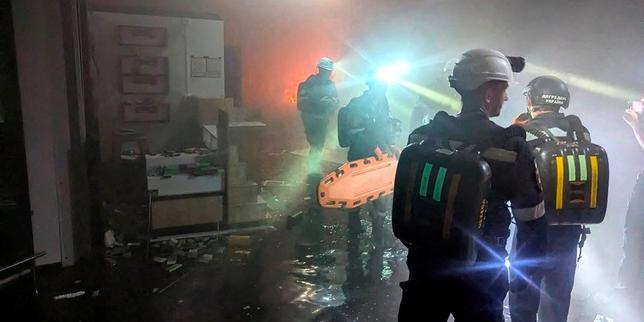
The headlines scream about the latest carnage in Kryvyi Rih. A shopping center hit. Dozens of civilians dead, including children. The mainstream press feeds you the same exhausted script: righteous outrage, counts of the fallen, and an existential cry for more Western interceptors to plug an unpluggable leak.
Stop reading the lazy consensus.
Everyone is asking how many more Patriot batteries or jet interceptors Kyiv needs to lock down its airspace. That is the wrong question entirely. It misses the brutal economic and mathematical reality of modern attritional warfare.
I have watched defense analysts blow billions of dollars trying to solve a geometry problem with brute-force hardware. Let's look past the emotion and dissect the cold calculus.
The Attrition Trap
The fundamental error in standard commentary is treating air defense as a defensive shield rather than an accounting ledger.
When a swarm of jet-powered Shahed drones or cruise missiles targets a municipal center, they are not just delivering ordnance. They are executing an economic ambush. A standard interceptor missile costs millions of dollars. A mass-produced long-range loitering munition costs a fraction of a percent of that interceptor.
You cannot shoot your way out of an arithmetic deficit.
Imagine a scenario where a defending nation attempts to achieve absolute airspace purity over every urban hub. The interceptors run dry long before the assembly lines in the opposing state stutter. When a double-tap strike hits a civilian nexus like a shopping hub, the tragedy is compounded by a systemic realization: high-end tactical air defense cannot be deployed on every street corner. There are simply not enough high-value platforms on Earth to protect static, civilian footprints against a saturated, low-cost vector.
The Architecture of Failure
Military theorists love to talk about integrated air defense networks as if they are impenetrable domes. They are not. They are Swiss cheese with expensive holes.
When regional governors report scores wounded and emergency responders caught in secondary blasts, the structural failure goes deeper than a lack of hardware. It exposes the fallacy of centralized civilian protection in a total-war environment.
Let us define terms. Strategic air defense was designed to protect high-value command nodes, nuclear deterrents, and critical military production lines. It was never engineered to defend a retail mall or a municipal square from low-altitude, variable-trajectory cruise vectors. When capitals and industrial centers rely on shrinking stockpiles of elite interceptors, every missile fired at a drone is a catastrophic misallocation of scarce resources away from true national survival assets.
The Unspoken Trade-Offs
Nobody in the mainstream media wants to admit the downside of the current defensive posture. By demanding that every population center be shielded like a presidential bunker, leadership creates a false sense of security that paralyzes localized evacuation and dispersion protocols.
Civilians continue routine commerce in the shadow of active frontlines because they trust in the abstract promise of an air defense umbrella. That umbrella is leaking.
The harsh truth is that static infrastructure inside range of modern precision strike packages is living on borrowed time. Relying purely on reactive interception is a strategy of slow attrition. The shift must move from catching missiles in flight to dismantling the supply chains, telemetry networks, and launch logistics hundreds of miles away.
Stop treating every aerial atrocity as a surprise requiring a moral plea. It is a mathematical inevitability of a war fought with asymmetric tools. Until defense policy shifts from reactive shielding to proactive industrial dismantling, the ledger will keep balancing itself in blood.