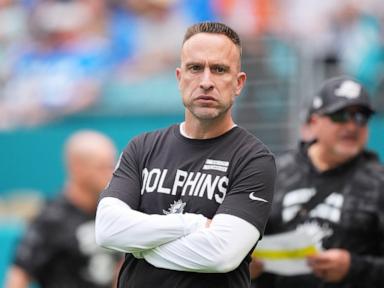
Silence in a losing locker room has a specific weight. It smells like wet tape, stale sweat, and copper. You hear the rhythmic hiss of a hydrotherapy tub in the corner and the sharp, violent click of shoulder pads hitting concrete floors. Nobody looks at the ceiling. Nobody checks their phone.
For the Miami Dolphins, that silence has become a familiar roommate. For a deeper dive into this area, we suggest: this related article.
Another Sunday afternoon ends with a one-score deficit. Another press conference begins with a familiar script. A twenty-two-year-old cornerback stares into a cluster of microphones, his jaw tight, talking about learning curves and growing pains. A second-year linebacker speaks softly about execution in the fourth quarter. For months, even years, the franchise wrapped itself in the protective bubble of its own roster age. They were building. They were learning. They were young.
Then came the moment when the excuse stopped working. Not because the birth certificates changed, and not because the roster suddenly sprouted gray hair, but because the men inside those jerseys finally realized that "young" is just a polite synonym for "unfinished." For further background on this development, extensive reporting can be read on Bleacher Report.
The Invisible Clock in the NFL
In professional football, potential is a currency with a brutal inflation rate.
When a team drafts high and stocks its depth chart with rookie contracts, the front office buys time. Fans forgive blown coverages in October if the perpetrator was playing in the Big Ten ten months earlier. Analysts excuse red-zone stalls when the offensive line averages fewer than twenty-five starts per man. Youth acts as an anesthetic. It numbs the pain of losing by promising that the loss is actually an investment.
Think of a hypothetical young quarterback—let us call him Marcus—standing on his own thirty-yard line with ninety seconds left and no timeouts. The stadium is a wall of noise. His left tackle has been beaten on three straight snaps. In year one, when Marcus forces a throw into double coverage and watches a safety take it the other way, the narrative is gentle. He will learn from that. In year two, when the exact same coverage fools him in the exact same way, the tone shifts. By year three, the word "potential" begins to sound like an accusation.
That is the psychological precipice the Miami Dolphins now occupy.
Across the league, average NFL careers hover around three and a half seasons. That statistic is not an abstract piece of trivia posted on a facility wall; it is a ticking clock audible in every film session. When a locker room is filled with players on their initial four-year deals, the window to win does not stretch out into some hazy, distant horizon. It is happening right now, in real time, while their bodies are cheap enough to fit under the salary cap and healthy enough to survive seventeen weeks of collisions.
Veterans know this secret. Rookies have to learn it the hard way.
Anatomy of a One-Score Collapse
To understand why the Dolphins have grown allergic to their own youth movement, you have to look at how close games are actually lost. Blowouts are simple. Blowouts happen when one team is physically outmatched, outcoached, or unprepared. One-score games are different. One-score games are decided in the margins—in the tiny, invisible spaces where discipline either holds or fractures.
Watch the final four minutes of a tight football game and ignore the ball. Watch the eyes of the players.
In the first quarter, football is chaos tempered by adrenaline. By the fourth quarter, adrenaline is gone. All that remains is habit. When a young team falls short by three points, or four points, or a single missed tackle on third-and-seven, the failure rarely stems from a lack of talent. Miami has never lacked speed. They have players who can run past almost anyone on the grass, athletes whose combine numbers look like typographical errors.
What betrays them is the quiet erosion of focus when fatigue sets in.
It is the defensive end who abandons his rush lane by six inches because he smells a sack, opening a crease for a scrambling quarterback to pick up twelve yards and a fresh set of downs. It is the wide receiver who rounds off a dig route by two yards because his calves are cramping, allowing a veteran nickelback to undercut the throw. It is the pre-snap false start on second-and-short that turns a manageable drive into a desperate heave.
None of those mistakes require a forty-inch vertical leap to fix. None of them require another offseason in the weight room. They require a level of mental scar tissue that only comes from deciding that "almost" is unacceptable.
I remember sitting in a cramped film room years ago, watching a grizzled defensive coordinator rewind a single three-second clip seventeen times. The play had gone for a forty-yard touchdown in the final minute of a tie game. The culprit was a rookie free safety who had bit on a pump fake. The coordinator did not yell. He did not throw his laser pointer. He simply froze the frame on the safety's cleats, turned to the room, and asked a question that hung in the air like smoke: At what point do we stop calling this a mistake and start calling it who we are?
Nobody answered him. You do not need to answer a question when the tape already has.
The Lie of the Learning Curve
There is a comforting myth in sports culture that improvement is linear. We like to believe that a team finishing 8-9 with a young roster will naturally progress to 10-7 the following autumn, and 12-5 the year after that. We treat growth like a staircase.
History tells a much harsher story.
In the National Football League, teams do not steadily climb stairs; they ride escalators that can reverse direction without warning. Injuries strike. Coordinators get hired away. Cap space evaporates the moment a star pass rusher or wideout demands market value. Look at the roster turnover across the AFC over any three-year span: roughly a third of a team's active players disappear every single offseason. The group of twenty-three-year-olds learning together in November will never share the exact same huddle again.
When Dolphins players stood at their lockers after their latest narrow defeat and rejected the youth label, they were pushing back against that linear myth. They were acknowledging a brutal truth: the league does not grade on a curve.
Opponents do not spot you three points because your starting secondary was born after the turn of the millennium. Referees do not swallow their whistles on a fourth-quarter holding penalty because your guard is still figuring out NFL blitz packages. The standings column on Tuesday morning contains only wins and losses, devoid of footnotes explaining the average age of the snap counts.
Consider what happens inside a locker room when youth becomes an accepted explanation for losing. Accountability quietly dies. If a loss can be attributed to inexperience, then nobody has to own the failure. The player can tell himself he just needs more reps. The coach can tell the media the group is ahead of schedule. Everyone sleeps a little easier on Sunday night, wrapped in the warmth of tomorrow.
Until tomorrow arrives and looks identical to yesterday.
Where Talent Stops and Execution Begins
Walk onto any NFL practice field on a Wednesday afternoon and you will struggle to tell the difference between a contender and a bottom-feeder. Every team has giants who move like tailbacks. Every quarterback can throw a sixty-yard spiral against air. The physical gap between the best team in football and the worst is thinner than a coat of paint.
The separation lives entirely in the response to adversity.
Think of a young boxer stepping into the championship rounds for the first time. For eight rounds, his hand speed dazzles the crowd. He wins exchanges on pure reflex. Then, in the ninth, he takes a clean hook to the ribs. His legs get heavy. His lungs burn. Suddenly, the flashy combinations vanish, and the fight becomes an ugly, claustrophobic test of who can keep their chin tucked and their hands high while drowning in exhaustion.
Close NFL games are the championship rounds.
For the Dolphins, the frustration boiling over in postgame interviews is the sound of a team realizing it has been winning the early rounds on speed and losing the late rounds on poise. They have the athleticism to overwhelm opponents in bursts, to turn a routine slant pass into an eighty-yard track meet, to collapse a pocket in two seconds flat. Yet when the game slows down into a mud fight—when the opponent takes away the deep ball, bleeds the play clock, and forces Miami to march twelve plays down the field without a single self-inflicted wound—the youth shows up like a crack in a foundation.
You can see it in the body language after a bad series. Shoulders slump a fraction of an inch. Helmets come off too quickly on the sideline. Young players wear their frustration on the outside because they have not yet learned how to compartmentalize failure. A veteran cornerback gets burned for a touchdown, jogs to the bench, drinks a cup of water, and forgets his own name by the time the kickoff team takes the field. A young cornerback carries that touchdown on his back for the next three drives, pressing so hard to make up for it that he gives up another one.
Rejecting the youth excuse is the first step toward breaking that cycle. It is a public declaration that the training wheels are off.
The Weight of Expectations in South Florida
Context matters, especially in Miami. This is a franchise haunted by its own history, a city that still measures every quarterback against a retired Hall of Famer with a quick release and every defense against a unit from half a century ago. Patience in South Florida has always been a scarce resource, baked thin by the tropical sun and decades of playoff droughts.
When a team in that market sells a rebuild, fans buy in with skepticism. When that rebuild produces flashes of brilliance—explosive offenses, suffocating defensive stands, moments where the team looks unstoppable—the skepticism turns into hunger. And hunger does not care about developmental timelines.
The players feel that shift. They hear it in the stadium when a third-down pass falls incomplete and a low groan ripples through the lower bowl. They read it on their phones before they even reach their cars in the player parking lot. They know that the grace period has expired.
More importantly, they know it from looking across the locker room at the veterans who do not have three years to wait. Every young roster still carries a handful of thirty-year-old linemen, special teams captains, and battle-scarred linebackers whose knees ache every morning before they even get out of bed. Those men are spending the last drops of their athletic lives in the huddle. Telling a thirty-one-year-old tackle that a loss was a "great learning experience for the young guys" is like telling a drowning man that the water temperature is invigorating.
When the younger players themselves step up to the podium and refuse that lifeline, they are finally aligning their urgency with the veterans beside them. They are admitting that if they lose, it is not because they are kids. It is because they were not good enough on that afternoon.
The Thin Line Between Frustration and Transformation
Anger in sports can be corrosive, or it can be clarifying.
There is a dangerous version of frustration that fractures a locker room—the kind where the defense quietly blames the offense for three-and-outs, where receivers wave their arms in disgust when the ball goes elsewhere, where coaches tighten their play-calling out of fear of making a mistake. That path leads to a slow, miserable unraveling by December.
Then there is the productive kind of anger. It is cold, quiet, and entirely inward-facing. It shows up at 6:30 in the morning on a Tuesday, when the facility is empty except for a few players sitting in the dark watching cut-ups of their own worst snaps. It shows up on the practice field on Thursday, when a second-year defensive back demands to re-run a rep because his footwork was sloppy, even though the pass fell incomplete.
This is the crossroads where the Miami Dolphins now stand.
By stripping away the excuse of youth, they have removed their own safety net. There is nowhere left to hide when the fourth quarter tightens up and the stadium gets loud. If they blow a coverage, it is on them. If they stall in the red zone, it is on them. If they watch another winnable game slip through their fingers in the final two minutes, there will be no comforting platitudes waiting for them at the podium.
That is a terrifying place for a young team to live. It is also the only place where real contenders are forged.
Late on a Sunday evening, long after the reporters have filed their stories and the stadium lights have been dimmed to a low hum, a rookie equipment assistant wheels a cart of grass-stained jerseys toward the laundry room. On the floor beside an empty locker sits a roll of white athletic tape, unwound and discarded, alongside a playbook with dog-eared corners and ink notes crammed into every margin. Tomorrow morning, the room will fill up again, the projectors will click on, and nobody in the building will care how old anyone is.