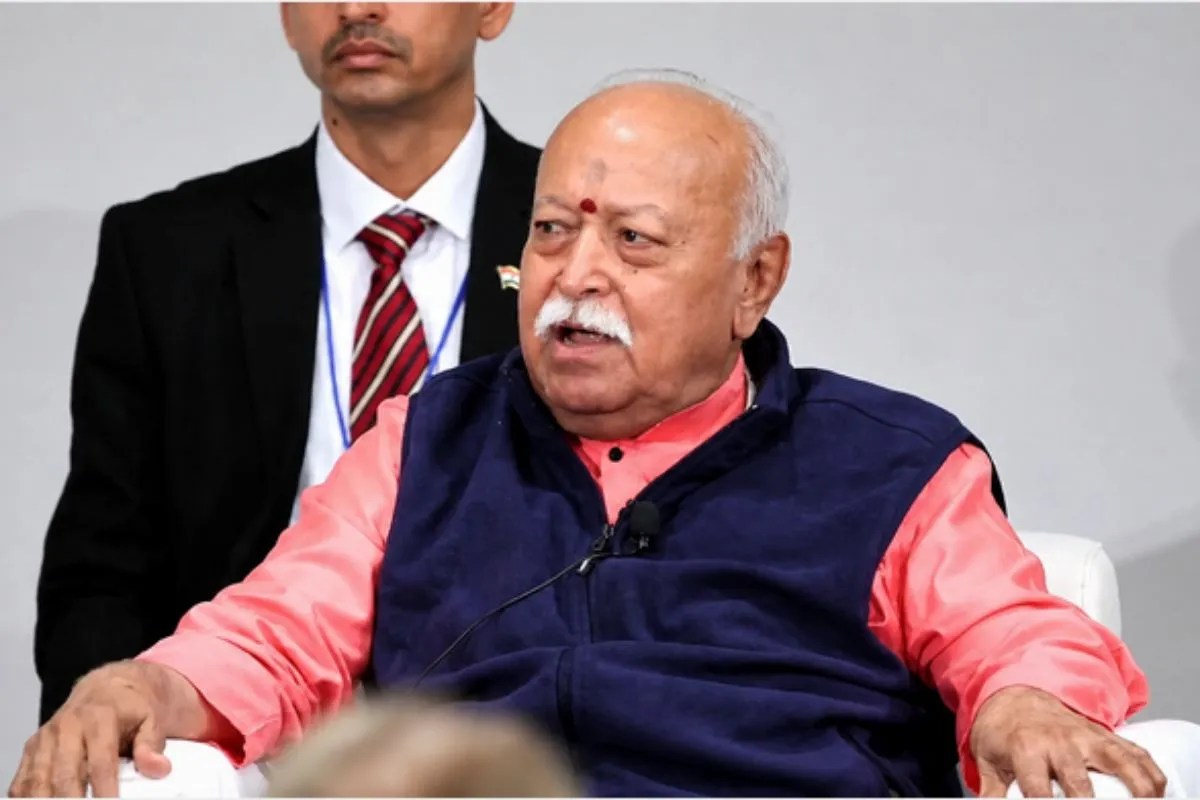
The billboards lighting up Times Square bore a carefully calibrated message of harmony, dialogue, and resolve. Beneath those glowing digital displays, however, lay a much sharper geopolitical strategy. When Rashtriya Swayamsevak Sangh chief Mohan Bhagwat took the stage at Madison Square Garden for the Universal Oneness Celebration, the event was billed as a cultural gathering of the Indian diaspora. Yet, the spectacle represented something far more consequential: the structured international normalization of hardline Hindu nationalism on Western soil.
For decades, the ideological parent of India's ruling Bharatiya Janata Party operated primarily within domestic borders, shaping state policy and social norms from New Delhi. The centenary-year global outreach tour, stretching across the United States, Canada, and the United Kingdom, signals a deliberate operational shift. The objective is not merely to connect with expatriates. The mission is to anchor the organization's core doctrines deep within Western civic life, converting foreign diaspora communities into active ideological outposts.
The machinery behind these high-profile international events deserves close inspection. On paper, the Madison Square Garden rally was organized by a relatively new non-profit entity called the American Hindus for Engagement and Dialogue, or AHEAD. Investigative reporting has repeatedly mapped the administrative plumbing connecting this forum directly back to veteran operatives of the Sangh network and its overseas affiliates. This structural separation allows the parent organization in Nagpur to project plausible deniability regarding direct foreign control, while still executing a synchronized global outreach campaign.
Outside the arena doors, the friction generated by this export strategy was immediately visible. Local civil rights groups, interfaith coalitions, and advocacy organizations staged sharp protests, joined by high-profile local political figures who questioned the rise of exclusionary movements. Critics pointed out the stark contradiction between preaching pluralism abroad while minority communities face systemic pressures and legislative marginalization back in India. For an organization attempting to rebrand itself as a benign cultural custodian, the pushback exposed deep anxiety among diverse immigrant communities who refuse to let a singular political ideology speak for their heritage.
During his address to roughly five thousand attendees inside the venue, Bhagwat leaned heavily into themes of individual responsibility and civic duty. He urged expatriates to remain loyal to their adopted home, describing the United States as their operational workplace, or karma bhumi, while keeping emotional ties to their birthplace. This dual-loyalty balancing act is a calculated rhetorical device. It aims to soothe host-country anxieties about foreign political interference while simultaneously binding the diaspora's cultural identity tightly to the mother organization's ideological framework.
By redefining concepts like Dharma not as narrow religious worship but as a universal social balance, the leadership attempts to make its worldview palatable to Western political sensibilities. It is a sophisticated translation mechanism designed to strip away domestic controversies and present Hindu nationalism as an ancient philosophy of global harmony. This sanitized framing plays well in arenas filled with sympathetic donors and professionals seeking cultural connection thousands of miles away from home.
The long-term implications of this international normalization extend far beyond a single weekend in Manhattan. As domestic political dynamics in South Asia increasingly bleed into Western electoral politics, the diaspora finds itself caught in an ideological tug-of-war. Local politicians must weigh the economic and numerical weight of organized diaspora groups against the moral hazards of embracing figures tied to polarizing sectarian movements.
The strategy is working precisely because it operates in the gray spaces of diaspora philanthropy and cultural pride. When community groups organize food distribution drives or interfaith symposiums alongside political rallies, drawing clear lines becomes remarkably difficult for municipal leaders who lack jurisdiction over private venue rentals.
The footlights of Madison Square Garden have dimmed, but the infrastructure of influence remains firmly planted abroad. The true measure of this global outreach will not be found in the applause inside the auditorium, but in how effectively foreign institutions and governments learn to navigate the quiet, persistent expansion of transnational nationalism.