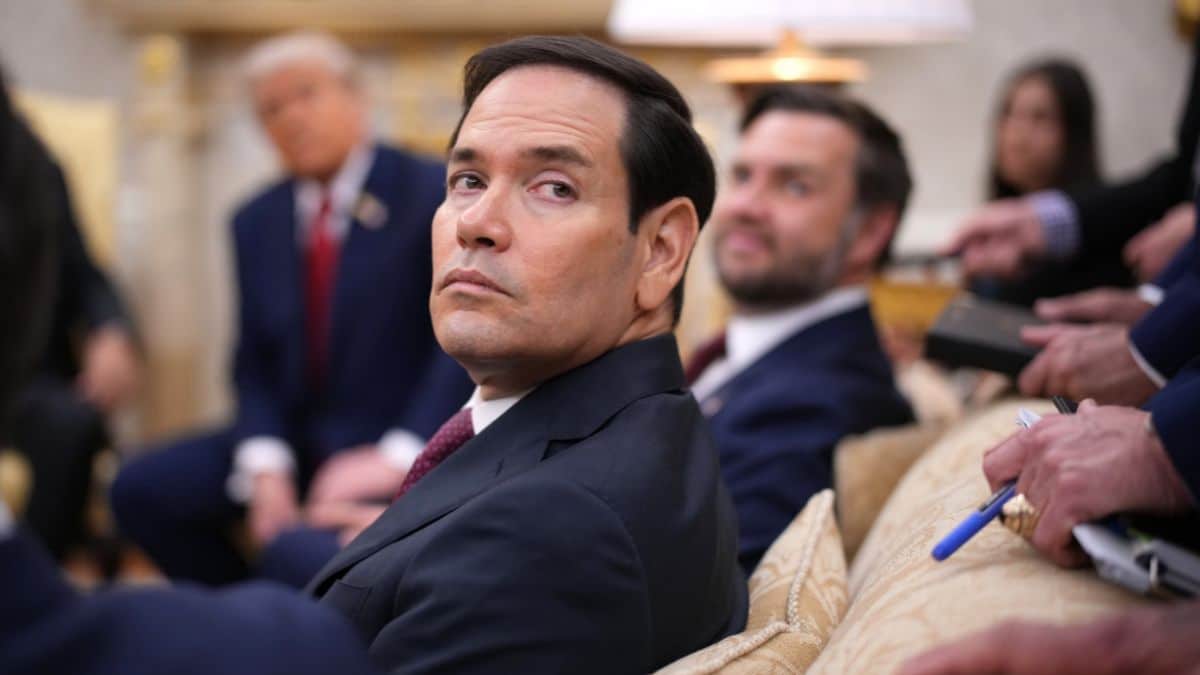
The diplomatic mission landing in Rome this week isn't a courtesy call. When U.S. Secretary of State Marco Rubio enters the Apostolic Palace on Thursday, he isn't just carrying a briefcase; he is carrying the weight of a fractured Western alliance. The immediate trigger is a verbal arson attack from the Oval Office that has left the first American-born pontiff, Pope Leo XIV, in the crosshairs of a president who views dissent as a security threat.
Rubio is attempting to bridge a chasm that is both theological and geopolitical. At the heart of the friction is the ongoing war with Iran, a conflict the Trump administration frames as a necessary preemptive strike and the Vatican views as a moral catastrophe. While the administration describes the trip as a "previously scheduled" engagement, the reality on the ground in D.C. and Rome tells a different story. This is a damage-control operation designed to prevent a total schism between the White House and the Catholic Church—a move that could alienate millions of voters and destabilize key alliances in Europe.
The Leo Doctrine vs. The Iran Strike
The conflict between Donald Trump and Pope Leo XIV escalated sharply following the U.S.-Israeli strikes on Iran launched on February 28. Since then, the Chicago-born pontiff has used his pulpit to call for an immediate ceasefire, invoking the "just war" doctrine to argue that the conditions for military force have not been met.
Trump’s response has been characteristically blunt. In a radio interview with Hugh Hewitt, the President accused the Pope of "endangering a lot of Catholics" by suggesting that a nuclear-armed Iran is an acceptable risk. "The pope would rather talk about the fact that it's OK for Iran to have a nuclear weapon," Trump claimed, a statement the Vatican has flatly rejected as a misrepresentation of the Pope’s actual position.
The Holy See has never endorsed Iranian nuclear proliferation. Instead, Leo XIV has argued that the current war is a disproportionate response that risks a global conflagration. By framing the Pope's pacifism as pro-nuclear, the Trump administration is attempting to strip the Vatican of its moral authority among American conservatives.
Rubio’s Strategic Balancing Act
Marco Rubio, a devout Catholic, finds himself in the unenviable position of serving two masters. He must defend a president who uses AI-generated imagery to cast himself as a messianic figure while simultaneously showing reverence to a Pope who views that same president's foreign policy as reckless.
During a recent briefing, Rubio tried to pivot the conversation away from the personal insults. He argued that the President’s frustration stems from a sincere concern for the safety of Christians worldwide. "He doesn't understand why anyone would think it's a good idea for Iran to ever have a nuclear weapon," Rubio told reporters. By reframing the dispute as a disagreement over "capabilities" rather than "morality," Rubio hopes to lower the temperature.
However, the Secretary of State is also using the trip to press the Vatican on other fronts. He is expected to discuss:
- The Cuban Blockade: The Vatican has been a vocal critic of the U.S. fuel blockade on Cuba, which has led to nationwide blackouts. Rubio is expected to push for humanitarian aid to be routed through the Church, provided the Cuban government stops "blocking" the distribution.
- The Strait of Hormuz: With Iran tightening its grip on global shipping lanes, the U.S. is looking for moral support for "Project Freedom," its military effort to keep the strait open.
- Italy's Alignment: Rubio also needs to repair ties with Prime Minister Giorgia Meloni. Once a staunch Trump ally, Meloni has recently distanced herself from the President's attacks on the Pope, fearing the political fallout in a deeply Catholic Italy.
The Tech Factor and the New Propagandists
The tension is being fueled by a new kind of information warfare. Last month, the President shared an AI-generated image of himself in papal-style robes, a move that many in the Vatican saw as a direct provocation. Though the image was later deleted and described as a "doctor's uniform" in a bizarre retraction, the message was clear: the administration is willing to use synthetic media to challenge traditional institutional authority.
This isn't just about a single image. The use of deepfakes and AI-driven social media campaigns has allowed the administration to bypass traditional Catholic media outlets, speaking directly to a base that often prioritizes political identity over denominational loyalty. This creates a "religious mission" for the administration—one that pits "patriotic Christianity" against what they label the "woke" multilateralism of the Vatican.
The High Stakes of the Thursday Meeting
The meeting on May 7 is timed to coincide with the first anniversary of Pope Leo’s papacy. It is a moment of extreme vulnerability for the transatlantic relationship. If Rubio fails to secure even a tepid "agreement to disagree," the administration has already threatened to withdraw U.S. troops from Italy as a punishment for Meloni’s support of the Pope.
The Vatican’s Secretary of State, Pietro Parolin, has stressed the need for "authentic dialogue," but the reality is that the two sides are speaking different languages. One speaks the language of strategic dominance and preemptive defense; the other speaks the language of de-escalation and the sanctity of sovereignty.
Rubio is a seasoned operative who knows that in diplomacy, sometimes a "frank conversation" is just a polite term for a stalemate. But with the Middle East in flames and a domestic election cycle looming, a stalemate may be the best he can hope for. If he can't convince the Pope to stop calling for a ceasefire, he at least needs to convince the American public that the Pope isn't the enemy.
The success of this mission won't be measured in a joint communiqué, but in whether the President's social media feed stays quiet about the Vatican for more than forty-eight hours. Given the current trajectory, that remains a high-risk bet.