Whitehall likes to pretend the Falkland Islands are a settled matter of sovereignty and self-determination, a static piece of the British identity frozen in 1982. This is a convenient fiction. In reality, the islands have morphed into a high-stakes geopolitical currency that Washington trades whenever it needs to squeeze London or appease Buenos Aires. The archipelago is not just a British overseas territory; it is a strategic pressure point that the United States uses to manage its influence across the Western Hemisphere. For the UK, the islands represent a non-negotiable commitment, but for the US, they are a variable in a much larger calculation involving Chinese expansion in South America and the stability of the Antarctic Treaty System.
Britain’s position is inherently fragile because it relies on a security guarantee that the US refuses to make explicit. While London views the islands through the lens of international law and the rights of the 3,600 people living there, Washington views them through the lens of regional pragmatism. Every time a British Prime Minister stands at a podium to declare the sovereignty of the Falklands is "not up for discussion," they are banking on a level of American support that has historically been transactional at best. If you found value in this piece, you should read: this related article.
The Neutrality Trap
The most uncomfortable truth for British diplomats is that the United States does not officially recognize British sovereignty over the Falkland Islands. Washington’s formal position remains one of neutrality, recognizing the "de facto" British administration while acknowledging the competing claims of Argentina. This is not an oversight. It is a deliberate policy of ambiguity that gives the State Department room to maneuver.
By refusing to take a side, the US prevents the Falklands from becoming a binary choice that could alienate South American partners. In the halls of the Pentagon, there is a lingering memory of the 1982 conflict, where the US was forced to choose between its oldest ally and its Cold War interests in Latin America. Today, that tension is even sharper. Argentina is heavily indebted and looking for alternatives to Western financial structures. If the US leans too far toward London, it risks pushing Buenos Aires further into the orbit of Beijing, which has already expressed support for Argentina's "Malvinas" claim in exchange for deeper economic and military ties. For another perspective on this development, check out the recent coverage from The Washington Post.
The UK finds itself in a cycle of constant reassurance. It must prove its value to Washington to ensure that the US doesn't trade away British interests for a smoother relationship with the Mercosur trading bloc. This puts London in a position of perpetual debt, often leading to British support for American foreign policy initiatives that offer little direct benefit to the UK, simply to keep the Falklands "insurance policy" active.
China is the New Variable in the South Atlantic
The South Atlantic is no longer a quiet backwater. It has become a frontier for Chinese naval ambitions and resource extraction. Beijing’s interest in the region is not merely symbolic; it is tied to the massive untapped oil and gas reserves in the North Falkland Basin and the strategic gateway to Antarctica. China has spent the last decade building a deep-space tracking station in Patagonia and investing heavily in Argentine infrastructure.
For Argentina, the Chinese "option" is a powerful tool for brinkmanship. By flirting with Chinese fighter jets or port investments, Buenos Aires forces Washington to pay attention. The US response is rarely to tell Argentina to back off its Falklands claim. Instead, the US often tries to "split the difference" by encouraging dialogue between London and Buenos Aires—a prospect that the UK views as a betrayal of the islanders' right to self-determination.
Britain is now forced to play a three-dimensional game of chess. It must maintain a military presence sufficient to deter Argentine adventurism while navigating a US-China rivalry that threatens to turn the South Atlantic into a theater of competition. The UK’s "Global Britain" strategy depends on its ability to project power, but that power is hollow if the primary regional hegemon, the US, views British territorial interests as a nuisance rather than a priority.
The Myth of the 1982 Solidarity
The historical narrative of the 1982 war often emphasizes the "special relationship" and the intelligence sharing that helped the British Task Force. While that support was vital, it was also hard-won and deeply contested within the Reagan administration. Figures like Jeane Kirkpatrick, then the US Ambassador to the UN, argued vehemently against supporting the UK, fearing the collapse of American influence in Latin America.
That internal divide never truly went away. It simply went underground. Modern American policymakers are less sentimental about the British Empire than their predecessors. They see a UK that has exited the European Union and is searching for a new role on the world stage. In this context, the Falklands are seen by some in Washington as an expensive colonial vestige that complicates American efforts to unify the Americas against authoritarian influence.
Why Self Determination is a Weak Shield
The British government consistently points to the 2013 referendum, where 99.8% of Falklanders voted to remain a British Overseas Territory. In a world governed strictly by liberal democratic values, this would be the end of the conversation. But international relations are governed by power, not just principles.
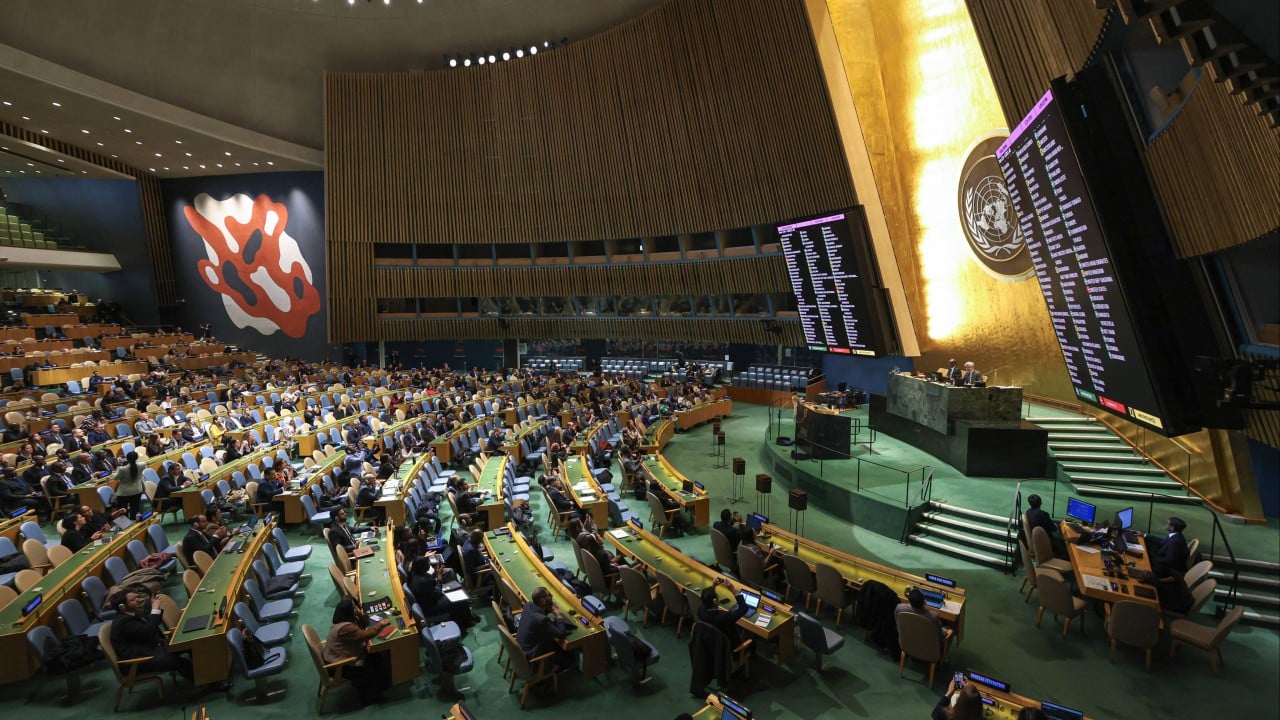
The UN Special Committee on Decolonization continues to view the Falklands as a colonial situation that must be resolved through bilateral negotiations. This gives Argentina a permanent platform to challenge the UK’s presence. When the US abstains or calls for "peaceful resolution" in these forums, it signals to the world that the inhabitants' wishes are secondary to geopolitical stability. The UK's reliance on the principle of self-determination is a moral high ground that offers very little protection against a coordinated diplomatic offensive by the G77 or other regional blocs.
The Resource War Beneath the Waves
Beyond the flags and the history, there is the matter of what lies beneath the seabed. The Falklands are sitting on an estimated 300 million barrels of oil in the Sea Lion field alone. For a UK struggling with energy security and an Argentina mired in economic crisis, these resources are a potential lifeline.
However, the threat of Argentine legal action against any company operating in Falklands waters has acted as a massive deterrent to international investment. The US has done little to discourage these legal threats. By allowing the "dispute" to simmer, Washington effectively prevents the Falklands from becoming an independent economic powerhouse that could challenge the regional status quo. The US benefits from a Falklands that is secure enough to be a British military outpost, but contested enough to keep London dependent on American diplomatic cover.
The Antarctic Gateway
The Falklands are the primary staging ground for any future claim to the Antarctic Peninsula. As the Antarctic Treaty comes under increasing pressure from countries like Russia and China, the territorial claims of the 20th century are regaining their importance. The British Antarctic Territory overlaps significantly with the claims of Argentina and Chile.
The US, which maintains no territorial claim of its own in Antarctica but "reserves the right" to make one, has a vested interest in keeping the claimants at each other's throats. As long as the UK and Argentina are focused on the Falklands, neither can effectively consolidate a dominant position in the Antarctic. The US acts as the ultimate arbiter of the frozen continent, and the Falklands dispute is the lever it uses to maintain that balance.
The Cost of the Status Quo
Maintaining a military presence in the Falklands costs the British taxpayer roughly £60 million a year in direct costs, with hundreds of millions more embedded in the wider defense budget. This includes a permanent garrison at Mount Pleasant, a rotating flight of Typhoon fighters, and a naval presence. For a cash-strapped Ministry of Defence, this is a significant burden.
The US knows this. They understand that every pound Britain spends on the South Atlantic is a pound not spent in the Indo-Pacific or Eastern Europe—areas where the US actually wants British help. There is a subtle, unspoken pressure from some quarters in Washington for the UK to "rationalize" its overseas commitments. This is code for finding a way to hand off the security of the South Atlantic, or at least making it less of a diplomatic headache for the White House.
A Relationship of Convenience
The UK often finds itself in the role of the jilted lover, shocked when Washington prioritizes its own regional interests. This happened during the Obama administration when the US supported a regional statement that referred to the islands as the "Malvinas." It happened again when the Trump administration showed little interest in reinforcing British claims. The pattern is clear: the US will support Britain on the Falklands only when it costs them nothing, and will pivot the moment a better deal appears on the horizon.
Britain’s strategy of "leaning in" to the US relationship to protect the Falklands has created a vulnerability. The more the UK tethers its global standing to American approval, the less leverage it has when Washington decides to play both sides. The islands are not a pillar of the special relationship; they are a test of it—one that Britain is currently failing to manage on its own terms.
The Path to Irrelevance
If London continues to treat the Falklands as a static issue, it will eventually find itself outmaneuvered. The geopolitical landscape is shifting toward a multi-polar reality where "traditional allies" are less important than "strategic partners." Argentina understands this and is playing a long game, waiting for a moment of British economic weakness or American distraction.
The UK cannot rely on a 40-year-old victory to secure its future in the South Atlantic. It needs a strategy that goes beyond military deterrence and rhetoric about self-determination. It needs to create a reality where the Falklands are an indispensable part of the global economy, making it impossible for Washington to treat them as a tradeable asset.
This means moving aggressively to develop the islands' resources, even in the face of diplomatic friction. It means building direct alliances with other regional powers like Brazil and Chile, rather than relying on the US to act as a middleman. Most importantly, it requires an honest appraisal of the "special relationship." Britain must stop viewing the US as a guarantor of its sovereignty and start viewing it as a competitor that happens to share some interests.
The Falkland Islands are a pressure point because Britain allows them to be. By treating American neutrality as a minor disagreement rather than a fundamental strategic threat, London has given Washington the keys to its southern flank. The only way to remove that pressure is to make the British presence in the South Atlantic so robust and economically vital that it is no longer a question for debate, but a fact of life that the US must accept, rather than manage.
The time for diplomatic politeness has passed. The UK must decide if it wants to be a sovereign power in the South Atlantic or a tenant whose lease is subject to the whims of the White House.
Stop waiting for a validation from Washington that is never coming. Build the infrastructure, pump the oil, and make the cost of ignoring British sovereignty higher than the cost of supporting it.