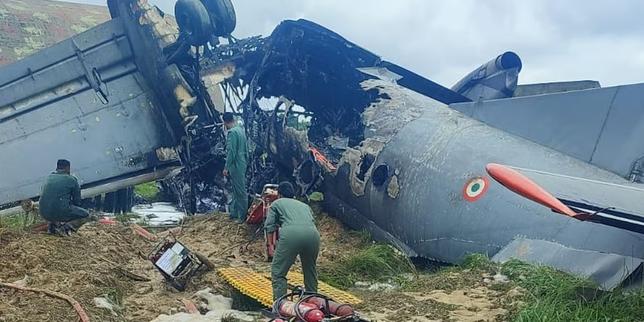
Five military personnel died when an Indian Air Force C-130J Super Hercules transport aircraft crashed during a routine training mission near Gwalior. The incident strips away the official veneer of routine operational hazards to expose a much deeper crisis within India's defense procurement and maintenance ecosystem. This was not an isolated pilot error. It represents a systemic failure in how New Delhi integrates, maintains, and operates its increasingly complex multi-billion-dollar Western defense assets alongside legacy Soviet-era infrastructure.
The loss of a frontline asset like the Lockheed Martin C-130J, a platform globally recognized for its reliability, sends shockwaves through the defense establishment. When a modern aircraft crashes under standard training conditions, the investigation must look beyond the cockpit. It demands an unvarnished examination of structural oversight, maintenance pipelines, and tactical training doctrines.
The Illusion of Modernization
New Delhi has spent the last two decades shifting away from its historical dependence on Moscow. The acquisition of American-made platforms was supposed to signal a new era of strategic capability. Instead, it created a logistical nightmare.
The Indian Air Force operates an incredibly fragmented fleet. On any given day, ground crews must service American transport planes, French fighters, Russian bombers, and domestic helicopters. Each country of origin brings a completely distinct engineering philosophy, metric system, and supply chain philosophy.
This fragmentation strains the engineering corps to a breaking point. A technician trained on the rugged, low-tolerance systems of a Soviet-designed Antonov An-32 cannot easily transfer those skills to the highly digitized, sensitive avionics of a Super Hercules. The tools are different. The diagnostics require proprietary software that often remains locked behind foreign intellectual property walls.
The Spare Parts Bottleneck
Bureaucratic inertia frequently paralyzes the procurement of critical components. Under the Defense Acquisition Procedure, ordering a replacement part involves multiple layers of committee approvals, financial scrutiny, and diplomatic clearance.
- Legacy systems often rely on reverse-engineered parts or cannibalized airframes.
- Modern Western platforms require certified OEM components that cannot be substituted.
- Customs delays at ports of entry can ground an aircraft for months over a single faulty sensor.
When frontline transport squadrons face pressure to maintain high operational readiness rates, commanders are forced to make hard choices. Training flights proceed with deferred maintenance items. Operational parameters get pushed. The margin for error shrinks until it disappears entirely.
Wake Turbulence and Tactical Miscalculations
The specific mechanics of low-level tactical training missions present extreme risks that are rarely discussed outside squadron briefing rooms. During simulated penetration flights, transport aircraft fly in tight formations at low altitudes to evade radar detection.
In these scenarios, the primary hidden enemy is wake turbulence. A heavy transport aircraft leaves behind powerful, invisible vortices of rotating air. If a trailing aircraft encounters these vortices at low altitude, the aerodynamic consequences are catastrophic.
$$L = \frac{1}{2} \rho v^2 S C_L$$
A sudden, violent loss of lift occurs when an airframe enters disturbed wake air. At 10,000 feet, a skilled pilot can recover from a sudden roll or altitude drop. At 500 feet, the aircraft strikes the ground before the flight control computers can even calculate a corrective response.
The Limits of Automation
Modern military transports rely heavily on fly-by-wire technology to protect the flight envelope. These systems prevent the pilot from over-stressing the airframe or entering a stall. However, automation can become a liability during sudden, violent atmospheric disturbances.
If sensor inputs become conflicted due to extreme atmospheric angles, the flight computers may hand control back to the pilot without warning. A sudden transition from automated flight to manual control in a high-stress, low-altitude environment regularly leads to spatial disorientation. The pilot loses the sense of the horizon, misinterprets instrument readings, and makes inputs that exacerbate the dive rather than correcting it.
Institutional Secrecy Silences Lessons Learned
The Indian Ministry of Defence routinely blankets military aviation mishaps in absolute secrecy. Courts of Inquiry are conducted behind closed doors, and the final reports are classified as state secrets.
This lack of transparency destroys the institutional memory required to prevent future accidents. In commercial aviation, every incident report is disseminated globally so every airline, pilot, and mechanic can learn from the failure. In the military ecosystem, the findings are buried to protect political reputations and preserve diplomatic relationships with foreign defense contractors.
[Accident Occurs] -> [Closed Inquiry] -> [Report Classified] -> [Lessons Buried] -> [Flawed Practices Continue]
Without public accountability, systemic issues go unaddressed. If a crash was caused by a specific maintenance omission or a flawed training doctrine, other squadrons operating the same platform remain completely in the dark. They continue practicing the same dangerous maneuvers until the next airframe breaks.
The True Cost of Political Procurement
Defense acquisition in India remains deeply political. Decisions to buy specific airframes are frequently driven by geopolitical balancing acts rather than pure tactical requirements.
When New Delhi signs a multi-billion-dollar deal for foreign aircraft, the focus centers on the headline capability. The unglamorous aspects of the deal—long-term lifecycle support, domestic depot-level maintenance facilities, and extensive simulator training packages—are often scaled back to keep the initial price tag palatable to voters.
"An aircraft is only as good as the supply chain that follows it into theater."
Without deep, domestic manufacturing capabilities for critical spares, India remains strategically vulnerable. The nation finds itself dependent on foreign technicians traveling across the globe to fix grounded fleets during diplomatic crises.
The Gwalior tragedy cannot simply be written off as bad luck or a blurted radio call in the dark. It stands as a stark warning that the rapid acquisition of advanced military technology without a matching overhaul of maintenance culture, bureaucratic speed, and operational transparency is a recipe for disaster. The country will continue to lose its highly trained aircrews not to enemy action, but to the weight of its own unaddressed systemic failures.


