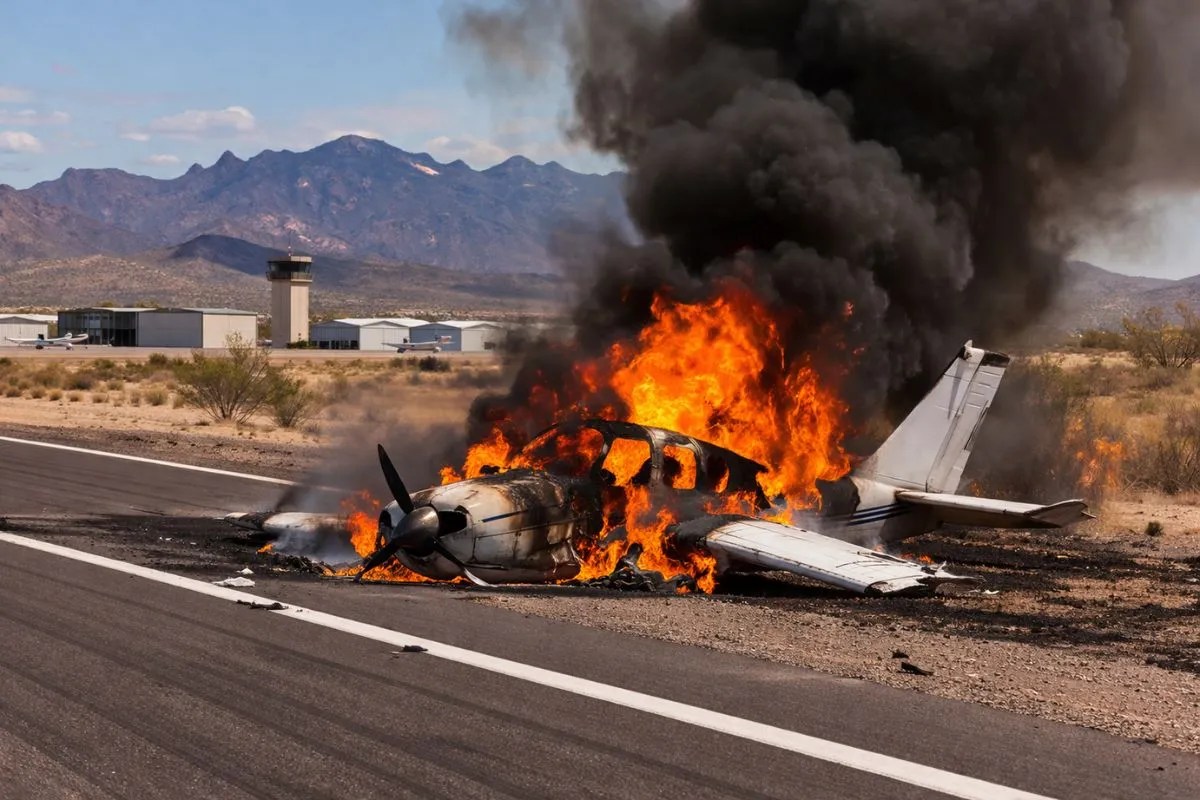
The headlines are predictable. A small plane skids off a runway in Arizona, a plume of black smoke rises, and the media industrial complex begins its synchronized dance of tragedy porn. Two people died. It is a grim reality. But the "consensus" reporting—the kind that focuses on the fire and the mangled aluminum—is doing a massive disservice to anyone who actually cares about risk management.
Standard reporting wants you to believe that private aviation is a lawless frontier of flying deathtraps. They focus on the "runway excursion" as if it’s a random act of God. It isn't. If you’re looking at the Arizona crash and thinking "this is why I only fly commercial," you’re falling for a classic cognitive bias that ignores the massive delta between mechanical failure and pilot ego.
The Myth of the Unreliable Engine
The public thinks small planes fall out of the sky because the engines quit. Data from the NTSB (National Transportation Safety Board) suggests otherwise. In the vast majority of general aviation accidents involving "loss of control" or "runway excursions," the machine was doing exactly what it was told to do.
The engine didn't fail. The pilot failed to manage the physics of the landing.
When a plane like the one in the Arizona incident "slides off the runway and catches fire," the media frames it as a technical malfunction. I’ve sat in cockpits for twenty years, and I can tell you: a plane doesn't just decide to leave the pavement. It is forced off by a series of compounding human errors—excessive approach speed, failure to go around, or poor braking technique.
We don't have a safety problem in private aviation. We have a discipline problem. We treat flying like driving a car, where you can "get away" with being mediocre. In the air, mediocrity is a death sentence.
Stop Blaming the Aircraft Age
Whenever a private jet or a prop plane goes down, the first thing "experts" point to is the age of the airframe. "The plane was 30 years old," they whisper, as if metal has an expiration date like milk.
This is a fundamental misunderstanding of aviation maintenance. A 1980s airframe that has been maintained under Part 135 or even strict Part 91 standards is often mechanically superior to a five-year-old plane that’s been sitting in a humid hangar rotting from the inside out.
The Arizona crash shouldn't make you check the manufacture date of your next charter. It should make you check the "Pilot in Command" (PIC) hours in that specific make and model. The industry loves to brag about "Total Time," but total time is a vanity metric. If a pilot has 5,000 hours in a Cessna 172 but only 20 hours in the high-performance jet they just crashed, they are essentially a student pilot with a dangerous amount of confidence.
The Cost of the "Go-Direct" Culture
The hidden culprit in these runway accidents is a toxic culture of "Get-there-itis."
Commercial airlines have rigid SOPs (Standard Operating Procedures). If the stabilized approach criteria aren't met by 1,000 feet, the pilots must go around. There is no debate. There is no ego. In private aviation, especially with owner-pilots, there is a lingering sense that a "Go-Around" is a sign of weakness or a waste of expensive fuel.
Imagine a scenario where a pilot is coming into a hot Arizona runway. The wind shifts. The plane is 15 knots too fast. A professional crew aborts. An amateur—or a professional pressured by a wealthy client—tries to "plant it." They touch down long, the brakes fade, the tires blow, and suddenly you’re watching a 6 o'clock news segment about a "horrific accident."
The accident didn't happen on the runway. It happened five miles out when the pilot decided their ego was more important than the physics of a stabilized approach.
The Statistical Illiteracy of "Danger"
Let’s talk about the numbers the media refuses to contextualize.
The fatal accident rate for general aviation is roughly 1.0 per 100,000 flight hours. For scheduled commercial airlines, it’s nearly zero. Does that make private flying "dangerous"? Only if you are incapable of assessing personal agency.
Risk in aviation is not a flat line. It is a choice. You can effectively reduce your personal risk profile to near-airline levels by doing three things that most private pilots find "annoying":
- Never fly into a runway shorter than 5,000 feet, regardless of what the manual says.
- Maintain a mandatory "two-pilot" rule for all cross-country flights.
- Fire any pilot who doesn't perform at least one practice go-around every ten landings.
The "tragedy" in Arizona isn't a failure of technology. It’s a failure of the industry to demand that private flyers stop acting like they’re exempt from the laws of motion.
The Real Danger is Post-Crash Survivability
The Arizona fire was the killer, not the impact. This is where the industry actually does have a systemic flaw that no one talks about: the archaic design of fuel systems in light aircraft.
While commercial liners have advanced fire suppression and crashworthy fuel bladders, many light aircraft are still flying with "wet wings"—where the structural skin of the wing is the fuel tank. One spark, one jagged piece of runway light, and you’re in an oven.
If we want to "fix" aviation safety, we should stop obsessing over GPS upgrades and start demanding retrofitted, self-sealing fuel bladders. But that’s not "sexy" for the marketing brochures, and it doesn't make for a dramatic headline. It just saves lives.
The Professionalism Gap
We are currently seeing a massive drain of experienced pilots leaving private aviation for the massive signing bonuses of the major airlines. What’s left? A vacuum being filled by "time-builders"—young pilots who are just using private jets as a stepping stone.
When you see a plane slide off a runway in a high-density altitude environment like Arizona, you’re often seeing the result of an inexperienced crew that doesn't understand how thin air affects ground roll and braking. They’re reading the charts, but they don't feel the plane.
Experience isn't just about hours; it's about having seen the "wrong" thing enough times to recognize it before it becomes fatal. The current "pilot shortage" is actually a "competency shortage."
Stop Asking "Is It Safe?"
People always ask: "Is it safe to fly private?"
It’s the wrong question. The right question is: "Is your pilot’s ego small enough to handle a missed approach?"
Safety isn't a feature of the airplane. It’s a byproduct of the culture inside the cockpit. The Arizona crash shouldn't be a catalyst for fear; it should be a catalyst for a brutal audit of who we let sit in the left seat. We need to stop treating these events as "accidents." They are the logical conclusion of poor decision-making.
The next time you see a headline about a runway fire, don't look at the plane. Look at the culture that allowed that plane to be there in the first place. High-performance machinery doesn't forgive "good enough." It only recognizes "perfect."
If you can't be perfect, stay on the ground. The runway doesn't care about your schedule.