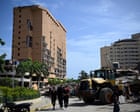
More than 100 Venezuelan migrants deported from the United States are missing and feared dead after their temporary processing hotel collapsed during the twin 7.2 and 7.5 magnitude earthquakes that shattered Venezuela. The victims arrived in Caracas on an Immigration and Customs Enforcement charter flight from Miami just hours before the seismic doublet struck the coast. They were transported straight to the Hotel Santuario La Llanada in the coastal city of La Guaira for mandatory civil registration and medical screening. When the ground buckled, the multi-story structure pancaked, trapping the vast majority of the 146 passengers under tons of concrete.
The disaster exposes the chaotic intersection of Washington's aggressive mass deportation campaign and the fragile reality of a homeland unequipped to receive its exiled population.
From Miami Detention to a Coastal Trap
On Wednesday morning, the charter flight tracked by aviation monitors departed Florida carrying 146 Venezuelan nationals, including 19 women and seven children. For many on board, the flight marked the end of years spent building lives in the American shadow. For others, it followed months in southern border detention facilities.
By afternoon, the Venezuelan government bused the entire cohort to La Guaira, a coastal gateway choked between the mountains and the Caribbean Sea. The state infrastructure required all returnees to undergo immediate document processing and health checks before being released to their home provinces. The Hotel Santuario La Llanada was designated as the overnight holding facility.
Survivors recall that the atmosphere inside the hotel was a mix of exhaustion and relief. They were told they would be permitted to board buses to their respective home states the next morning. Then, the coast began to shake.
A Seismic Doublet and Total Isolation
The physical collapse happened with terrifying speed. The first 7.2 magnitude shock wave sent structures swaying across the capital region, but it was the immediate 7.5 follow-up tremor that brought the hotel down.
Lisbeth Portillo, a 58-year-old grandmother who had been living in South Florida since crossing the U.S.–Mexico border in 2021, was resting on the second floor when the walls dissolved. She had stepped onto the balcony moments prior, noting an oppressive, unnatural heat over the water before the building began to rattle.
The sound was deafening. Portillo describes a rhythmic cracking sound before the floor dropped out entirely. A falling concrete beam pinned her, but the subsequent shifting of the second tremor opened a small cavity, allowing her to crawl free into the choking dust.
Only about 20 deportees managed to scramble out of the immediate wreckage. They emerged into a wasteland where barefoot, injured citizens were fleeing the coastal strip. With all regional cellular towers severed and power grids dead, the survivors walked five kilometers through the debris to reach a local National Guard outpost simply to find a working satellite link or radio.
For those left underneath, rescue has been agonizingly slow. Local emergency teams in La Guaira are completely overwhelmed by the scale of the broader catastrophe, which has claimed more than 1,700 lives nationwide. Specialized heavy machinery is scarce, and the continuous aftershocks make tunneling into the hotel ruins a lethal gamble.
The Bureaucratic Void
While family members in the United States scramble for information, they are met with a wall of silence from both governments. U.S. Immigration and Customs Enforcement officials routinely decline to comment on the fate of individuals once an aircraft touches down and custody is transferred to foreign nationals. Meanwhile, the administrative apparatus in Caracas is in triage mode, unable to provide an official manifest of who was pulled from the hotel alive or dead.
Liliana Rojas, whose 33-year-old partner was on the Wednesday flight from the El Paso processing center, spent days calling international emergency hotlines. The American facility merely confirmed his departure. The Venezuelan regional authorities have no record of his whereabouts.
This tracking failure is not an anomaly. It is the direct result of a policy pipeline designed to expedite the removal of bodies from domestic soil without establishing reciprocal safety nets for their arrival. The resumption of regular deportation flights to Venezuela in early 2025 has proceeded at a relentless pace, with multiple flights landing weekly regardless of the worsening domestic conditions on the ground.
The Illusion of Return
The tragedy undercuts the political rhetoric surrounding deportations, which often frames the return of migrants as a routine administrative conclusion. In practice, individuals are frequently dropped back into environments where basic building codes are unenforced, public services are fractured, and emergency response capabilities are virtually non-existent.
The Hotel Santuario La Llanada was unsuited to serve as a high-density government processing center. Like much of the hasty commercial construction along the La Guaira coast, the building lacked the structural reinforcement necessary to survive the severe fault-line activity native to northern Venezuela.
The deportees were placed in this vulnerable position by a system that prioritizes clearance statistics over operational safety. While natural disasters cannot be predicted, the concentration of newly arrived, undocumented, and un-communicative individuals in a single, unverified structure represents a systemic failure of oversight.
Portillo was lucky. Her family in Maracaibo managed to drive through the shattered highway network to retrieve her from the National Guard post. Others remain buried, nameless digits in an international policy debate that moved on long before their plane ever touched the tarmac.