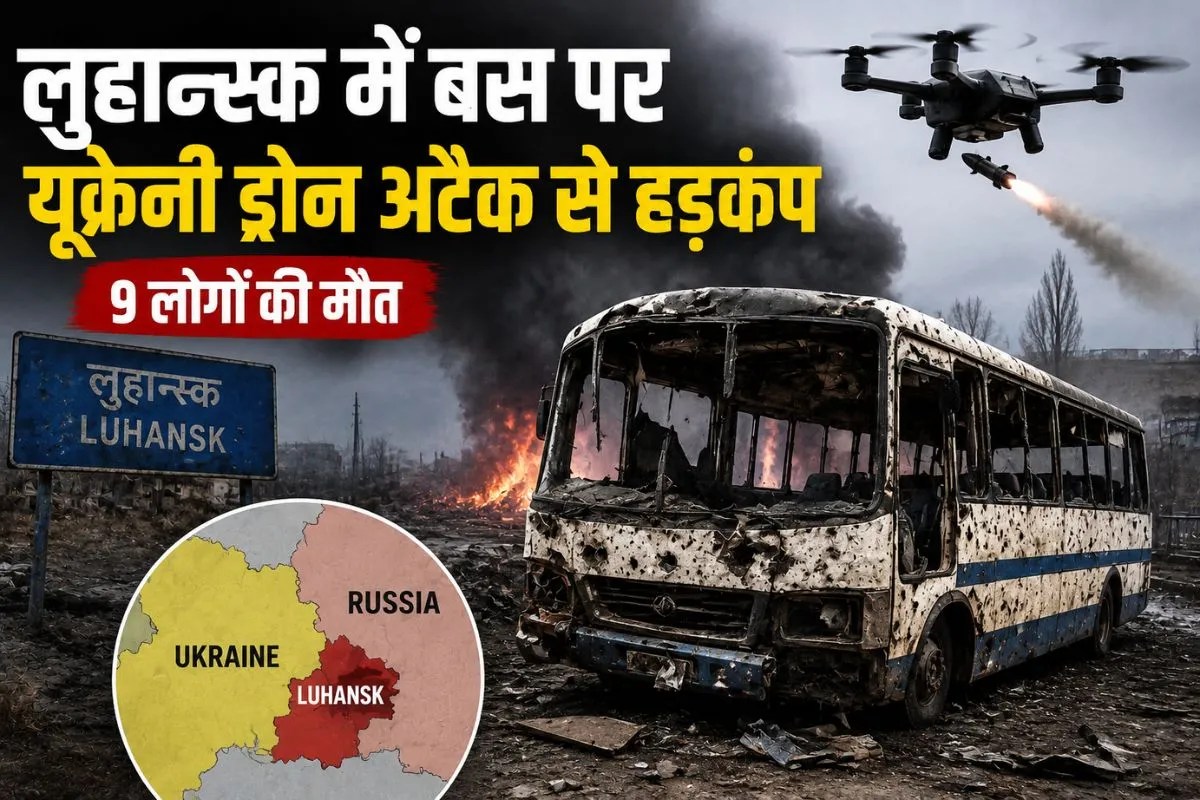
Morning on the eastern frontier usually begins with the sound of breaking ice or distant thunder. On this particular day, in the contested expanses of Luhansk, the morning started with a routine hum. An ordinary commuter bus, painted in dull colors that had long since surrendered their brightness to dust and weather, rolled down a stretch of asphalt connecting small settlements. Inside, the air smelled of stale tobacco, damp wool, and the faint, bitter scent of cheap instant coffee from thermos flasks.
People were going about the quiet, agonizingly normal business of surviving an abnormal reality. A woman in a worn winter coat adjusted her scarf, thinking of the grandchildren waiting at the end of the line. A man with grease-stained knuckles checked his watch, calculating how many hours of daylight remained before the evening curfew descended. They were teachers, laborers, retirees, and shopkeepers. They were simply passengers moving through a geography that had stopped making sense years ago. Meanwhile, you can explore similar developments here: The Anatomy of Cross-Border Disaster Response Structural Failures in South Asia.
Then came the sky.
It arrived not with the soaring majesty of aviation, but with a harsh, whining buzz—the mechanical shriek of a drone. To understand the bigger picture, check out the detailed article by TIME.
(Note: The following reconstruction of the drone attack is based on verified regional reports and emergency service dispatches from the Luhansk sector.)
There was no time to duck. No time to scream a warning that could travel faster than the speed of electronics and high explosives. The impact shattered the morning silence into a thousand jagged pieces of shrapnel, fire, and suffocating grey smoke. When the dust finally settled over the blood-stained tarmac, the bus was no longer a vehicle. It was a twisted cage of smoking metal. Nine civilian lives had vanished in a fraction of a second, absorbed entirely by the indifferent arithmetic of modern warfare.
Accusations flew instantly across the digital wires of international diplomacy. Fingers pointed westward toward Kyiv, with regional authorities condemning the strike as a deliberate, calculated atrocity aimed at non-combatants. Across the invisible lines of control, silence or counter-narratives took hold. But back on that ruined stretch of road, geopolitics meant nothing. The only reality left was the silence of people who would never reach their destination.
We have grown dangerously accustomed to reducing human tragedy to numbers on a screen. A casualty ticker scrolls at the bottom of a broadcast; a dateline flashes briefly before a commercial break. We scroll past the suffering because the human brain, overwhelmed by relentless catastrophe, builds a fortress of numbness. We tell ourselves it is happening elsewhere, to other people, under different skies.
Yet, proximity is an illusion.
Consider what happens when a community is hollowed out like a rotten tree. When the local bus route becomes a lottery of survival, the social fabric tears entirely. Fear replaces routine. Isolation replaces community. People stop gathering at bus stops. They stop sending their children to the corner market. The psychological perimeter of a human life shrinks from an entire region down to the four walls of a basement, and eventually, down to the fragile barrier of a closed eyelid.
In conflicts defined by automated technology and remote-controlled destruction, the civilian always bears the heaviest weight. Historically, war was at least bounded by visible fronts, where armies clashed against armies. Today, the front line is wherever a sensor detects movement, and the distinction between a soldier marching to a trench and a grandmother riding a local transport has dissolved into static.
This is the hidden cost of innovation in warfare. Every technological leap that removes the soldier from the physical risk of combat also removes the psychological barrier to taking a life. When an operator sits in a climate-controlled room miles away, staring at a high-definition screen crosshairs glowing green, the human being inside the vehicle ceases to be a person with a history, a family, and a favorite song. They become pixels. They become coordinates. They become an objective to be neutralized.
And that is where the true horror lies. Not just in the shattered metal of a Luhansk bus, but in the normalization of the distance between the killer and the killed.
We look at these reports and feel a momentary shudder of horror, followed by the exhausting resignation of helplessness. What can one person do against the machinery of empires? How do we mourn nine strangers whose names we will likely never pronounce correctly?
We start by refusing to let them become invisible. We remember that behind every statistical surge in regional violence is a morning interrupted, a cup of coffee left unfinished on a wooden table, and a journey that ended halfway through a sentence.
The smoke over the eastern plains eventually drifts away, carried off by indifferent winds toward the horizon. The debris is cleared from the asphalt, and traffic attempts to resume its rhythm over the scars left by fire. But the road remains haunted. And somewhere out there, another motor hums quietly in the sky, searching for the next ordinary vehicle carrying ordinary people toward an impossible future.