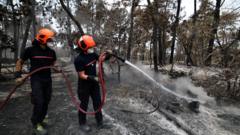
In the scorching summer heat of southern France, a devastating forest fire is terrifying enough on its own. But when the person suspected of igniting the blaze is one of the very volunteer firefighters trusted to extinguish it, a local crisis transforms into a national scandal. This rare but deeply unsettling phenomenon, known to criminologists as firefighter arson, exposes a profound vulnerability within the emergency services. The case in the Hérault region, where a long-serving volunteer admitted to starting multiple fires, reveals that the greatest threat to the forest might sometimes come from the inside.
To understand how a protector becomes a predator, one must look beyond the charred trees and examine the psychological and structural cracks in our emergency response systems.
The Dark Psychology of the Savior Complex
Firefighting is a profession built on heroism and public adoration. For most, the motivation is pure service. Yet, for a troubled few, the desire to be viewed as a hero becomes a destructive obsession.
Criminologists call this the hero complex. The individual craves the rush of adrenaline, the camaraderie of the fire station, and the gratitude of a rescued community. When fires do not occur naturally or frequently enough to satisfy this craving, the individual creates the emergency themselves.
They light the spark. They return to the station. They put on the uniform. Then, they rush to the scene to fight the very monster they created, basking in the praise of their peers and the public.
This is not a crime of profit. It is a crime of ego, control, and psychological validation. In the French case, the suspect reportedly sought social recognition and a thrill that ordinary life could not provide. The fire became a stage, and the volunteer was both the playwright and the lead actor.
A System Built on Unvetted Trust
The French model of firefighting relies heavily on volunteer forces. These individuals, known as sapeurs-pompiers volontaires, make up nearly eighty percent of the country's firefighting workforce. They are ordinary citizens—mechanics, teachers, farmers—who step up when the alarm sounds.
This system is magnificent in its community spirit, but it is dangerously fragile in its screening processes.
Volunteer departments are perpetually short-staffed, especially as summers grow longer and hotter due to changing climate patterns. When recruitment pressure rises, background checks and psychological evaluations often become secondary concerns.
- Volunteer recruitment focuses primarily on physical fitness and basic technical aptitude.
- Psychological screening is frequently rudimentary, consisting of basic interviews rather than deep personality assessments.
- Local stations operate as tight-knit social clubs where questioning a colleague's integrity is viewed as a betrayal.
This culture of automatic trust creates a blind spot. A member who shows an unusual obsession with fire or who is always the first to arrive at a newly reported blaze is often praised for their dedication, rather than questioned for their suspicious proximity to the starting points.
The Severe Ecological and Social Toll of Insider Arson
When an insider starts a fire, the damage is uniquely severe. Firefighters possess specialized knowledge that ordinary arsonists lack. They understand terrain, wind patterns, response times, and fuel loads.
They know exactly where to strike to cause the maximum amount of chaos while ensuring they have enough time to get back to the station and join the response crew.
In the Hérault fires, thousands of hectares of ancient Mediterranean forest were reduced to ash. Habitats were destroyed, vineyards scorched, and hundreds of residents forced to flee their homes. The financial cost of mobilizing hundreds of personnel, water-bombing aircraft, and heavy machinery runs into millions of euros.
But the social cost is even higher.
The relationship between a volunteer fire department and its local village is sacred. Residents trust these men and women with their lives and properties. When that trust is shattered by an act of betrayal, the social fabric of the entire region begins to fray. Neighbors look at neighbors with suspicion. Every siren becomes a source of anxiety rather than comfort.
Redefining the Safety Net
Fixing this vulnerability requires a uncomfortable confrontation with the reality of emergency service recruitment. The solution is not to disband the volunteer network, which remains absolutely vital for rural survival, but to professionalize the oversight.
First, psychological screening must be standardized and repeated at regular intervals, not just conducted once during initial recruitment. Firefighters deal with high-stress environments that can trigger dormant psychological issues over time. Continuous monitoring is essential.
Second, departments must utilize modern data analytics to monitor fire patterns alongside personnel dispatch records. If a specific volunteer is consistently near the origin of fires before they are officially reported, software should flag this anomaly automatically, removing the burden of suspicion from human colleagues who might be hesitant to accuse a friend.
Finally, the culture of silence must be dismantled. Firefighters must be trained to recognize the warning signs of arsonist behavior within their own ranks, and anonymous reporting channels must be established to allow concerns to be raised without fear of social ruin.
The flames in southern France have been extinguished, but the ash left behind serves as a stark warning. As long as emergency services prioritize quick recruitment over rigorous psychological vetting, the very people sent to save the forest will remain a potential source of its destruction.


