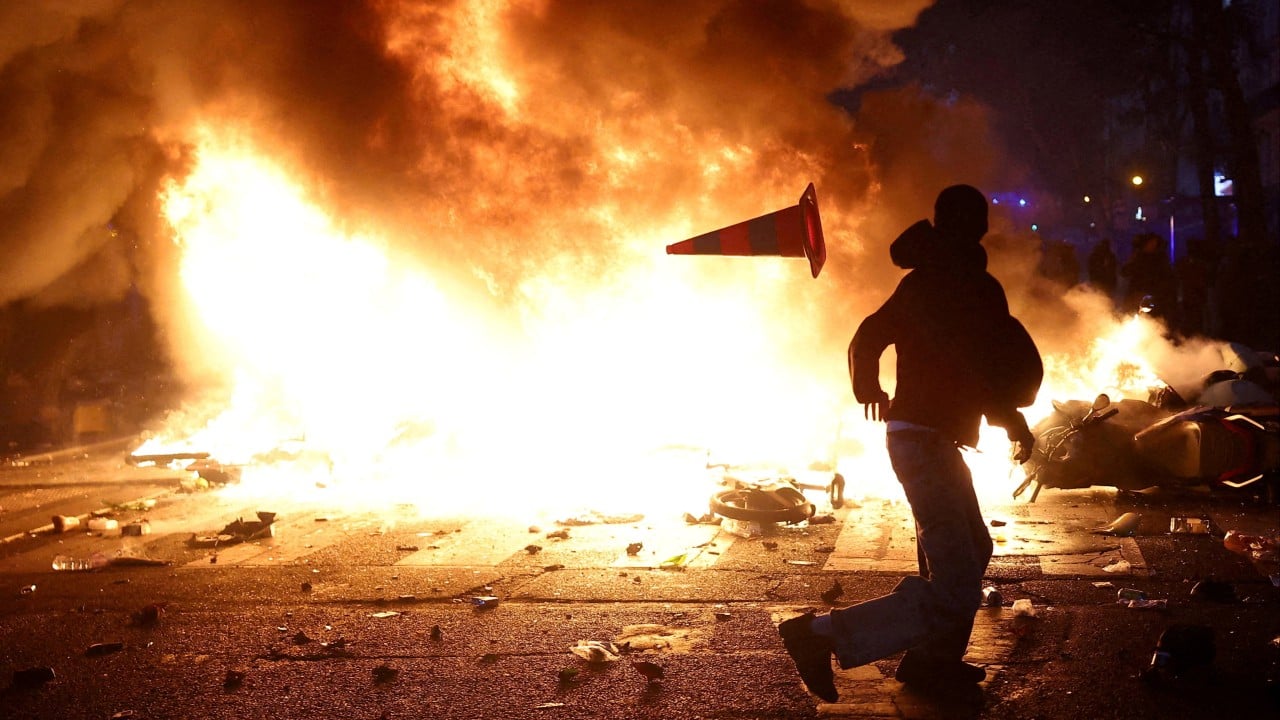
A fire broke out near Adolf Hitler’s former mountain retreat in the Bavarian Alps, prompting emergency evacuations, rapid firefighter mobilization, and the swift arrest of a suspect by German authorities. While initial wire reports treated the incident as a straightforward arson arrest at a notorious historical site, the reality on the ground in Obersalzberg is far more complicated. The blaze did not simply threaten timber and historic stone; it ignited decades of unresolved tension over how modern Germany polices, preserves, and protects the physical remnants of the Third Reich from both neo-Nazi pilgrims and impulsive vandals.
Firefighters from Berchtesgaden and surrounding municipalities scrambled up steep, winding mountain roads to contain the flames before they could spread into the dense surrounding forests or reach sensitive historical structures. Thick smoke drifted across the alpine ridge, visible for miles across the valley floor. Local police established a perimeter quickly, detaining a suspect near the scene shortly after the first emergency calls came in. Yet the operational success of the emergency response masks a persistent vulnerability that regional security officials have quietly worried about for years.
Anatomy of an Alpine Flashpoint
To understand why a fire in this specific corner of southeastern Bavaria triggers immediate national scrutiny, you have to understand the geography of Obersalzberg. Perched high above the town of Berchtesgaden near the Austrian border, the mountainside is not a single building. It is a sprawling complex of tunnels, ruins, foundations, and surviving structures scattered across rugged terrain.
When headlines refer to "Hitler's mountain retreat," they are usually conflating several distinct sites. There is the Berghof, Hitler’s actual residence, which was heavily bombed by the Allies in 1945 and demolished by Bavarian authorities in 1952 specifically to prevent it from becoming a shrine. There is the Kehlsteinhaus, better known in English as the Eagle's Nest, a mountaintop teahouse sitting at 1,834 meters that survived the war intact and now operates as a seasonal restaurant and tourist destination. And then there is the Dokumentation Obersalzberg, a modern museum and educational center built over the sprawling bunker network that once housed the Nazi leadership.
Fighting a fire anywhere on this mountain is a logistical nightmare. The roads are narrow, switchbacked, and prone to bottlenecks. Water pressure at higher elevations requires relay pumping from valleys below, and heavy alpine winds can turn a localized brush or structural fire into an uncontrollable crown fire within minutes.
- Terrain constraints limit the size and weight of fire apparatus that can reach upper elevations quickly.
- Subterranean bunker networks create ventilation hazards, trapping heat and toxic smoke underground while complicating search-and-rescue protocols.
- Dense tourist foot traffic during peak months means evacuations must funnel hundreds of civilians down single-lane mountain passes while emergency vehicles push upward.
The rapid arrest of a suspect indicates that local law enforcement had eyes on the area—or benefited from immediate eyewitness reporting—proving that surveillance around Obersalzberg has tightened considerably over the last decade. Still, catching a suspect after a match is struck does not solve the underlying problem of why people keep coming to this mountain to make statements.
The Architecture of Contested Memory
Competitor coverage almost always misses the ideological tug-of-war embedded in the soil of Obersalzberg. Every stone on that ridge is contested territory. For nearly eighty years, the Free State of Bavaria has walked an impossible tightrope between historical education and the prevention of far-right idolatry.
In the immediate postwar decades, the strategy was erasure. Blow up the Berghof. Let the forest swallow the concrete foundations. Pretend the mountain was just another scenic Bavarian resort. That approach failed miserably. By the 1990s, local officials realized that unguided ruins were acting as a magnet for neo-Nazis, conspiracy theorists, and morbid curiosity seekers who wandered the woods unsupervised, leaving wreaths, taking selfies at the overgrown Berghof steps, and inventing their own mythologies.
The opening of the Dokumentation Obersalzberg in 1999—and its massive expansion completed in recent years—represented a fundamental shift in strategy. Instead of hiding the history, the state decided to contextualize it aggressively. Today, visitors are confronted with unambiguous documentation of the atrocities planned from this exact mountainside, from the invasion of Poland to the machinery of the Holocaust.
"You cannot demolish memory with dynamite, nor can you leave historical crime scenes unguarded in the woods and expect silence."
Yet visibility brings its own set of security headaches. By turning Obersalzberg into an internationally recognized educational landmark attracting hundreds of thousands of visitors annually, authorities also created a high-profile target. A fire here guarantees global headlines. Whether the perpetrator is driven by far-right extremism, anti-fascist vigilantism, mental instability, or sheer nihilism, the symbolic value of burning anything connected to Hitler’s alpine headquarters is unmistakable.
Why Standard Security Models Fail at Historical Sites
Protecting a standard museum is straightforward. You install perimeter fencing, deploy motion sensors, station guards at choke points, and lock the doors at night. You cannot put a glass box around an entire mountain.
Obersalzberg remains a living, multi-use landscape. Alongside the documentation center and the Eagle's Nest, the area includes luxury hospitality developments, public hiking trails, forestry operations, and residential properties. Thousands of hikers traverse the trails every week without passing through a single security checkpoint.
This open-access reality creates massive blind spots for German intelligence and local police. Consider the competing priorities at play on the ridge:
| Stakeholder Group | Primary Objective | Security Implication |
|---|---|---|
| Bavarian State Authorities | Prevent far-right pilgrimage and maintain public order | Requires continuous monitoring without turning the region into a militarized zone |
| Historical Educators | Preserve authentic ruins and bunker access for research and public memory | Restricts invasive structural modifications that might damage original masonry |
| Local Tourism Operators | Keep roads, trails, and viewpoints accessible to paying visitors | Opposes heavy-handed closures, bag searches, or intimidating police checkpoints |
| Forestry & Fire Services | Maintain clear access routes and mitigate wildfire risks | Struggles against protected conservation zones and steep topographical barriers |
Because nobody wants to turn a premier Bavarian tourist region into an armed fortress, security relies heavily on reactive policing and discreet surveillance. Cameras watch key historical choke points, such as the remaining retaining wall of the Berghof. Plainclothes officers periodically patrol known gathering spots. But if someone walks off a public hiking trail with an accelerant and a lighter, the first warning sign is usually smoke.
The Psychological Pull of the Berghof Ruins
To understand the motive behind attacks or arson at Obersalzberg, you have to strip away the Hollywood mythology surrounding Hitler’s mountain sanctuary. During the 1930s, Joseph Goebbels’ propaganda ministry worked tirelessly to portray the Berghof as a peaceful alpine retreat where a benevolent leader communed with nature, petted his dogs, and hosted foreign dignitaries.
In truth, Obersalzberg was the second seat of government for the Third Reich. Hitler spent roughly a quarter of his entire time in power there. Crucial military escalations and genocidal policies were finalized in its reception rooms while staff looked out over the Untersberg mountain range.
That stark contrast—breathtaking natural beauty paired with unimaginable state terror—creates a potent psychological charge that still resonates today. For far-right extremists, the site represents a lost center of power. For others, the physical survival of any structure associated with the regime feels like an intolerable insult to its victims.
When a suspect is arrested for setting a fire on this mountain, investigators have to untangle those competing impulses immediately. German prosecutors treat politically motivated crimes at Nazi-era sites with extreme severity under strict constitutional laws governing public peace and anti-constitutional symbols. However, investigative veterans know that headlines often outpace the actual forensic psychology of the perpetrator. Sometimes an arsonist is executing an ideological statement; other times, an unstable individual simply gravitates toward the most famous name on the regional map to ensure their actions are noticed.
The Hidden Infrastructure Vulnerability
Beyond the ideological drama, this fire exposes a physical problem facing historical sites across Europe: aging infrastructure colliding with climate-driven wildfire risks.
The surviving concrete and stone structures at Obersalzberg are nearly ninety years old. Built rapidly in the late 1930s using forced labor and wartime materials, many of the ancillary buildings, retaining walls, and tunnel entrances suffer from decades of freeze-thaw damage. Timber framing in surviving structures is bone-dry. Meanwhile, Alpine summers and autumns have grown noticeably drier over the past twenty years, turning the spruce and beech forests blanketing the slopes of the Kehlstein into tinderboxes.
Fire departments in rural Bavaria are overwhelmingly staffed by dedicated volunteers—highly trained, deeply committed locals who drop their day jobs when the sirens wail. They know every bend in the road and every hydrant in the valley. Yet asking volunteer brigades to simultaneously manage complex structural fires, hazardous underground bunker ventilation, tourist evacuations, and potential crime scenes pushes local emergency infrastructure to its absolute limit.
If a blaze starts during dry, windy conditions—known locally as the Föhn, a warm, dry downslope wind common in the Alps—firefighters have a window of minutes, not hours, before a localized arson incident becomes an ecological and historical catastrophe.
What Happens After the Sirens Fade
Once the embers are cooled and the crime scene tape comes down, the legal and political machinery in Bavaria will follow a predictable path. The suspect will face interrogation by state security investigators (Staatsschutz), who handle politically sensitive offenses in Germany. Prosecutors will examine digital footprints, travel records, and financial transactions to determine whether the suspect acted alone or was radicalized within an online network.
Meanwhile, preservationists and state officials will quietly assess the physical damage and review surveillance blind spots. Every incident like this triggers fresh debate in Munich and Berlin over whether current protections around Third Reich sites are sufficient.
Some voices routinely call for completely sealing off the remaining ruins of the Berghof, arguing that any physical trace left above ground invites trouble. Historians push back just as hard, warning that erasing physical evidence plays directly into the hands of Holocaust deniers and historical revisionists who thrive when tangible proof disappears.
The arrest on the mountain proves that local police and emergency responders can contain a crisis before it spirals out of control. Yet as long as the concrete foundations of Obersalzberg remain embedded in the Bavarian rock, the mountain will continue to attract those who want to worship the past, those who want to burn it down, and the firefighters forced to stand in between.