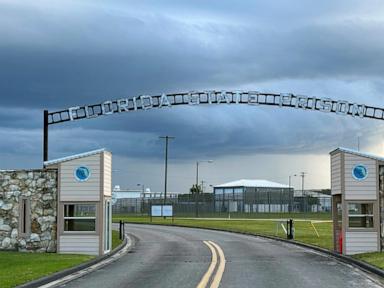
The headlines are predictable. They read like a scorecard. "Sixth execution of the year." "Justice served for a decade-old crime." The mainstream media treats these events like sports statistics, tracking the velocity of Florida’s death chamber as if efficiency equals efficacy. It does not.
If you think the surge in Florida’s execution rate in 2026 is a victory for law and order, you are looking at the wrong map. We are witnessing the frantic clearing of a backlog, a desperate attempt to prove a point that the legal system stopped being able to justify decades ago. The "lazy consensus" suggests that more executions mean a safer society or a more decisive judiciary. In reality, it signals a system that has failed to innovate, failed to manage its own docket, and is now resorting to the ultimate "fix" to mask its internal rot. Recently making headlines in related news: The Anatomy of Legal Reciprocity in Public Personalities Taylor Frankie Paul and the Mechanics of Restraining Orders.
The Myth of the Deterrence Spike
Let’s start with the most tired argument in the room: deterrence. Proponents love to claim that a busy execution chamber sends a message. Data from the Death Penalty Information Center and various longitudinal studies across the American South tell a different story. Crime rates don’t fluctuate based on whether a state executes five people or fifteen in a calendar year.
The criminal mind does not perform a cost-benefit analysis based on the current throughput of the Florida Department of Corrections. To suggest otherwise is to ignore the psychology of violent crime. Most of these cases, including the horrific killing of a 13-year-old by a family member, are products of profound psychological dysfunction, not calculated risks weighed against state policy. By the time a man is sitting on death row for twenty years, the "message" has long since evaporated. We aren't deterring the next monster; we are just performing a ritual for a public that has been conditioned to mistake vengeance for safety. More details into this topic are covered by The New York Times.
The Logistics of Desperation
Why six executions already? Why now? It isn't because Florida suddenly became more efficient at finding the truth. It is because the legislative hurdles were lowered. We saw the shift from a unanimous jury requirement to an 8-4 vote. This wasn't an upgrade; it was a downgrade of the "beyond a reasonable doubt" standard.
When you lower the bar for the ultimate punishment, you aren't making the state stronger. You are making it lazier. I have watched legal departments and state offices trade quality for quantity when the political pressure to "get results" reaches a fever pitch. In any other industry, if you lowered your quality control standards to increase your output, your stock would crater. In the business of state-sanctioned death, the public cheers for the increased volume while ignoring the precariousness of the process.
The Cost of the "Quick Fix"
The fiscal conservatives in the room should be the loudest critics here. The irony of the pro-death penalty stance is that it is the most expensive way to run a justice system.
- Pre-trial costs: Capital cases require more experts, more investigators, and more time.
- Automatic appeals: The state is legally bound to fund a multi-decade marathon of litigation.
- Incarceration: Death row housing is significantly more expensive than general population housing.
When Florida ramps up its execution schedule, it isn't saving money. It is finally paying the bill on a debt that has been accruing interest for twenty years. We are burning millions of taxpayer dollars to end a life that could have been neutralized by a life sentence without parole for a fraction of the cost. If this were a private corporation, the CFO would have been fired years ago for choosing the most expensive, least effective solution to a long-term problem.
The "Justice for Families" Fallacy
We are told these executions provide "closure." This is perhaps the most predatory lie in the entire narrative. As someone who has navigated the intersection of policy and human trauma, I can tell you that "closure" is a marketing term used by politicians, not a clinical reality for the grieving.
By the time an execution happens in 2026 for a crime committed in the early 2000s, the family has lived in a state of suspended animation for two decades. They have been dragged through every appeal, every stay, and every gruesome detail of the crime, over and over again. The state doesn’t give them peace; it gives them a front-row seat to a legal circus that refuses to leave town.
True justice would have been a swift, certain life sentence that allowed the family to begin their mourning process in 2008, rather than keeping the wound open until 2026 so a governor could look "tough" on a Sunday morning talk show.
The Intellectual Cowardice of the Middle Ground
Most people want to be "moderate." They say things like, "I support the death penalty for the worst of the worst."
This is an intellectual cop-out.
The "worst of the worst" is a moving target defined by whoever holds the gavel. When we accept a high volume of executions as a metric of success, we accept the inevitability of a mistake. You cannot have a high-output system without a margin of error. In manufacturing, a 1% error rate is world-class. In the execution of human beings, a 1% error rate is a moral catastrophe. Since 1973, over 190 people have been exonerated from death row in the U.S. That is not a "robust" system. That is a system that is failing nearly 10% of the time at its most critical juncture.
Imagine a scenario where a commercial airline crashed 10% of its flights. Would you celebrate the airline for having the most departures in the country? Of course not. You would grounded the entire fleet. Yet, we watch Florida’s 2026 execution streak and call it "justice."
The Pivot Nobody Admits
The real reason for this surge isn't about the specific crimes or the specific inmates. It is about political branding. Executions are the ultimate performance art for a certain type of voter. They provide a visceral, albeit temporary, sense of resolution.
But look at the mechanics. Look at the drugs being used, the secrecy surrounding the suppliers, and the rushed protocols. This isn't the behavior of a confident, transparent government. It is the behavior of an entity trying to get the job done before the next legal challenge or the next pharmaceutical embargo hits.
We are prioritizing the "kill count" over the integrity of the process. We are celebrating the fact that the machine is running fast, without ever asking where it’s actually going.
The focus on the "13-year-old step-niece" in the headlines is a calculated emotional hook. It’s designed to make you stop thinking and start feeling. It’s designed to make any critique of the process seem like an endorsement of the criminal. I’m not here to defend a killer. I’m here to tell you that a state that measures its success by how many people it can put down in a calendar year is a state that has given up on actually solving the root causes of violence.
Stop looking at the needle and start looking at the system that’s holding it. Florida isn't winning. It's just cleaning out its closets because it doesn't know how to build a better house.
The sixth execution of 2026 isn't a milestone. It’s an admission of failure.