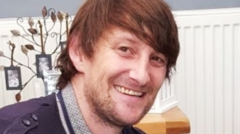
The call to emergency services sounded like a scene from a nightmare. A man, breathless and panicked, claimed he’d just stumbled upon a brutal attack. He told operators he was a Good Samaritan, an innocent passerby who tried to intervene when he saw his old school friend being mauled by an unknown assailant. It’s the kind of story that tugs at the heartstrings. You want to believe in the hero who risks it all for a former classmate. But investigators have seen this script before. They know that when the details feel a bit too cinematic, the truth is usually buried in the blood spatter.
In the case of David Hodgson and the killing of Robert "Roy" Benwell, the "hero" narrative didn't even survive the first 24 hours of scrutiny. This wasn't a random act of violence or a rescue gone wrong. It was a calculated, frenzied murder hidden behind a thin veil of fake altruism. If you think you can outsmart a modern forensics team with a shaky alibi and some crocodile tears, you're living in a fantasy.
The Myth of the Random Attacker
Most people think killers are masterminds. They aren't. They’re usually impulsive, messy, and desperate. When Hodgson told police that a mysterious figure had jumped Roy and then vanished into the night, he relied on an old trope. The "shadowy stranger" is the go-to excuse for the guilty. It’s easy to say, but nearly impossible to prove because, well, it didn't happen.
Crime scene investigators look for what they call "directional flow." If a third party had actually been involved, there would be an extra set of footprints. There would be DNA that doesn't belong to the victim or the witness. There would be a trail of exit. In the Benwell case, the scene was a closed loop. The only people present were the victim and the man claiming to be his savior.
Detectives looked at the relationship. These two weren't just random acquaintances; they were school friends with a history. That’s a red flag. Random attacks are rare. Most murders are intimate. They’re about money, grudges, or perceived slights that have been simmering for decades. When you hear "Good Samaritan," you should usually start looking for a motive.
Why Blood Spatter Is a Liar's Worst Enemy
You can scrub your hands. You can burn your clothes. You can even lie to a polygraph. But you cannot change the physics of fluid dynamics. Blood spatter is the most honest witness in the room.
If Hodgson had been trying to save Roy, the blood on his clothing would have looked a certain way. We call this "transfer stains." This happens when you touch a bloody surface or try to apply pressure to a wound. It’s smeared, dull, and localized.
But a "frenzied murder" creates something entirely different: high-velocity impact spatter. When a weapon—whether it’s a knife, a hammer, or a pipe—hits a body repeatedly, it flings tiny droplets of blood backward onto the attacker. This is "cast-off." These droplets are microscopic. They land in the hair, inside the pockets, and behind the ears.
When forensics teams analyzed the "Good Samaritan," they didn't find the large, messy smears of a rescuer. They found the misted patterns of a killer. It proved he was standing over the victim during the strikes, not after them. You can't explain that away by saying you were "just trying to help." The geometry of the room simply says you're lying.
The Psychology of the Frenzied Attack
There’s a massive difference between a professional hit and a personal execution. A frenzied attack, involving dozens of wounds, tells a story of pure, unadulterated rage. It’s what psychologists call "overkill."
In the Benwell murder, the sheer number of injuries pointed to someone who wasn't just trying to stop Roy, but someone who wanted to erase him. This isn't the work of a mugger. A mugger wants your wallet and a quick escape. Overkill suggests a deep-seated emotional connection. It suggests the killer knew the victim's face and hated it.
Signs of a Staged Crime Scene
- The "Hurry Up" Factor: The suspect calls 911 almost too quickly, trying to control the narrative before police arrive.
- Selective Memory: They remember the "attacker's" height perfectly but can't remember what they did with their own phone.
- Injuries on the "Hero": Often, killers will give themselves a minor "defensive" wound to look like a victim. Forensics can tell these are self-inflicted because they lack the force and "hesitation marks" of a real fight.
Digital Breadcrumbs and the 2026 Reality
If this crime happened today, Hodgson wouldn't have even made it to the police station before his story fell apart. We live in an era of digital footprints that are impossible to erase.
Between CCTV, doorbell cameras, and the GPS pings from a smartphone, the "mysterious attacker" has nowhere to hide. If a third person had fled that scene, they would have been caught on a neighbor's Ring camera. If Hodgson had planned the meeting, there would be a trail of deleted texts or a Google search for "how to clean blood off suede."
Even "incognito" mode is a joke to modern digital forensics. They find the cache. They find the timestamps. They find the truth. In the Benwell case, the lack of an external trail was just as damning as the physical evidence. The world didn't see a third man because the third man was a ghost.
The Trial and the Weight of Truth
When this case hit the courtroom, the defense tried to play on the "school friend" bond. They tried to paint Hodgson as a man traumatized by what he saw. But the jury saw the photos. They heard the experts explain that the blood on his shoes could only have gotten there if he was the one swinging the weapon.
The "Good Samaritan" defense is a gamble. It relies on the hope that the police are lazy and the jury is gullible. It fails because science doesn't have an emotional bias. A DNA profile doesn't care if you went to school together. A forensic pathologist doesn't care how loud you cried on the witness stand.
The conviction of David Hodgson wasn't just a win for the local police; it was a testament to the fact that the "perfect crime" is a myth. Every contact leaves a trace. You cannot enter a space, kill a human being, and leave without taking a piece of that scene with you.
How to Evaluate True Crime Stories
- Look for the "Why Now?": Why would a friend suddenly turn? There's always a trigger, usually financial or romantic.
- Check the Physical Logistics: Does the timeline actually allow for a third party to escape? Usually, the math doesn't add up.
- Follow the Forensics: If the DNA doesn't match the story, the story is fiction. Period.
If you find yourself following a high-profile case, stop listening to the "he said, she said" drama. Look at the forensics. Look at the blood. Look at the data. The "Good Samaritan" who happens to be covered in his friend's blood isn't a hero. He's just a killer who ran out of luck and time.
Stop falling for the "random stranger" defense. It's the oldest lie in the book, and in the modern age, it's the easiest one to disprove. Stick to the hard evidence and you'll see the truth long before the verdict is read.