The midnight air over Novofedorivka usually carries the heavy, salty dampness of the Black Sea. But just after midnight, the coastal breeze tore open. The sound came first as a low, synchronized hum, like a plague of mechanical hornets tracking across the dark water. Then came the rattle of small arms fire, panicked and blind, followed by five distinct, earth-shaking thuds.
Deep inside the Saki air base, a multi-million-dollar piece of military hardware began to burn.
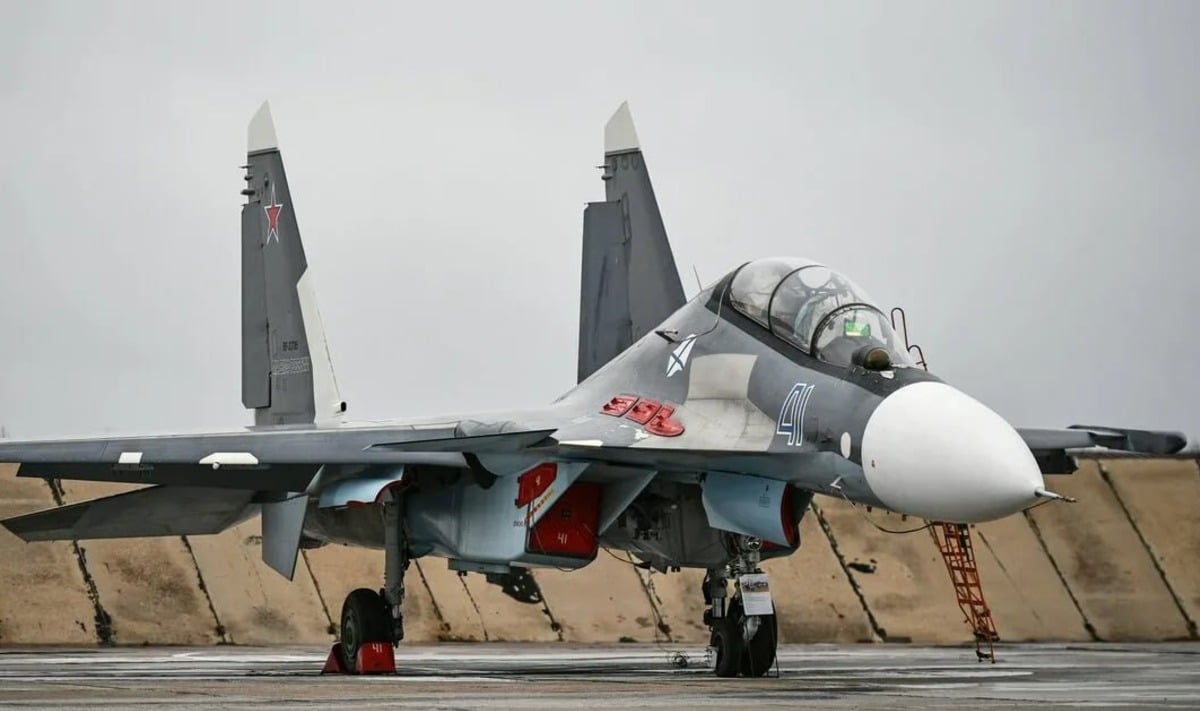
For years, the Saki airfield in occupied Crimea functioned as a fortress of untouchable certainty. From its runways, Russian Su-30 and Su-30SM fighter jets screamed into the sky, carrying the power to dictate terms to the lands below. To the pilots who flew them and the crews who polished their hulls, these hangars were sanctuaries. They were thick, concrete structures designed to shield engineering marvels worth anywhere from $30 million to $50 million apiece from the elements and the enemy.
Then the Security Service of Ukraine (SBU) sent a swarm of cheap, plastic-and-carbon drones to rewrite the math of modern warfare.
To understand how a handful of lawnmower-engined drones can upend a multi-million-dollar air defense network, consider a hypothetical mechanic named Nikolai stationed at Saki. For months, Nikolai’s routine has been defined by the luxury of distance. The front lines are hundreds of miles away. The war is something that happens to other people, viewed through Telegram videos or experienced as a distant vibration. His job is to maintain the intricate avionics of a Su-30SM—a twin-engine, supermaneuverable beast of a jet.
But when the roof of the hangar collapses in a shower of sparks and burning fuel, distance evaporates.
The SBU confirmed five direct hits on the base’s hangar infrastructure. It was not a random act of harassment. It was a cold, calculated execution. Preliminary reports revealed that both Su-30 and Su-30SM jets were nestled in those structures when the roofs caved in. The subsequent inferno inside the Su-30SM hangar could be seen from miles away, lighting up the Crimean night and leaving thermal signatures that lit up satellite tracking maps like a flare.
The strike did not happen in a vacuum. It marks the opening salvo of a highly coordinated, 40-day campaign officially authorized by Ukrainian President Volodymyr Zelenskyy. The objective is not merely territorial attrition; it is psychological leverage. By choosing a 40-day window, Ukraine is deliberately introducing a relentless ticker into the minds of Russian planners. It is an "influence operation" designed to prove that no asset, no matter how deeply buried behind air defenses or concrete walls, is safe.
The economic asymmetry of this conflict is dizzying. A modern fighter jet is an incredibly complex ecosystem of rare metals, advanced radar systems, and foreign-sourced microchips. If you lose one, you cannot simply order another from a factory floor; the supply chains are strangled by sanctions. A drone, by contrast, can be assembled in a basement in Kyiv using off-the-shelf components, a basic soldering iron, and a commercial battery.
When a $20,000 drone annihilates a $50 million jet, the strategic calculus of occupation crumbles.
It forces the occupier to make agonizing choices. Do you pull your air defenses away from the front lines to protect your rear-area parking lots? If you do, the infantry on the ground gets chewed up by artillery. Do you move your jets further back into mainland Russia? If you do, you burn precious flight hours and fuel just getting to the battlespace, shortening the operational lifespan of your fleet.
The fire that broke out in the reeds near the Saki shores—ignited by the falling debris of missiles and drones—eventually died down as dawn broke over Crimea. But the smoke rising from the hangar remained. For the people living in the shadow of the base, and for the planners sitting in Moscow, the silence that followed was far louder than the explosions. The forty-day clock is ticking, and the sky is no longer a shield.