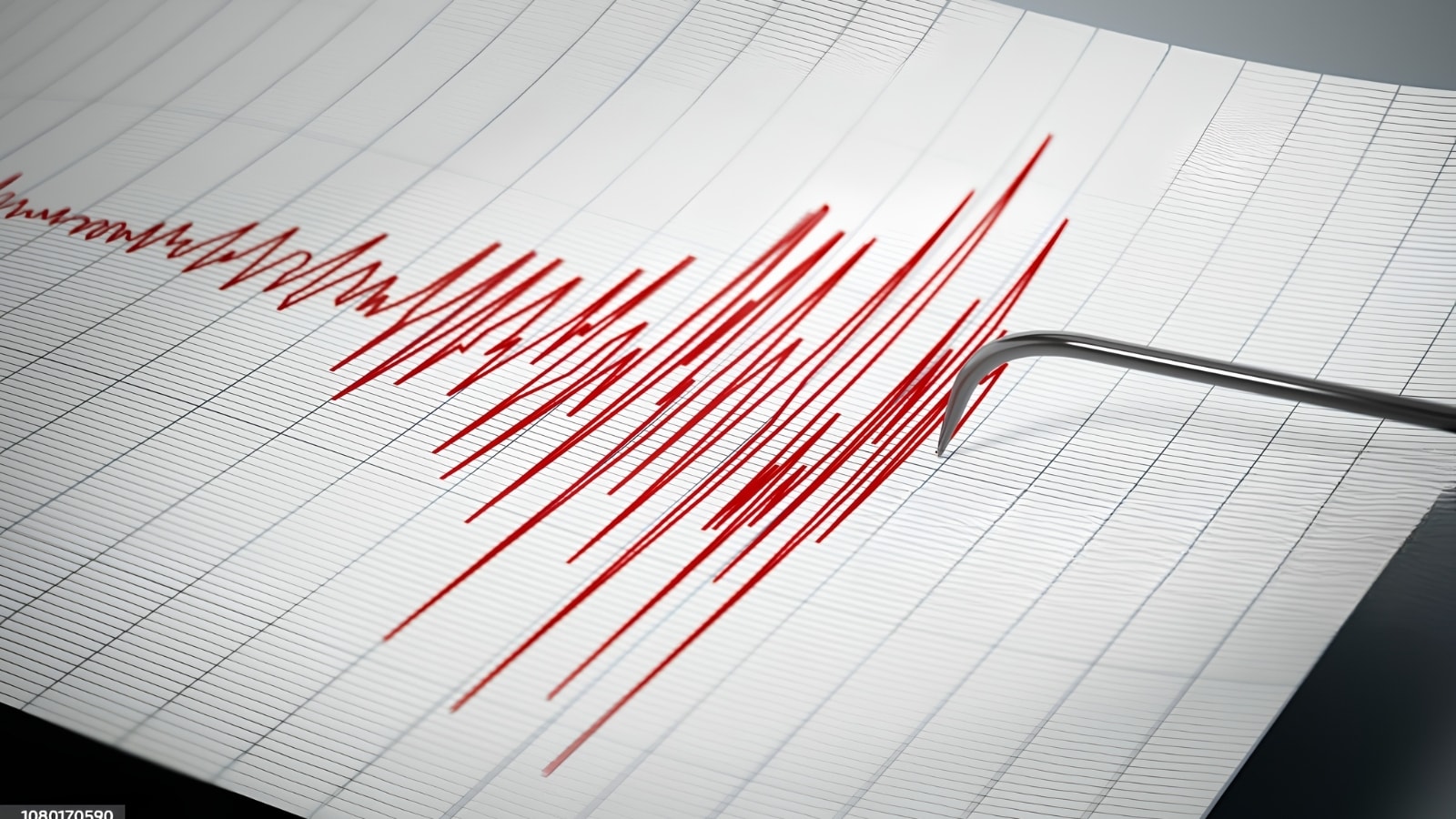
Silence.
That is the first lie an earthquake tells you, arriving in the fraction of a second before the floorboards begin to hum like a plucked cello string and the teacup on your desk starts a frantic, circular dance across the wood grain. Recently making news lately: Anatomy of Urban Mass Casualty Events in High-Density Pedestrian Zones.
When a seismic wire report drops across Western news feeds bearing a dry, clinical headline—Strong earthquake with magnitude of 5.7 strikes Japan—the world outside the archipelago glances at the digits, notes the absence of a tsunami warning, and scrolls past toward sports scores or market tickers. To an outsider, 5.7 is a statistical shrug. It sits comfortably below the catastrophic thresholds of 7.0 or 8.0 that rewrite geography and dominate evening broadcasts for weeks.
Yet standing inside a fourth-floor apartment in eastern Japan when that 5.7 arrives feels nothing like a shrug. It feels like the planet itself has lost its footing and is dragging your living room down with it. Further information on this are detailed by The New York Times.
The Anatomy of Forty Seconds
To understand what a 5.7 magnitude tremor actually does to human flesh and reinforced concrete, leave behind the cold geometry of the Richter or Moment Magnitude scales and step into a hypothetical Tuesday evening in a coastal prefecture like Chiba or Miyagi.
Meet Kenji, a 42-year-old structural logistics coordinator who lives fifteen minutes from the Pacific coast. At 7:14 PM, Kenji is standing over his stove, watching miso soup simmer while his eight-year-old daughter, Hana, sketches at the low dining table. There is no Hollywood roar of crumbling skyscrapers. Instead, there is the Kinkyu Jishin Sokuho—Japan’s Earthquake Early Warning system—chiming simultaneously on Kenji’s phone, his tablet, and the municipal loudspeaker outside his window with an eerie, two-tone descending chime engineered specifically to bypass rational thought and trigger immediate muscular action.
You have maybe six seconds.
Six seconds between the arrival of the fast-moving, nearly imperceptible primary wave (the P-wave) and the arrival of the slower, violent secondary wave (the S-wave) that actually tears plaster from walls and throws bookshelves across rooms. In those six seconds, Kenji does not check social media. He turns off the gas burner—though modern Japanese smart meters automatically shut off gas lines once shaking hits a threshold of Shindo 5—and drops beneath the heavy oak dining table beside his daughter, pulling a sofa cushion over the back of her neck.
Then the S-wave hits.
A magnitude 5.7 earthquake releases roughly the energy of 15 kilotons of TNT, roughly equivalent to the blast yield of the device dropped on Hiroshima, except buried thirty to fifty kilometers beneath the Earth's crust. Because seismic scales are logarithmic, a 5.7 carries over thirty times more energy than a 4.7, yet thirty times less than a 6.7. Numbers, however, fail to capture the Shindo scale—Japan’s proprietary seismic intensity measurement that abandons how much energy the Earth released at the hypocenter and measures instead how violently your coffee table is slamming against your shins right now.
At a Shindo 4 or 5-Lower, which a shallow or moderately deep 5.7 routinely generates across hundreds of square kilometers, standing upright becomes nearly impossible. Cabinets swing open like startled mouths. Unsecured ceramic plates launch outward in flat, lethal trajectories. The building itself does not crack; instead, it sways with a sickening, rhythmic groan, flexing like a bamboo stalk in a typhoon because Japanese building codes enacted in 1981 and tightened after the 1995 Kobe disaster mandate base isolation and ductile steel framing designed to bend rather than snap.
Forty seconds later, the floor goes still. The hanging ceiling lamp continues to swing in wide, hypnotic arcs. Hana is crying quietly, clutching her colored pencils. Kenji’s heart hammers against his ribs at 140 beats per minute, even though not a single windowpane in his apartment has shattered.
Why 5.7 Is the Psychological Fault Line
If you ask anyone who has lived through multiple major seismic cycles in Tokyo, Sendai, or Kumamoto, they will tell you an uncomfortable truth: massive earthquakes break cities, but moderate-to-strong earthquakes break sleep.
A magnitude 5.7 sits directly on the psychological fault line of disaster preparedness. It is too weak to collapse modern code-compliant housing, yet far too violent to ignore. Every resident of the Japanese archipelago carries a mental ledger of past tremors—most notably the March 11, 2011 Tohoku catastrophe, a 9.1 colossus that triggered a devastating tsunami and nuclear meltdown, as well as the 2016 Kumamoto sequence, where a magnitude 6.2 "foreshock" lulled residents back into their damaged homes just twenty-eight hours before a magnitude 7.0 mainshock flattened them.
Consider what happens next in the mind of someone living on the Pacific Ring of Fire: is this the main event, or is this merely the throat-clearing before something worse?
Seismologists at the Japan Meteorological Agency (JMA) cannot answer that question in the first hour. No scientist on Earth can. While seismology excels at mapping tectonic stress—specifically where the Pacific Plate and Philippine Sea Plate dive relentlessly beneath the North American and Eurasian plates at rates of up to eight centimeters per year—earthquake prediction remains an unsolved frontier. Instead, JMA officials hold press conferences within ninety minutes of any Shindo 5 tremor to deliver a sober, standardized warning: For the next week, particularly over the next two to three days, remain vigilant against earthquakes of similar or greater intensity.
That single sentence alters the rhythm of daily life for millions of people.
Tonight, Kenji will not sleep in pajamas. Across thousands of households in the affected region, residents quietly lay out sturdy sneakers, thick socks, flashlights, and heavy jackets beside their beds before turning off the lights. Bathwater is left inside the tub rather than drained, serving as an emergency reservoir for flushing toilets if municipal water mains rupture. Smartphone batteries are topped off to 100 percent and kept tethered to portable power banks.
This is the invisible tax of living where four tectonic plates grind against one another like rusted gears. The wire service reports zero fatalities and minor transit delays, declaring the event a non-story. Meanwhile, an entire region spends the next seventy-two hours listening to the wind rattle the window frames and wondering if that low rumble is a passing delivery truck or the floor preparing to drop out again.
The Invisible Ballet of Infrastructure
While human nervous systems remain frayed for days after a 5.7 tremor, Japan’s physical infrastructure executes an astonishing, pre-programmed choreography within milliseconds of the first tectonic twitch.
Look at the Shinkansen—the bullet train network carrying hundreds of thousands of passengers at speeds approaching 320 kilometers per hour. Traveling at nearly ninety meters per second, a train hitting warped tracks during an earthquake would suffer catastrophic derailment. To prevent this, East Japan Railway and its sister operators rely on UrEDAS (Urgent Earthquake Detection and Alarm System), a network of coastal and inland seismometers wired directly into the railway’s overhead power grid.
When that 5.7 struck off the coast or beneath the coastal plain, coastal sensors detected the initial P-wave before the destructive shaking even reached the rail corridor. Within two seconds, substations automatically severed electrical power to the overhead catenary lines, engaging emergency pneumatic brakes across every train in the sector. Passengers felt a sudden, firm deceleration, watched the countryside outside slow to a halt, and waited quietly in air-conditioned carriages while track inspection crews walked the ballast with laser levels and ultrasonic scanners.
Zero derailments. Zero passenger injuries. In more than sixty years of Shinkansen operation—including during the 9.1 megathrust earthquake of 2011—not a single passenger has ever died from a derailment or collision caused by seismic shaking.
That same invisible choreography ripples through every layer of urban survival:
- Elevators in commercial towers and apartment blocks detect the P-wave via internal seismic sensors, automatically halting at the nearest floor and sliding their doors open so no one remains trapped in dark shafts if power fails.
- Water treatment plants trigger emergency shutoff valves on major trunk lines, preserving clean drinking water inside fortified underground tanks even if residential distribution pipes crack under shear stress.
- Hospital surgical suites transition seamlessly to independent diesel and battery microgrids without a single flicker of the operating lamps, while base-isolated foundations allow entire multi-story medical wings to glide horizontally on massive rubber-and-lead bearings while the earth bucks beneath them.
To the casual observer reading a three-paragraph news brief, the lack of collapsed bridges or burning neighborhoods makes a 5.7 earthquake seem almost routine—a testament to Japanese resilience that gets reduced to a tired cultural cliché.
Resilience, however, is not a genetic trait or a mystical stoicism. It is expensive, exhausting, unglamorous engineering paid for in higher construction costs, stricter zoning laws, mandatory school drills twice a semester, and decades of learning from past failures. When a 5.7 hits a nation without that invisible armor, brick walls crumble onto sleeping families, unreinforced concrete pancaked floors trap thousands, and routine tremors become generational tragedies.
The Cost of Casual Familiarity
There is a quiet danger hidden inside competence, and Japanese disaster psychologists worry about it constantly. It is called normalcy bias—the human brain’s stubborn tendency to assume that because nothing catastrophic happened the last ten times the alarm chimed, nothing catastrophic will happen the eleventh time either.
When you experience three or four magnitude 5 tremors every year, the adrenaline response dulls. A coworker pauses mid-sentence during a Zoom call, waits for the monitor to stop wobbling, offers a tight smile, and resumes discussing quarterly spreadsheets. Commuters glance up from their phones on the Yamanote Line platform, feel the concrete vibrate beneath their soles, and go right back to reading manga before the chimes even finish echoing through the concourse.
Yet every tectonic stress release is a roll of loaded dice. A magnitude 5.7 occurring at a depth of sixty kilometers produces rolling, manageable motion at the surface. That exact same 5.7 occurring at a depth of eight kilometers directly beneath a dense urban basin—what seismologists call a chokugata or direct-hit inland earthquake—delivers violent, vertical hammer blows that tear water pipes out of foundations, topple vending machines onto sidewalks, and spark electrical fires when knocked-over space heaters ignite tatami mats once power is restored.
Look closer at the emergency kit sitting in the corner of Kenji’s entryway closet. Inside the gray waterproof backpack sit foil-wrapped emergency rations with a five-year shelf life, a hand-crank AM/FM radio, heavy leather work gloves for clearing broken glass, two bottles of water, a whistle, and a laminated card listing the exact address of the nearest municipal elementary school gymnasium designated as an evacuation shelter.
Every six months, on September 1—Japan’s national Disaster Prevention Day, marking the anniversary of the 1923 Great Kanto Earthquake that killed over 100,000 people—millions of families open those backpacks, rotate out expiring crackers, test flashlight batteries, and verify their emergency contact plans. Not because they live in constant terror, and not because they expect the worst from every 5.7 tremor, but because they understand a fundamental pact with geography: you do not conquer the earth beneath Japan. You negotiate with it, one reinforced bolt and one packed rucksack at a time.
The Quiet After the Chimes
Back in Kenji’s apartment, it is 8:30 PM. The miso soup has long since gone cold on the stove, reheated twice between aftershocks that registered 3.4 and 2.9—tiny, subterranean sighs as the fractured rock thirty kilometers below settles into its new alignment.
Hana has fallen asleep on the living room futon, still wearing her thick cardigan and woolly socks just in case the alarm chimes again before midnight. Beside her pillow sits a small pink flashlight she insisted on choosing herself at the hardware store last autumn.
Kenji stands at the sliding glass balcony door, looking out over a city where every streetlight is burning steady, every convenience store sign glows bright against the dark, and the distant tail lights of commuter trains are already moving smoothly along the elevated tracks. To anyone watching from afar, nothing happened here tonight. Just another number on a seismic feed, already sliding down the page into yesterday’s archive.
Inside the quiet apartment, Kenji reaches down, adjusts the edge of the blanket over his daughter’s shoulder, and checks that his shoes are pointed toward the front door.