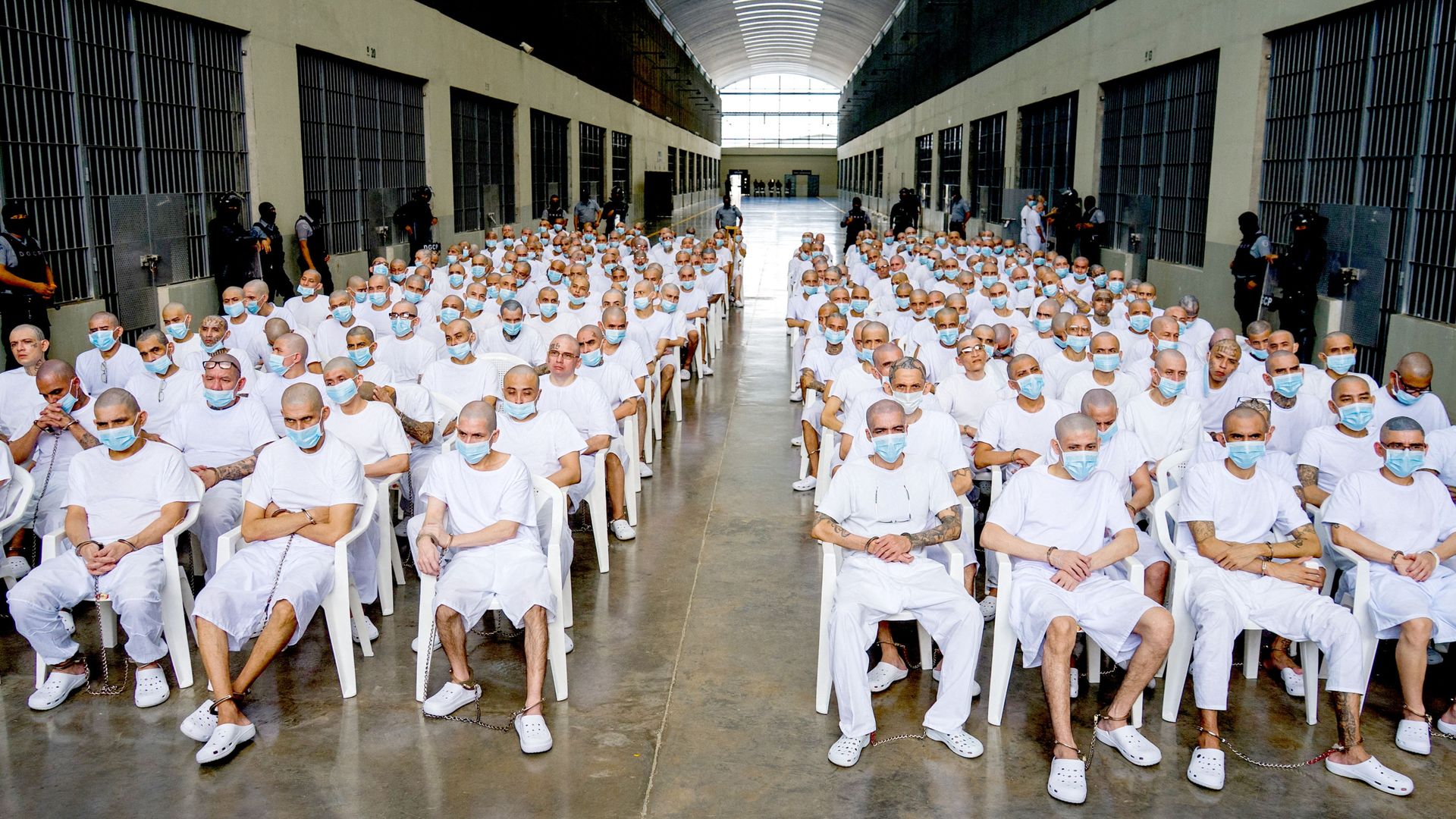
The air inside the courtroom does not move. It is heavy, thick with the respiratory heat of hundreds of men squeezed into a space designed for a fraction of their number. They sit shoulder to shoulder, a sea of white T-shirts and buzzed hair, their skin a map of ink that tells the history of a war fought in the shadows of San Salvador’s alleys. This is not a trial in the way we usually understand the word. It is an industrial processing of human wreckage.
There are 492 of them. They are the upper echelon, the middle management, and the foot soldiers of MS-13. Collectively, the state of El Salvador has accused them of more than 47,000 crimes.
Numbers like that are impossible to visualize. They blur into a grey fog of statistics. To understand the weight of 47,000 crimes, you have to stop looking at the mass of white shirts and look instead at a single, empty chair in a kitchen in Santa Tecla. You have to hear the sound of a shopkeeper’s hand shaking as he counts out "protection" money that should have gone toward his daughter’s school shoes.
This is the story of how a nation decided to amputate its own limbs to save the body.
The Ledger of Blood
For decades, the Mara Salvatrucha, or MS-13, functioned as a shadow government. They didn't just commit crimes; they administered a dark sort of order. If you lived in their territory, you paid their taxes. If you had a dispute, you went to the local palabrero—the "word-man"—rather than the police. The cost of this parallel society was written in the soil.
The current mass trial is the culmination of a state of emergency that has fundamentally rewritten the social contract in El Salvador. The government’s logic is cold and mathematical. If a virus is killing the host, you do not treat the cells individually; you flood the system with a cure so potent it might just kill the patient, too.
Among the 47,000 counts are 500 homicides. Imagine 500 funerals. 500 coffins being lowered into the volcanic earth. Then add the disappearances. In El Salvador, "disappeared" is a verb that people use for the weather. It is something that happens. You walk to the bus stop, and you never arrive. Your family spends years looking for a patch of disturbed dirt in the woods.
The prosecution’s case hinges on the idea of corporate liability. In their eyes, it doesn't matter if a specific man pulled a specific trigger. If he was part of the "wheel" of the gang, he is responsible for every rotation. It is a legal sledgehammer.
The Invisible Stakes
Consider a hypothetical woman named Maria. She is not in the courtroom, but she is the reason the courtroom exists. Maria ran a small stall selling pupusas. Every Friday, a teenager with a serpent tattooed on his neck would walk by. He didn't have to say anything. He just looked at her. Maria would hand over twenty dollars—nearly a third of her weekly profit.
That twenty dollars is one of the 47,000 crimes. It is an act of extortion, a dry legal term that fails to capture the way Maria’s stomach would cramp every Friday morning. It doesn't capture the way she had to tell her son they couldn't afford the meat for dinner, or how she learned to keep her eyes fixed on the ground to avoid "disrespecting" a boy half her age.
When the state of emergency began, the boy with the serpent tattoo disappeared into the maw of the prison system. For the first time in twenty years, Maria kept her twenty dollars. She looked up when she walked down the street.
But there is a price for this newfound peace.
The legal system has become a conveyor belt. In these mass trials, defense attorneys are often given only minutes to represent hundreds of clients. The presumption of innocence has been replaced by a presumption of association. If you live in the wrong neighborhood, if you have the wrong friends, if you were in the wrong place when the trucks rolled in, you are part of the 47,000.
This is the terrifying trade-off of the modern era. How much liberty are you willing to set on fire to stay warm?
The Architecture of the Cage
The men in the courtroom are being held in the CECOT—the Terrorism Confinement Center. It is a mega-prison, a brutalist monument to the state’s will. It is a place where the sun is a luxury and silence is enforced by the barrel of a rifle.
Critics argue that by grouping 492 defendants together, the state is making a mockery of due process. How can a judge truly weigh the evidence of a specific kidnapping against a specific individual when that individual is just a face in a crowd of five hundred?
The government’s answer is simple: The gang is a single organism. You do not try the fingers of a hand for a punch; you try the man.
This logic is seductive because it works. The homicide rate in El Salvador has plummeted. The streets are quiet. You can walk through "No-Go" zones at midnight. The transformation is so radical it feels like a miracle. But miracles usually require a sacrifice.
The sacrifice here is the very concept of the individual. In the eyes of the law, these men have ceased to be people with disparate lives, choices, and levels of guilt. They have been compressed into a monolithic entity called "The Gang."
The Ghosts in the Room
The trial isn't just about the crimes of the past; it’s about the fear of the future. The 47,000 counts include 30,000 instances of "illegal association." This is the crime of belonging. It is the legal mechanism that allows the state to hold someone indefinitely simply because they are part of the structure.
There is a tension in the air that no amount of police presence can stifle. It is the tension of a society holding its breath. Everyone knows that the gangs have not vanished; they have been suppressed. They are under the water, waiting for the surface to clear.
Imagine the logistical nightmare of a trial this size. The mountains of paperwork, the thousands of hours of wiretap audio, the testimonies of witnesses who are terrified that their names will leak. The prosecutors speak in a rhythmic, exhausted drone, reading out dates and locations that represent shattered lives.
"June 12th, extortion. August 4th, aggravated assault. September 1st, homicide."
Each sentence is a tombstone.
The defense tries to poke holes in the collective narrative. They point out that some of these men were low-level lookouts, pressured into the life before they were old enough to shave. They argue that a "mass trial" is an inherent violation of human rights. But their voices are small against the roar of a public that is tired of burying its children.
The Weight of the Verdict
The outcome of this trial is almost a foregone conclusion. The political will behind these prosecutions is absolute. The President has staked his entire legacy on the total eradication of the gangs. To lose this case—or even to allow a significant number of acquittals—would be a crack in the armor of the state.
But even a "guilty" verdict for all 492 men doesn't solve the underlying math.
For every gang member in a white T-shirt, there is a family left behind. There are children growing up with fathers in the CECOT, their only connection to the world of the "civilized" being a record of 47,000 crimes they didn't commit but will forever inherit.
The trial is a mirror. On one side, you see the face of a monster that nearly devoured a nation. On the other, you see a state that has become so efficient at hunting monsters that it has forgotten how to see individuals.
As the sun sets over the courthouse, the vans arrive to take the men back to their cells. They move in a synchronized, shackled shuffle. The chains clink against the pavement, a metallic percussion that echoes in the quiet street.
Outside the gates, a few women wait. They don't have signs. They don't shout. They just watch the vans go by. Maybe their sons are among the 492. Maybe their brothers. Or maybe they are the victims, waiting to see if 47,000 counts of justice can ever fill the hole left by a single bullet.
The courtroom is finally cleared. The lights are flicked off. But the 47,000 crimes remain, a heavy, invisible presence in the dark, waiting for the next day's processing to begin. The silence is not peace; it is simply the absence of noise, and in El Salvador, everyone knows how quickly the silence can break.