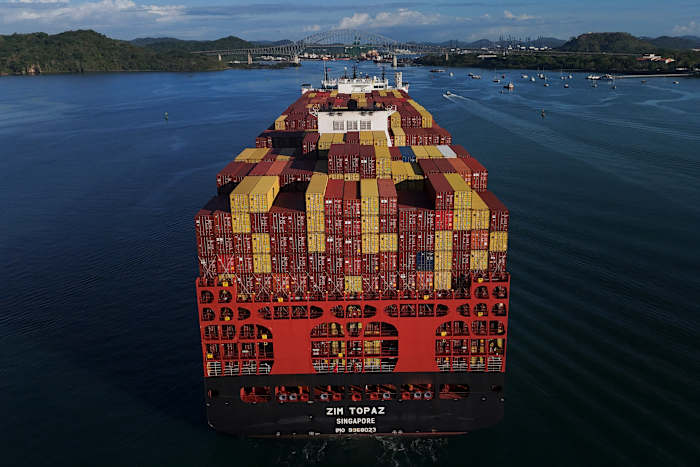
A captain stands on the bridge of a Neo-Panamax vessel, staring at a digital display that represents a literal wall of money. Below his feet, thousands of steel containers hum with the vibration of the engines, carrying everything from high-end semiconductors to the plastic trinkets destined for a discount bin in Ohio. He is tired. His crew is restless. But more importantly, his employers are desperate.
To his east, the traditional shortcut through the Suez Canal is haunted by the threat of drone strikes and regional instability in the Strait of Hormuz. To his west, the Panama Canal—the world’s great liquid shortcut—is running dry.
This is the geometry of a modern crisis. When the world’s arteries constrict simultaneously, the cost of "skipping the line" ceases to be a business expense and becomes a high-stakes gamble. Recently, that gamble reached a staggering peak: $4 million. That is not the cost of the cargo. It is not the cost of the fuel. It is simply the price of an auction slot to move to the front of the line.
Four million dollars just to keep moving.
The Sky Is Falling, Literally
We often think of global trade as a series of spreadsheets and GPS coordinates. We forget that it is entirely dependent on the clouds.
The Panama Canal does not run on seawater. It runs on rain. Every time a ship passes through the intricate system of locks, roughly 50 million gallons of fresh water are flushed out into the ocean. That water comes from Lake Gatun. For over a century, the tropical downpours of Panama kept that reservoir brimming. But a sustained, brutal drought fueled by El Niño turned the heavens off.
As the water level dropped, the authorities did the only thing they could: they started rationing. They cut the number of daily transits from 36 to 22, then 18. They restricted the "draft" of the ships, meaning vessels had to carry less weight to sit higher in the water, lest they scrape the bottom of the canal.
Imagine a highway where half the lanes are closed, and every car is required to leave its trunk empty. Now imagine that every hour you sit idling, you lose tens of thousands of dollars in liquidated damages and fuel costs.
A Choice Between Two Fires
In a normal year, a frustrated shipping magnate might simply divert their fleet. If Panama is backed up, you go east. You send the ships through the Mediterranean, down the Suez Canal, and out into the Indian Ocean.
But the world is rarely normal anymore.
As the drought parched Central America, the Red Sea became a gauntlet. Conflict in the Middle East, specifically the targeting of vessels near the Strait of Hormuz and the Bab el-Mandeb, turned the Suez route into a potential graveyard. Insurance premiums for Red Sea transits skyrocketed. Some companies refused to send their crews into the line of fire at any price.
This created a geographic pincer movement. To the east, fire. To the west, dust.
Logistics managers in glass towers in Geneva and Singapore found themselves staring at a map where every path was painted red. They could take the long way—the grueling, 10-day detour around the Cape of Good Hope at the tip of Africa. That route burns thousands of tons of extra fuel and throws global supply chains into a chaotic "buffer" period where goods simply vanish from the market for weeks.
Or, they could fight for a spot in Panama.
The Auction of Despair
The Panama Canal Authority operates a secret weapon for the wealthy and the hurried: the auction system. While most ships wait their turn in the "standard" queue—which can last upwards of two weeks—a few slots are held back for the highest bidder.
In a stable world, these slots might go for a few hundred thousand dollars. A hefty "convenience fee," but manageable.
As the bottleneck tightened, the bidding wars turned feral. We watched the numbers climb. One million. Two million. Finally, a Japanese shipping giant paid nearly $4 million in a single auction to bypass the queue. When you add the standard transit fees, the total bill for one trip across the 50-mile stretch of land touched $4.5 million.
Why would anyone pay the price of a Manhattan penthouse just to drive through a ditch?
Consider a hypothetical carrier—let's call it the Northern Star. It is carrying liquefied natural gas (LNG). The price of that gas is volatile. If the Star arrives in port on Tuesday, the cargo is worth $50 million. If it arrives ten days late because it sat at anchor in the Pacific, the market may have shifted, or a contract penalty may have triggered, costing the owners $10 million.
Suddenly, a $4 million bribe to the gods of geography looks like a bargain. It is a cold, mathematical desperation.
The Human Toll of the Bottleneck
While the headlines focus on the $4 million figure, the reality on the water is much more somber.
The crews are the ones who pay in time and sanity. A ship at anchor is a floating prison. You are surrounded by the horizon, seeing the lights of Panama City mocking you from a distance, but you cannot move. Provisions run low. The monotony is crushing. Engineers work overtime to keep generators humming in the tropical heat, praying the cooling systems don't fail while the ship sits stagnant.
Beyond the hull, the "invisible stakes" begin to manifest in your local grocery store.
Global trade is a high-wire act of "just-in-time" delivery. When a ship pays $4 million to jump the line, that cost doesn't vanish into the ether. It is distributed. It is baked into the price of the grain, the fuel, and the electronics. We are all participating in that auction; we just don't see the bidding paddle in our hands.
The drought in Panama is a reminder that our high-tech, digital economy is still tethered to the physical world's whims. We can build AI that predicts the weather, but we cannot make it rain. We can build ships that carry 15,000 containers, but we cannot move them through a dry mountain.
The New Geography of Risk
We are entering an era of "chokehold economics."
For decades, the global community assumed that the Great Connnectors—Panama, Suez, Malacca—were permanent fixtures of the landscape, as reliable as the rising sun. We built our entire civilization on the assumption of friction-less movement.
That era has ended.
The $4 million auction is a signal flare. It tells us that the "buffer" in our systems has been used up. We are now living in a world where the margin for error is zero. When a canal dries up or a strait becomes a war zone, there is no "Plan B" that doesn't involve astronomical costs or massive delays.
Companies are now forced to rethink the very nature of distance. Is it cheaper to manufacture goods in a country that is closer, even if the labor is more expensive, simply to avoid the $4 million "gate tax" of the maritime world?
The map is being redrawn, not by cartographers, but by climate patterns and cruise missiles.
The Ghost Ships in the Lake
On a quiet night in Gatun Lake, you can see them—the massive silhouettes of vessels waiting for their turn. They look like ghost ships, haunting a landscape that wasn't designed for this kind of stillness.
The water is still. The engines are quiet. Somewhere, a computer is calculating the next auction price, and a CEO is deciding if their company can survive another month of this.
We used to say that "time is money." In the Panama Canal today, that phrase has been replaced by a much harsher reality. Time is no longer just money; time is a luxury that only the most desperate can afford to buy.
The rain will eventually return, and the auctions will likely subside. But the memory of the $4 million crossing will remain. It is a permanent scar on the psyche of global trade—a reminder that the path between two points is never as straight, or as certain, as it looks on a map.
The next time you see a ship on the horizon, don't just see a vessel. See a gambler. See a survivor of a geographic lottery where the entry fee is higher than most of us will earn in a lifetime, and the prize is simply the right to keep sailing into an uncertain future.

.png?width=1200&auto=webp&trim=0%2C0%2C0%2C0)