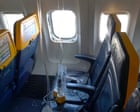
The Sound Before Silence
There is a specific quality to the roar of a jet engine at cruising altitude. It is a constant, heavy white noise that settles into the back of your jaw, vibrating through the titanium frame of the cabin until it feels less like machinery and more like the pulse of the sky itself. You stop hearing it after the first twenty minutes. It becomes the floorboards of the world.
Then, the floorboards give way.
Imagine sitting in row twelve, three miles above the earth. (Note: this hypothetical perspective mirrors the spatial reality of investigators reconstructing the terrifying moments of a specific, harrowing flight.) The air inside the cabin is pressurized, engineered, thin. Outside, the atmosphere is a hostile vacuum, howling at five hundred miles per hour. A passenger looks out the small, oval window. The plastic pane is cold against a forehead.
Crack.
It does not sound like glass. It sounds like a whip.
In a fraction of a second, the physics of routine air travel collide with brutal, unyielding chaos. The window fractures. The pressure differential—that invisible, relentless force holding the artificial climate inside the tube—finds its escape route. A sudden, violent rush of air. A passenger pulled halfway toward the freezing abyss, caught in a terrifying threshold between the safety of the cabin and the deadly void outside.
How did we get here? How does a piece of structural architecture designed to withstand the crushing loads of thousands of flight cycles suddenly fail?
Anatomy of a Catastrophe
To understand the panic, one must look at the silence that follows. The investigators arrived later, wearing high-visibility vests on a rain-slicked tarmac, but the real story began months, perhaps years, before.
Air travel is built on a quiet contract of trust. We strap ourselves into aluminum cylinders, hand our luggage to strangers, and hurtle through the stratosphere. We trust the rivets. We trust the skin. Most of all, we trust the windows.
When official reports finally surfaced regarding the Ryanair incident where a passenger was partly sucked out of a broken cabin window, they did not point to a sudden structural defect in the fuselage, nor did they blame a manufacturing flaw in the acrylic panes. The investigation pointed to something far more visceral, something that had happened moments before or during a previous rotation.
Engine debris.
Let that sink in. A piece of metal, tearing free from a turbine blade at high revolutions, acting not as a stray pebble, but as a high-velocity projectile. It struck the fuselage. It found the exact point of vulnerability.
Physics is indifferent to our travel plans.
Consider the sheer kinetic energy packed into a modern turbofan engine. Inside, compressor blades spin at staggering velocities, subjected to extreme thermal stress and centrifugal forces. When a blade fails—whether due to fatigue, foreign object damage, or micro-fractures—it doesn't just fall off. It shatters. Those shards become shrapnel.
In this case, the debris trajectory intersected with the passenger cabin exterior. It struck near the window assembly, compromising the outer pane and transferring shockwaves through the multi-layered acrylic structure. The outer layer shattered. The middle layer weakened. When the cabin pressure applied its outward force against the compromised boundary, the threshold failed.
It is a terrifying reminder that an airplane is not a monolithic fortress. It is a mosaic of thousands of distinct parts, each relying on the integrity of the other.
The Human Cost of the Invisible
Statistics are comforting. We are told, with metronomic regularity, that commercial aviation is the safest mode of transport ever devised. The numbers are undeniable. You are statistically more likely to be struck by lightning while eating a sandwich than to perish in a commercial jetliner accident.
Numbers, however, are cold comforts when you are dangling by your seatbelt.
We rarely talk about the psychological fallout of survival. What happens to the passenger who was halfway out into the slipstream? What does the world look like when the illusion of absolute safety is violently stripped away in the span of three seconds?
Fear has a distinct taste. It tastes like copper and cold sweat.
When the window gave way, the immediate reaction was not analytical. It was primal. Passengers grabbed shoulders, screamed into the wind-tunnel roar, and fought against the vacuum. Crew members, trained for the unthinkable, moved with the mechanical precision of practiced muscle memory. They secured the cabin. They descended into thicker air.
Yet, the descent is the longest part of the journey. Dropping from thirty-eight thousand feet to a safe landing altitude feels like an eternity when the wound in the side of your plane is hissing reminders of what almost was.
The aviation industry operates on a philosophy of redundancy. Dual hydraulic systems. Backup electrical buses. Multi-pane windows designed with an outer sacrificial pane, a middle structural pane, and an inner scratch pane. The system is designed so that even if one layer fails, another holds.
In this rare, alarming instance, the cascading force pushed past the margins of safety. It exposed the raw edge where engineering meets the infinite cruelty of the upper atmosphere.
Looking Beyond the Black Box
When the headlines fade and the regulatory bodies issue their dense, acronym-laden directives, the real work begins. Maintenance schedules are scrutinized. Engine borescope inspections are tightened. Ultrasonic testing of turbine blades becomes even more rigorous.
Every safety regulation in aviation is written in blood and quiet terror.
We learn because we must. We reinforce the engine casings. We change the inspection intervals. We add another layer of verification to ensure that a turbine failure remains contained within the engine cowl, never allowed to reach the passenger cabin windows.
As travelers, we board our next flights with a renewed, fragile awareness. We walk down the jetbridge, slide into our seats, and glance out the window. We trace the small, neat plastic border with our fingers. We wonder, just for a second, about the invisible forces holding the sky at bay.
Then the engines spool up. The heavy white noise fills the cabin, vibrating through the frame, becoming the floorboards of our world once more. We look out at the clouds, trusting that the machinery will hold, and we rise into the blue.


