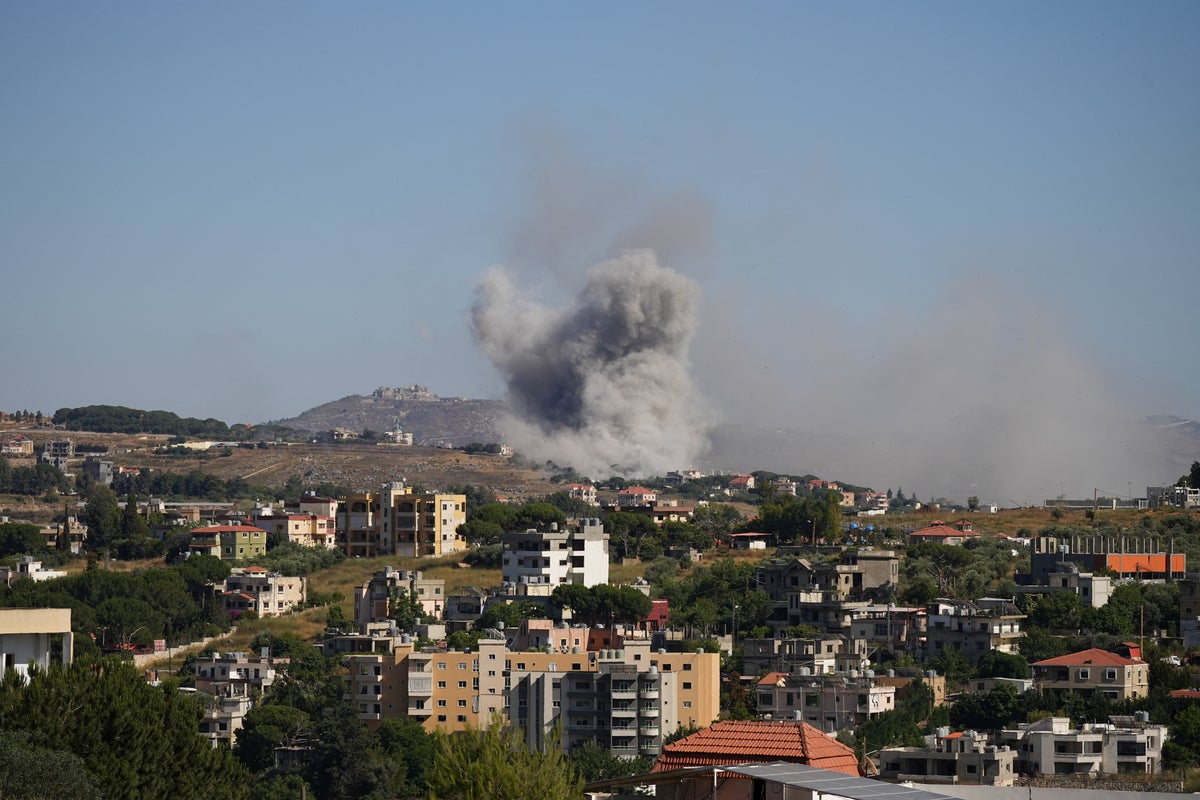
The teacup did not rattle until the third explosion.
In a small, sun-bleached apartment just outside Tyre, Lebanon, an old man named Lebanon—not the country, just a man who carried its history in his bones—watched the amber liquid slosh against porcelain. He did not run. When you have lived through decades of border friction, you learn that running is often just a way to meet the shrapnel halfway. Instead, he listened. The low, guttural growl of jet engines over the Mediterranean. The sharp, concussive snap of iron dome interceptions echoing from the south.
Thousands of miles away, in air-conditioned rooms lined with mahogany and secure servers, papers were shuffled. A press release was drafted. The words were sanitized, scrubbed of blood and dust, reduced to the bloodless vocabulary of geopolitics: Peace talks abandoned. Strategic escalations. Cross-border exchanges.
To the world watching through digital screens, it was Tuesday. Another cycle of a seemingly eternal loop. But on the ground, the collapse of the latest diplomatic channel between regional powers didn't feel like a headline. It felt like oxygen leaving a room.
The Anatomy of a Broken Promise
Diplomacy is a fragile architecture built on the assumption that both sides prefer a bad deal to a good war. For weeks, whisperings of a ceasefire had circulated through backchannels. It was a delicate scaffolding, raised by mediators who traded in nuance and conditional concessions. The hope was small, a flickering candle in a hurricane, but it dictated the rhythm of daily life. When the talks were active, shopkeepers in southern Lebanon opened their shutters. Mothers in northern Israel let their children play in the yards instead of the reinforced concrete bunkers.
Then, the scaffolding collapsed.
The immediate catalyst was a sequence of targeted strikes and retaliatory rocket barrages, but the root cause was far older and more stubborn. It is the calculus of deterrence. When one side feels it must strike to prove it cannot be intimidated, the other side must strike harder to prove the same. It is a mathematical equation where the only output is grief.
Consider a hypothetical family living in Kiryat Shmona, an Israeli town near the Lebanese border. Let us call the father David. For David, the failure of the peace talks isn't a political disappointment. It is the realization that his family will spend another month sleeping in a communal bomb shelter, the air thick with the smell of damp mattresses and anxiety. His children can distinguish the sound of a Katyusha rocket from a mortar shell by the pitch of the whine alone. That is a literacy no child should possess.
Across the border, less than ten miles away, a woman we will call Farah hangs laundry on a line that looks out over the hills. She can see the smoke rising from the valleys. For Farah, the end of the talks means the local pharmacy will remain empty of her mother’s heart medication, trapped behind lines of military checkpoints and supply chains strangled by conflict.
David and Farah do not know each other. They would likely view each other through the lens of inherited enmity. Yet, their days are perfectly synchronized, dictated by the same rhythm of fear and survival.
The Invisible Stakes
We often talk about war in terms of territory, throw-weights, and troop movements. This is a comfort mechanism. It turns tragedy into a chess match, making it intellectual and distant. The real cost of a day of chaos is measured in the invisible things that break.
Trust is the first casualty, and it has a generational half-life. When peace talks are abandoned so abruptly, it solidifies the cynical belief that dialogue is a weapon used by the enemy to buy time. The moderates on both sides, those lonely voices suggesting that coexistence is a practical necessity rather than an idealistic dream, find themselves silenced. They are mocked by the hardliners. See? the extremists say. We told you they only understand force.
The collapse of these negotiations also reveals a terrifying shift in modern warfare: the automation of escalation. With drone swarms and algorithmic targeting systems, the time between a provocation and a devastating response has shrunk from days to milliseconds. Human beings, with all our capacity for hesitation, second thoughts, and mercy, are being cut out of the loop. The machines are hungry, and they feed on data points that represent human lives.
The Echo in the West
It is easy for those outside the region to treat the Middle East as a tragic, distant theater. A place where violence is endemic, an unfortunate property of the soil. This is not just a moral failing; it is a profound misunderstanding of how interconnected our world has become.
The shockwaves of a chaotic day in Israel and Lebanon do not stop at the Mediterranean. They ripple through global energy markets, shifting the price of crude oil within minutes. They alter maritime trade routes, forcing cargo ships to take the long, expensive journey around the Cape of Good Hope, which eventually manifests as a higher price tag on a gallon of milk or a pair of shoes in Ohio or Manchester.
More than economics, there is a cultural contagion. The polarization of the Middle East acts as a mirror for the polarization of the West. The anger is exported, pure and uncut, via algorithms designed to maximize outrage. It spills into college campuses, city councils, and family dinner tables thousands of miles from the blast radius. We become participants in a war we do not understand, waving flags we did not sew, screaming slogans whose historical weight we cannot grasp.
The Weight of the Unseen
Living through this cycle breeds a specific kind of exhaustion. It is a fatigue that settles deep in the marrow. You learn to live with a dual consciousness. On the surface, you buy groceries, pay taxes, and complain about the traffic. Beneath that surface, you are always listening for the siren. You are always calculating the fastest route to a windowless room.
The most dangerous part of this ongoing tragedy is normalcy. When chaos becomes the baseline, the world stops looking for solutions and starts looking for ways to manage the status quo. But a status quo built on explosives is a house built on embers. It requires only one spark, one miscalculated drone strike, one panicked commander, to set the entire structure ablaze.
The peace talks were not abandoned because peace is impossible. They were abandoned because peace requires a courage that is currently in short supply among those who hold the pens and the triggers. It requires the willingness to lose face to save lives. It requires looking at the person across the border and seeing, not a strategic threat, but another human being who is also tired of being afraid.
The afternoon sun began to dip below the horizon, casting long, bloody shadows across the hills of Galilee and the valleys of southern Lebanon. In the quiet interval between the afternoon air raids and the night-time barrages, the old man in Tyre finally picked up his teacup. It had grown cold. He drank it anyway, staring out the window at a sky that promised nothing but more fire.