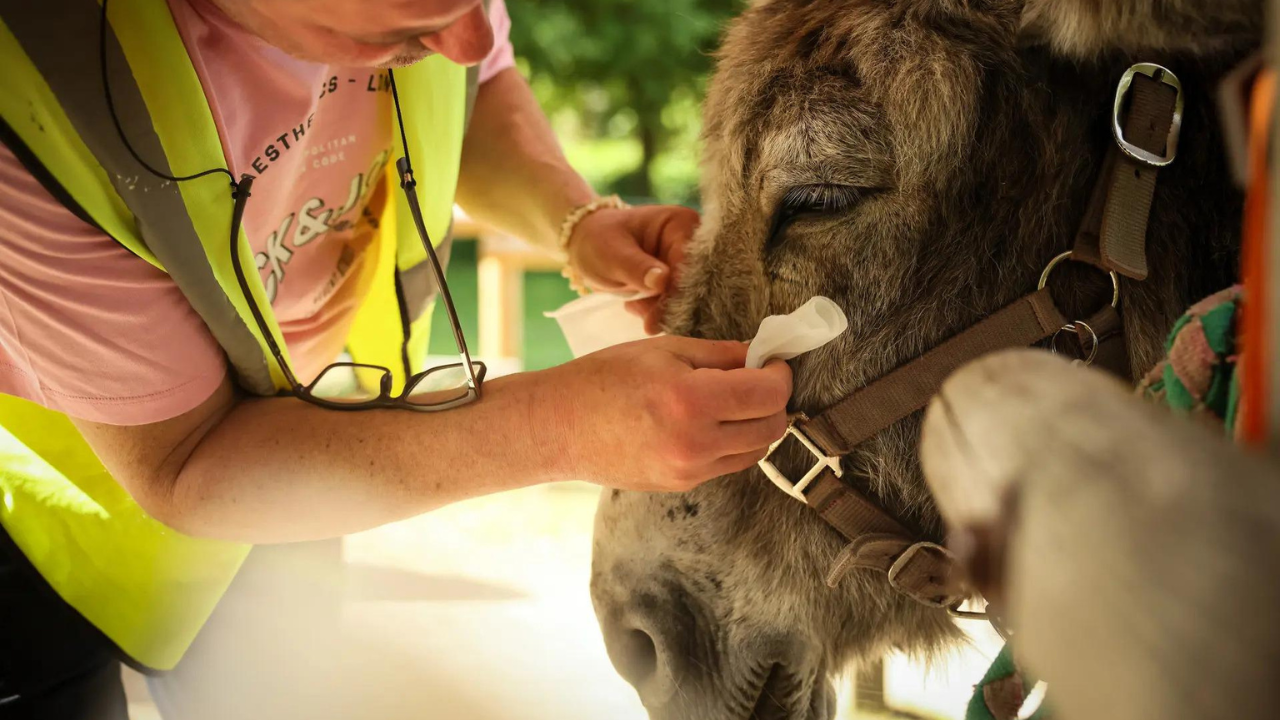
On the rural fringe of Paris, a public psychiatric facility is quietly testing an unconventional approach to severe mental illness. Instead of relying solely on standard pharmacology, clinicians are putting patients in fields with donkeys. This is equine-assisted therapy, but stripped of its usual luxury-wellness branding. The program addresses a persistent crisis in modern psychiatry: the profound isolation and emotional flattening that accompanies chronic mental illness. Initial data suggests that regular interaction with these animals can lower patient stress markers and improve compliance with traditional medical treatments.
But this is not a simple feel-good story about friendly animals. It is a calculated response to a system under strain.
The Mechanics of Non Verbal Intervention
Psychiatric care often hits a wall when patients withdraw entirely from verbal communication. Chronic depression, severe trauma, and advanced schizophrenia can render traditional talk therapy ineffective. This is where animal-assisted intervention enters the clinical framework, operating on principles of emotional mirroring and physiological regulation.
Donkeys possess specific behavioral traits that make them uniquely suited for psychiatric rehabilitation. Unlike horses, which typically respond to fear with a flight instinct, donkeys freeze. They assess threats with a deliberate, sometimes stubborn stillness. For a patient experiencing a hyper-aroused nervous system or mania, a flighty animal escalates anxiety. A donkey’s immobility forces a pause.
The therapeutic process relies heavily on tactile interaction and synchronized pacing. To get a three-hundred-pound animal to walk with them without a lead, a patient must regulate their own physical movements and internal state. If a patient is aggressive or erratic, the animal walks away or refuses to budge. The feedback is immediate, objective, and entirely free of the judgment that patients often perceive from human medical staff.
Clinicians observe that this interaction stimulates the production of oxytocin while reducing cortisol levels. It provides a biological bridge. By stabilizing a patient's immediate physiological stress, medical teams find they can reintroduce standard therapeutic dialogues that were previously blocked by acute symptoms.
Institutional Skepticism and the Funding Battle
Integrating livestock into a public health framework is a logistical nightmare. It faces intense resistance from traditionalists within the medical community. Skeptics argue that the clinical evidence supporting animal therapy is largely anecdotal, relying on small sample sizes and qualitative observations rather than rigorous, double-blind clinical trials.
They have a point. Measuring the long-term efficacy of a donkey walk on a patient with treatment-resistant schizophrenia is notoriously difficult. Critics worry that these programs divert scarce resources away from proven psychiatric interventions and core infrastructure.
The financial reality of public healthcare in France exacerbates this tension. Funding for innovative therapies is rarely secure. While standard pharmaceutical treatments follow established budgetary pathways, animal programs often rely on a fragile mix of temporary hospital grants, regional agricultural subsidies, and private donations.
Maintaining these animals requires specialized staff, secure land, veterinary care, and strict liability insurance. In a climate where public hospitals are routinely cutting beds and facing nursing shortages, spending part of the budget on hay and hoof trimmers is a hard sell to administrative boards. The program on the outskirts of Paris exists in a state of perpetual justification, forced to constantly prove its economic value against traditional line items.
Safety Protocols and Ethical Concerns in Public Wards
Bringing large animals into close proximity with unpredictable psychiatric patients presents obvious safety challenges. A panicked animal can cause serious injury, and an agitated patient can easily compromise the welfare of the therapy animal.
To mitigate these risks, the Paris program enforces strict operational guidelines.
- Pre-Session Screening: Patients undergo rigorous psychiatric evaluation before participating to ensure they are not in an acute state of psychosis or prone to sudden violence.
- Dual-Staff Facilitation: Every session requires both a trained mental health professional to monitor the patient and an experienced animal handler to manage the donkey.
- Short Working Intervals: Animals are rotated frequently to prevent chronic stress, burnout, or behavioral deterioration from absorbing patient trauma.
- Physical Boundary Control: Sessions occur in dedicated, enclosed spaces designed to allow the animal to retreat to a safe zone if it feels overwhelmed.
There is also the ethical question of animal consent. For decades, working animals were treated as mere tools for human benefit. Modern veterinary science challenges this framework, demanding that therapy animals be viewed as active participants whose emotional and physical well-being must be protected. If an animal shows signs of reluctance or distress, the session is terminated immediately. This protocol is not just about animal welfare; it teaches patients about boundaries, consent, and respecting the autonomy of another living being.
The Broader Implications for Western Psychiatry
The experiment outside Paris highlights a growing recognition that Western medicine’s heavy reliance on isolation and chemical restraint has significant limitations. Pharmaceuticals are vital for managing acute crises, but they rarely solve the long-term social and emotional decay that accompanies chronic mental illness.
Hospitals across Europe are watching the Paris data closely. If a public hospital can successfully integrate agricultural elements into an urban medical framework, it challenges the sterile, architectural philosophy of modern clinical design. Concrete walls and locked wards may offer security, but they do little to rebuild a shattered psyche.
The real test for the Paris program is scalability. It is one thing to run a boutique initiative on the rural edge of a metropolis where land is accessible. It is quite another to implement this in a dense urban hospital center. The future of this therapeutic model depends on creating standardized training certifications for handlers and establishing clear, repeatable clinical frameworks that can be audited by insurance providers and state health ministries.
Ultimately, the presence of donkeys in a psychiatric facility is a stark reminder of what is often missing from modern healthcare: the physiological necessity of connection. The program does not promise a cure. It offers a stabilizing tool, an unusual entry point into the hard, messy work of psychological rehabilitation. The success of the initiative lies in its refusal to treat mental health as a purely chemical equation to be solved, recognizing it instead as a complex state of existence that sometimes requires a completely different approach to heal.