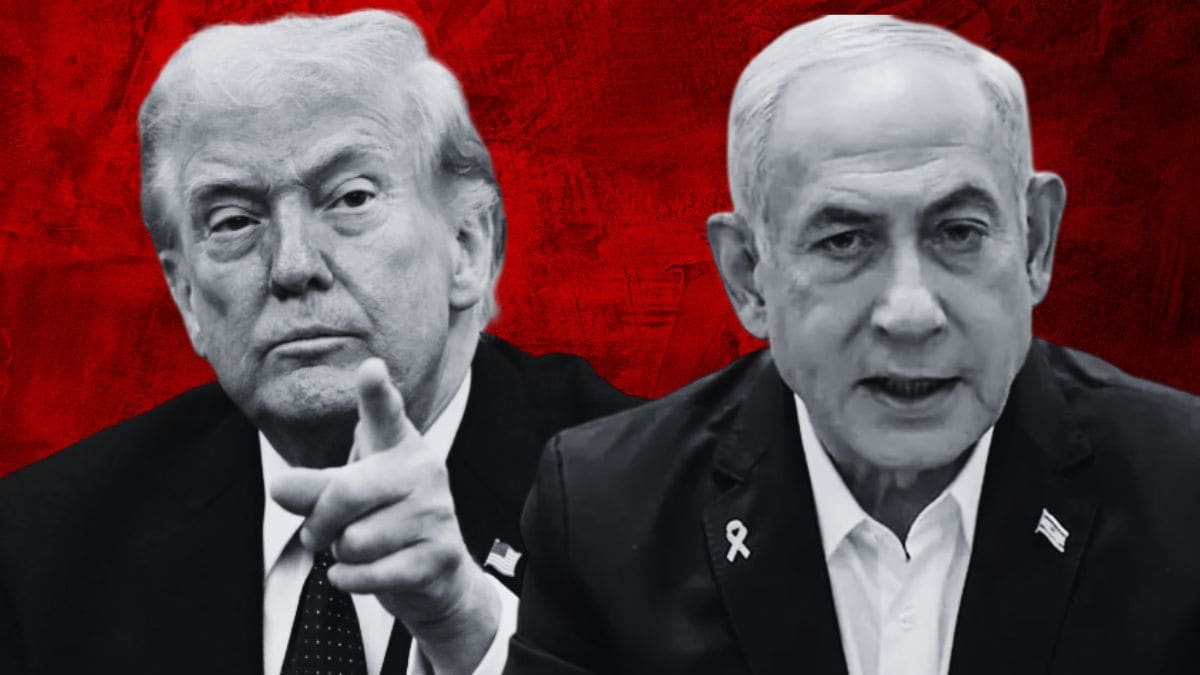
The operational reality of a modern geopolitical alliance is defined not by shared values, but by the asymmetric distribution of leverage. When a security guarantor and a dependent proxy misalign on their core objectives, the resulting friction is rarely polite; it is mathematical. The high-velocity verbal confrontation between US President Donald Trump and Israeli Prime Minister Benjamin Netanyahu regarding military operations in Lebanon illustrates the exact breaking point where domestic political imperatives collide with regional escalation cost functions.
The immediate catalyst for the friction was Israel's hyper-targeted but structurally destructive kinetic campaign against Hezbollah in Beirut. By deploying heavy ordnance to eliminate individual commanders within dense urban centers, Israel triggered an asymmetric diplomatic reaction function from Iran. Tehran signaled a hard boundary: any further escalation in Lebanon would terminate ongoing bilateral truce negotiations with Washington. For an American administration calculating its grand strategy based on minimizing long-term regional military expenditures while securing a legacy-defining diplomatic framework, the destruction of a Lebanese apartment building represents an unacceptable negative return on investment.
The Geopolitical Cost Function of Proxy Warfare
To understand the mechanics of the breakdown, one must map the competing strategic priorities using a fundamental game-theoretic matrix. The American executive branch operates on a macro-level objective function, while the Israeli leadership is bound by a micro-level survival function.
                  US STRATEGIC MATRIX (Macro)
          +-----------------------------------------+
          |  Contain Iran -> Secure Global Truce    |
          |  Reduce Mid-East Military Capital       |
          +-----------------------------------------+
                              |
                     [Structural Tension]
                              |
          +-----------------------------------------+
          |  Tactical Deterrence via Attrition      |
          |  Domestic Political Cohesion via War    |
          +-----------------------------------------+
                ISRAELI OPERATIONAL MATRIX (Micro)
The tension between these two matrices manifests in three distinct structural bottlenecks.
1. The Disproportionate Escalation Threshold
Every military action carries a tactical value and a strategic cost. For Jerusalem, the tactical value of neutralizing a mid-level Hezbollah operative is high, as it restores degraded domestic deterrence metrics. However, the external cost is borne disproportionately by Washington. When Israel shifts from precision strikes in southern Lebanon to deep incursions and heavy bombardment in Beirut, it crosses a cost threshold. The US calculates that the marginal benefit of killing one insurgent is far outweighed by the systemic risk of total regional war, which would necessitate the deployment of American defensive assets and disrupt global energy markets.
2. The Iran Truce Interdependency
Washington's broader Middle Eastern strategy relies on a delicate, sequencing-dependent architecture. Securing a comprehensive diplomatic understanding with Iran requires maintaining stability across secondary theaters. Because Iran conditions its diplomatic compliance on a cessation of hostilities in Lebanon, Israel's refusal to accept a truce creates an immediate bottleneck. In essence, Netanyahu's tactical autonomy directly cannibalizes Trump's macro-strategic objective.
3. The Depletion of Diplomatic Capital
National reputation is a finite resource that directly converts into freedom of action on the global stage. The explicit warning from Washington—that excessive kinetic operations are generating near-universal international animosity—is not an emotional plea; it is an assessment of asset depreciation. When global opposition forces traditional allies to enact punitive measures, such as France barring Israeli defense firms from major trade expositions, the strategic insulation of the proxy weakens. The security guarantor is forced to spend its own diplomatic capital to protect the proxy, reducing the guarantor's capacity to execute policy elsewhere.
The Asymmetry of Personal and Political Debt
Beyond the structural mechanics of regional warfare, the confrontation exposed the raw transactional leverage underpinning the relationship between the two leaders. The invocation of personal interventions—specifically, the public pressure exerted on Israeli institutions regarding Netanyahu's ongoing corruption trials—demonstrates how domestic legal vulnerability alters international bargaining power.
In a standard client-state relationship, leverage is maintained via the flow of military hardware, intelligence syndication, and veto protection at the United Nations Security Council. When an American president explicitly reminds a foreign counterpart of the personalized political and legal costs absorbed to maintain that counterpart's domestic position, the nature of the alliance shifts from institutional to transactional.
Netanyahu’s immediate behavioral pivot on the call—moving from a posture of sovereign military execution to quick compliance—reveals the limits of tactical defiance. The operational reality is clear: Israel possesses the local capacity to initiate high-intensity conflicts, but lacks the structural depth, industrial ammunition capacity, and diplomatic insulation required to sustain them without continuous American underwriting. When the guarantor threatens to withdraw that underwriting, the client's strategic calculations must adjust instantly.
The Shift in Border Enforcement and Containment
The immediate tactical consequence of this friction was observed in the rapid recalibration of troop movements along the Blue Line. Following the directive from Washington, Israeli forces aborted a planned major raid into Beirut, altering the immediate trajectory of the northern campaign.
This forced de-escalation highlights the fundamental limits of the "maximum pressure" doctrine when applied dynamically. While designed to isolate adversaries, the doctrine frequently incentivizes proxies to overreach, assuming the guarantor's support is absolute and unconditional. By establishing a hard operational boundary at the Lebanese border, the US reasserted its role as the final arbiter of regional escalation thresholds.
The ongoing bilateral channels between Washington and Tehran, operating concurrently with these field adjustments, confirm that the overarching American priority remains a structured containment framework rather than a decisive military victory for either regional alignment.
Executing the Realignment Playbook
For regional decision-makers and defense analysts, the strategic play moving forward requires abandoning the assumption of a permanent, frictionless US-Israel alignment. The operational playbook must adapt to a highly transactional American foreign policy model that prioritizes immediate, quantifiable stabilization over long-term ideological campaigns.
- Establish Multi-Tiered Communication Redundancies: Defense establishments must decouple tactical military planning from high-level political rhetoric. Operational green lights must be verified through institutional military-to-military channels rather than relying on perceived personal alignment between executives.
- Price in Strategic Friction: Israeli planning must factor the "American Veto Threshold" directly into its deployment models. Operations targeting high-value targets in urban centers like Beirut must be assessed not just on the probability of tactical success, but on the predictable diplomatic cost function it triggers within the US National Security Council.
- Prepare for Conditional Assistance: Future security assistance allocations will increasingly be tied to explicit compliance with regional de-escalation frameworks. Survival strategies built on the assumption of indefinite, unconditional resupply are fundamentally flawed in an era of transactional diplomacy.
The strategic trajectory is set: Washington will enforce the boundaries of its macro-regional goals with increasing bluntness, and any client state that miscalculates its true level of autonomy will find its operational freedom curtailed with severe velocity.
Trump-Netanyahu Phone Call Analysis
This investigative video from NDTV Profit India details the specific leaks from Axios regarding the high-stakes conversation, offering key journalistic context on how the escalation in Lebanon threatened broader US diplomatic maneuvers with Iran.