The convergence of local military actions and overarching bilateral diplomacy creates high-stakes friction when a third-party actor operates outside the negotiating framework. The June 14, 2026, Israeli airstrike on the Dahieh district of southern Beirut—hours before the projected electronic signing of a United States–Iran Memorandum of Understanding (MoU)—illustrates this geopolitical misalignment. While the executive branches in Washington and Tehran attempt to codify a regional stabilization architecture, the underlying security calculations of Jerusalem and Hezbollah remain bound to a distinct, highly reactive escalation cycle.
To understand why this diplomatic breakthrough faces existential risk, the situation must be evaluated through structured strategic frameworks rather than viewed as an isolated act of regional non-compliance.
The Triadic Escalation Framework
Geopolitical analysis frequently mischaracterizes the Middle Eastern theater as a single, centralized conflict. It is more accurately modeled as a triadic system governed by two distinct but overlapping operational loops:
                  [ United States ]
                         ▲
                         │  Bilateral
                         │  Diplomacy
                         ▼
   [ Israel ] ◄═══════► [ Iran ]
        │                    │
        │ Local              │ Proxy
        │ Escalation         │ Command
        ▼                    ▼
   [ Israel ] ◄═══════► [ Hezbollah ]
- The Strategic Loop (US–Iran): Managed via regional mediators including Pakistan and Qatar. This loop operates on macro-level variables: global energy security, nuclear proliferation limits, international maritime access, and broad sanctions-relief mechanisms.
- The Tactical Loop (Israel–Hezbollah): Governed by localized deterrence metrics, border security constraints, and immediate kinetic retaliation thresholds.
The structural bottleneck occurs because the Strategic Loop attempts to absorb the Tactical Loop without providing formal veto power or institutional guarantees to the primary local actor, Israel. This asymmetry creates what game theorists call a non-cooperative game with incomplete information.
Israel perceives a structural defect in the emerging US–Iran MoU. The proposed 60-day agreement establishes a framework where the US lifts its naval blockade on Iranian ports and grants oil export waivers in exchange for Iran reopening the Strait of Hormuz and recommitting to nuclear enrichment limitations.
However, the framework lacks an explicit enforcement mechanism to neutralize the asymmetric military capabilities of Iran's regional proxies. For Jerusalem, a ceasefire that stabilizes Iran's macroeconomic position while leaving Hezbollah’s rocket and drone infrastructure intact along the northern border is a net-negative security outcome.
The Cost Function of Regional Sabotage
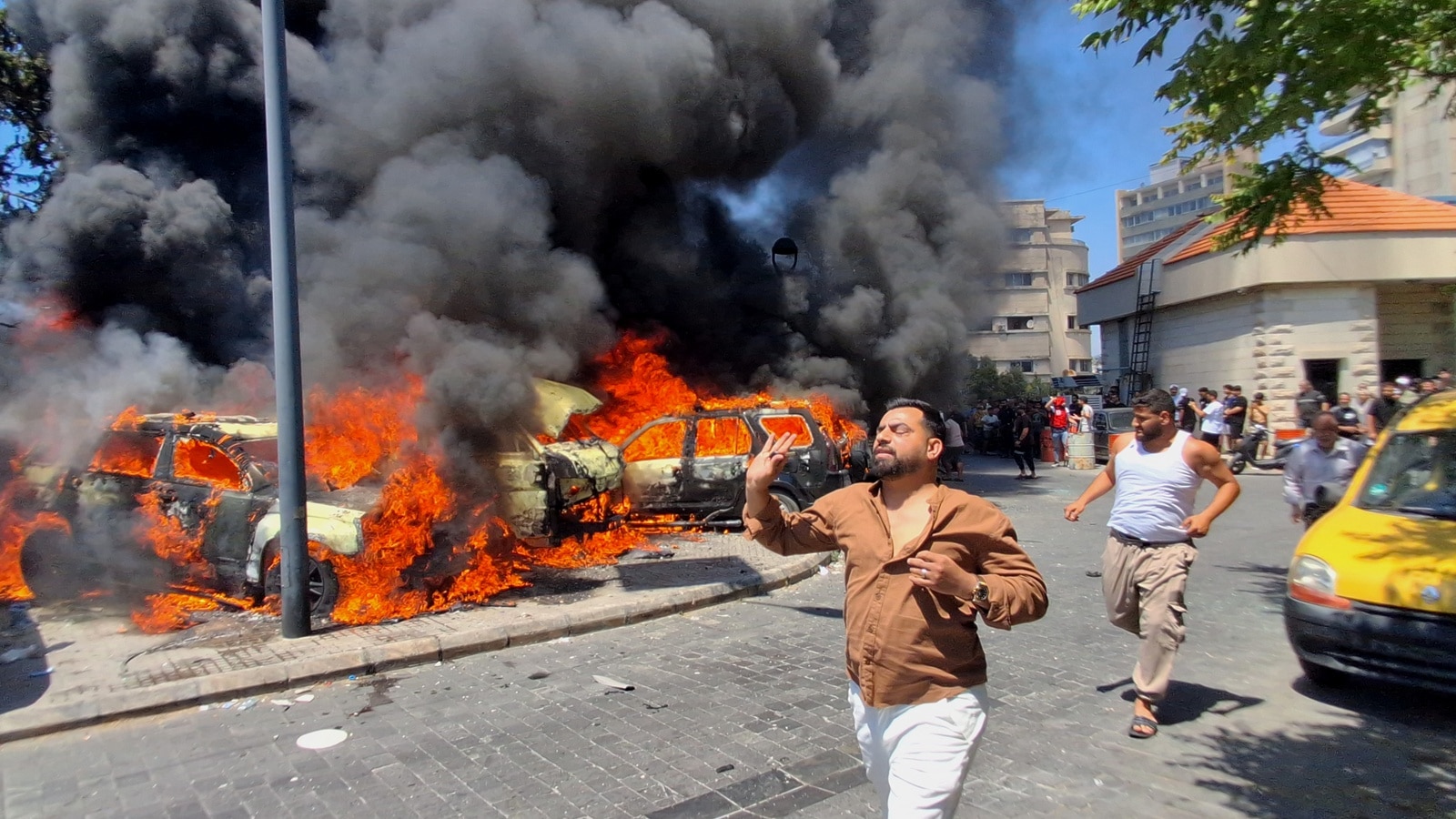
The timing of the Dahieh strike—which targeted and killed Hezbollah commander Ali al-Hajj following a three-drone incursion into northern Israel—reveals a calculated execution of defensive signaling. The strike can be modeled through an institutional cost-benefit matrix evaluating Israel's strategic alternatives.
| Strategic Variable | Adhering to US-Imposed Restraint | Executing the Dahieh Strike |
|---|---|---|
| Deterrence Credibility | Degrades; establishes a precedent that proxy incursions during diplomatic windows carry zero kinetic cost. | Maintained; reinforces the operational rule that domestic territorial integrity supersedes external diplomatic timelines. |
| Alliance Strain (US-IL) | Low; maintains alignment with the executive branch's immediate diplomatic objectives. | High; induces public friction with the executive branch, as seen in explicit executive social media rebukes. |
| Leverage Over Final Terms | Zero; accepts a secondary role in a regional framework negotiated by external intermediaries. | Moderate; forces the negotiating parties to structurally account for local security redlines prior to formal signing. |
The Israeli security establishment calculated that the long-term cost of allowing a proxy drone incursion to pass without a response exceeded the short-term cost of diplomatic friction with the United States. By executing a high-profile strike in the Lebanese capital, Jerusalem demonstrated that it retains operational independence, effectively challenging the assumption that a bilateral US–Iran agreement can automatically dictate local border dynamics.
The Broken Transmission Mechanism of Proxy Deterrence
A critical vulnerability within the proposed peace architecture is the flawed assumption of absolute command and control between Tehran and its network of non-state allies. The institutional logic of the MoU presumes that an agreement signed by Iran will instantly alter the behavior of Hezbollah along the Blue Line. This perspective overlooks the dual-identity model of modern proxy forces.
Hezbollah operates simultaneously as an extension of Iranian strategic depth and as a localized Lebanese political and military entity. When Hezbollah launches projectiles into northern Israel, it often responds to localized operational opportunities or tactical friction points rather than executing direct orders from Tehran.
Conversely, when Israel retaliates, it acts on a doctrine of immediate defense. This local action triggers an automated response within the Iranian political structure.
Following the Dahieh strike, Iranian Parliament Speaker Mohammad Bagher Ghalibaf stated that the attack demonstrated a lack of Western capability or will to enforce commitments, casting doubt on the utility of further dialogue. This reaction exposes the friction in the transmission mechanism:
- A local proxy friction point occurs (Hezbollah launches three drones).
- A defensive counter-strike is executed (Israel hits a command node in Beirut).
- The strategic diplomatic track stalls because the sovereign state sponsor (Iran) views the counter-strike as a breach of faith by the negotiating superpower’s ally.
This sequence shows how easily a macro-level diplomatic strategy can be disrupted by micro-level tactical choices when local security dynamics are excluded from the main negotiating framework.
The Macroeconomic and Strategic Realities
Despite the immediate friction caused by the Beirut strike, the underlying structural forces driving both the United States and Iran toward an initial agreement remain powerful. The geopolitical motivations behind the 60-day MoU depend on clear economic and strategic realities.
The Maritime Maritime Energy Chokepoint
The continuous closure of the Strait of Hormuz since early 2026 has altered global energy logistics. The containment of this maritime chokepoint removed significant daily crude volumes from the global market, creating sustained inflationary pressure on Western economies. For the United States, reopening this shipping lane is a matter of macroeconomic stability.
The Sanctions-for-Access Exchange
The mechanical core of the deal relies on a specific sequence of actions:
- Day 1 to 30: Iranian forces begin clearing maritime mines in the Strait of Hormuz. Concurrently, the United States suspends its naval blockade on Iranian shipping hubs and issues an oil export waiver.
- Day 31 to 60: Iran permits untolled commercial transit through the shipping lane while negotiations begin regarding its highly enriched uranium stockpiles.
- The Financial Incentive: The long-term incentive for Tehran is the phased release of approximately $24 billion in frozen foreign reserves, contingent on verifiably dismantling key elements of its nuclear enrichment infrastructure.
The tension between these long-term economic incentives and short-term security demands creates an unstable negotiating environment. The Supreme National Security Council in Tehran faces intense domestic pressure from hardline factions who view any concessions under ongoing Israeli bombardment as strategic capitulation.
Therefore, while the executive leadership in Washington asserts that the electronic signing is merely delayed by hours, the structural durability of the agreement remains vulnerable to subsequent local security developments.
The Strategic Path Forward
To prevent local security actions from consistently disrupting regional diplomacy, the architectural design of the transition framework must be adjusted. The current model relies on an unsustainable assumption that macro-level economic agreements can suppress unresolved border conflicts.
A more stable framework requires separating the maritime and economic terms of the US–Iran MoU from the land-border security arrangements of the Levant. The upcoming phase of negotiations must establish a distinct, localized security channel that directly addresses border demarcation and proxy containment. This channel must operate in parallel with the primary energy and sanctions tracks rather than remaining a secondary consideration.
Without a clear mechanism that addresses Israel's defensive requirements and restricts proxy cross-border capabilities, any regional agreement will remain highly vulnerable to local disruptions. The immediate priority for international mediators is to establish formal de-escalation thresholds that decouple localized border defense from the broader execution of the maritime and nuclear agreements.