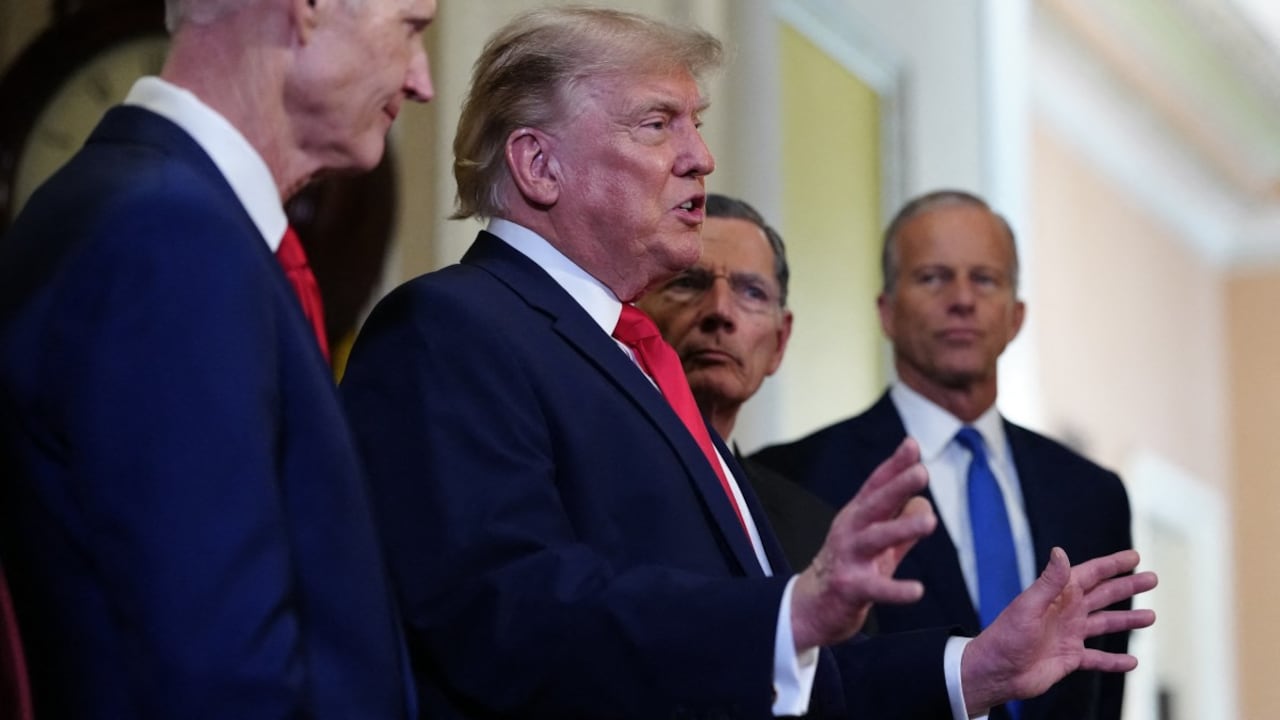
The confrontation between the executive branch and Senate Republicans over the recent military conflict with Iran exposes a structural divergence in how state power, legislative oversight, and geopolitical risk are managed. This institutional friction reached a critical threshold following a 50-48 Senate vote invoking the War Powers Resolution of 1973. Rather than a superficial partisan disagreement, this development illustrates a classic systemic tension: the executive reliance on unconstrained signaling in international crisis-bargaining versus the legislative requirement for fiscal accountability, defined operational timelines, and constitutional authorization.
The underlying friction is driven by distinct institutional incentives. The executive branch operates under a model that prioritizes agility, strategic ambiguity, and unilateral execution to extract concessions from foreign adversaries. Conversely, the legislature functions to bound long-term liabilities, regulate the national purse, and mitigate open-ended military commitments. When an operational timeline deviates from initial executive projections, these competing models inevitably collide.
The Mechanics of Two-Level Crisis Bargaining
To understand the executive reaction to the Senate vote, one must analyze the mechanisms of international negotiations through the lens of two-level game theory. In this framework, a chief executive simultaneously negotiates with foreign counterparts (Level I) and domestic actors whose approval is required to validate or sustain the policy (Level II).
The executive position rests on the premise that any public demonstration of domestic dissent reduces international bargaining power. By signaling internal division, the legislature alters the adversary’s perception of the state’s resolve. In the context of the recent Memorandum of Understanding (MOU) with Tehran—which initiated a 60-day window to negotiate a permanent cessation of nuclear ambitions—the White House views the Senate's war powers resolution as an unwanted variable that increases Iran’s bargaining leverage. The executive calculation assumes that if the adversary believes the president's domestic authority to resume hostilities is legally or politically restricted, that adversary will escalate its demands or stall negotiations to exploit the perceived constraint.
This model, however, contains a fundamental flaw. It treats domestic cohesion as a commodity that can be commanded indefinitely without a continuous exchange of information. The executive branch failed to recognize that as the duration of a military operation extends, the legislative tolerance for information asymmetry decays.
The Legislative Cost Function and Information Asymmetry
The defection of four Republican senators—Bill Cassidy, Susan Collins, Lisa Murkowski, and Rand Paul—to join Democrats in reining in executive military authority was dictated by specific operational and structural variables rather than ideological alignment.
The first variable is the divergence between projected timelines and operational reality. The military campaign, executed under the designation Operation Epic Fury, was initially presented to lawmakers as a highly targeted, brief intervention projected to last approximately four weeks. The reality materialized as a four-month campaign that failed to definitively secure its primary objectives before a fragile truce was implemented. This duration mismatch fundamentally altered the cost-benefit analysis for legislators.
The second variable is the statutory threshold established by the War Powers Resolution of 1973. The statute mandates a 60-day window for unauthorized executive military actions, after which forces must be withdrawn unless Congress explicitly grants an authorization for the use of military force (AUMF) or declares war. The expiration of this 60-day window without an executive request for formal legislative authorization created a structural bottleneck. For constitutional institutionalists within the legislature, permitting the executive to bypass this statutory boundary without pushback creates a precedent that permanently erodes article I legislative authorities.
The third variable is acute information asymmetry. Legislators are structurally exposed to political risk when voting on defense appropriations or defending military actions to constituents without access to verifiable intelligence and strategic roadmaps. When the executive branch refuses or fails to provide detailed operational briefings regarding the end state of a conflict, the legislature shifts from a posture of deference to one of defensive friction. This dynamic was explicitly articulated during the closed-door confrontation when senators noted that the administration had left Capitol Hill in the dark regarding the shifting objectives of the campaign.
The Fiscal Paradox of Post-Conflict Agreements
The strategic schism is further amplified by a profound fiscal contradiction between the administration's diplomatic framework and its simultaneous demands on the domestic treasury. This economic tension manifests in two distinct financial mechanisms:
- The Postwar Reconstruction Fund: The signed interim MOU contains a provision establishing a $300 billion fund designated for Iranian postwar reconstruction and economic stabilization. While the executive branch asserts that the United States will not directly capitalize this fund, the scale of the financial concession—intended to incentivize Iranian compliance on nuclear enrichment and maritime access—drew immediate condemnation from fiscal conservatives. The proposed sum represents a multi-magnitude increase over previous historical precedents, creating intense skepticism regarding enforcement mechanisms and the potential diversion of fungible resources into asymmetric military rebuilding by Tehran.
- The Supplemental Defense Request: Concurrent with the announcement of a framework designed to de-escalate the conflict, the Pentagon requested $70 billion to $80 billion in immediate supplemental defense funding. This request is designed to backfill depleted domestic munitions stockpiles and offset the operational burn rate of the four-month campaign, which independent estimates place near $100 billion.
This creates a distinct political vulnerability for legislators. Members of Congress are being asked to authorize massive emergency defense expenditures to stabilize domestic readiness while simultaneously defending a diplomatic framework that unfreezes or facilitates hundreds of billions of dollars for the adversary. The economic friction is worsened by macroeconomic pressures, including volatile domestic energy costs and cost-of-living constraints, which reduce public tolerance for open-ended foreign expenditures. A recent Reuters/Ipsos metric indicated that only 25 percent of the domestic population views the conflict as having been worth its accrued costs, directly impacting the political calculus of lawmakers facing upcoming midterm elections.
Strategic Implications for the Sixty-Day Window
The passage of the war powers resolution, though legally disputed by the executive branch as unconstitutional and functionally symbolic given the current ceasefire, establishes an institutional precedent that will shape the next phase of the conflict.
The immediate consequence is the fragmentation of the administration's domestic flanking strategy. The executive branch can no longer present a unified national front to international interlocutors. In the upcoming negotiations regarding nuclear verification protocols, maritime transit fees in the Strait of Hormuz, and regional proxy containment, Iranian negotiators will operate with the knowledge that the American executive faces a highly fractured domestic legislature that holds the ultimate power of the purse.
To salvage the strategic position, the executive branch must pivot away from a strategy of elite bullying and unilateral demands. The administration must transition to a structured, institutionalized consultative process with congressional leadership. This requires delivering comprehensive, classified operational briefings that explicitly define the verification mechanisms of the nuclear pact, the exact funding sources for the proposed reconstruction mechanisms, and the precise contingencies that would trigger a resumption of hostilities.
Failure to execute this institutional realignment will result in a complete legislative blockade of the pending supplemental defense appropriations. Without these funds, the military's operational readiness will remain degraded, undermining the credible threat of force required to compel long-term Iranian compliance with any negotiated treaty. The path forward dictates that the administration treat legislative consent not as a rhetorical baseline to be coerced, but as a core component of sustainable statecraft.