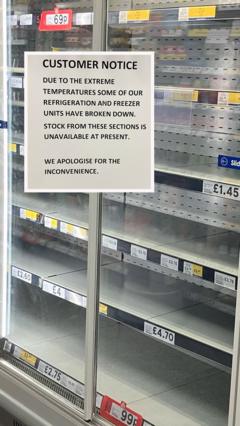
Summer hits and you melt. You grab an ice-cold drink from the fridge to cool down. But inside that sleek metal box, a quiet mechanical panic is unfolding. As extreme summer temperatures become the normal routine rather than the exception, we have to face an annoying reality. Our cooling appliances are struggling to keep up.
Most people assume a refrigerator just works regardless of the weather outside. You plug it in, it stays cold, and your milk doesn't spoil. That assumption is wrong. When a heatwave strikes, your kitchen turns into a high-stress environment for your appliances.
Can our fridges cope with heatwaves? The short answer is barely. Without your help, they burn out, spike your electricity bills, and quietly ruin your food.
The Unforgiving Physics of Keeping Things Cold
To understand why summer threatens your kitchen, you have to understand what a fridge actually does. It does not create cold. It removes heat.
Think of your refrigerator as a heat pump. It pulls warmth out of the insulated interior chamber and dumps it into your room. It uses a chemical refrigerant that evaporates and condenses in a continuous loop. This process relies entirely on a temperature gap. The coils on the back or bottom of your unit need to be hotter than the air around them to shed that captured heat.
When your kitchen hits 35°C or 40°C during a severe heatwave, that temperature gap shrinks. The room air is simply too hot to absorb the heat coming off the coils efficiently. The thermodynamic process slows down to a crawl.
Your compressor is the heart of this system. When the heat cannot escape, the compressor has to work twice as hard. It runs constantly without breaking. It gets incredibly hot to the touch. Under normal conditions, a compressor runs for maybe 30% to 50% of the day. In a severe heatwave, it runs at 100% capacity. It eventually overheats and cuts out entirely to prevent an electrical fire, leaving your groceries to rot.
The Secret Climate Code on your Appliance Label
Every refrigerator is built with a specific climate classification. Manufacturers hide this information on a tiny sticker inside the door or on the back of the unit. Almost nobody checks it before buying, but it dictates exactly how much heat your appliance can handle.
The international standards use four main climate classes.
The Subnormal classification covers ambient temperatures from 10°C to 32°C. The Normal class spans 16°C to 32°C. Subtropical covers 16°C to 38°C. Tropical handles 16°C to 43°C.
If you live in a region where traditional summers were mild, your kitchen likely holds a Normal or Subnormal rated appliance. These units are mechanically incapable of dealing with sustained temperatures above 32°C. When a heatwave pushes your indoor temperature past that threshold, the appliance operates outside its engineered limits. The internal temperature will rise, no matter how low you turn the digital thermostat.
Why the Garage Fridge is a Disaster Waiting to Happen
Keeping an old secondary fridge or freezer in the garage or a garden shed is a common habit. It seems like a great place for extra drinks and bulk frozen food. During a heatwave, this setup becomes an absolute disaster.
Garages and sheds lack proper insulation. They turn into literal ovens during July and August, easily reaching temperatures well over 45°C. A standard domestic appliance cannot shed heat into a 45°C room.
The oil inside the compressor thins out too much when temperatures skyrocket. This causes friction, mechanical wear, and rapid component failure. Even worse, if you have a modern combination fridge-freezer in an unheated space, extreme external heat confuses the internal sensors. The freezer section might defrost completely because the single thermostat thinks the fridge section is doing fine, or vice versa.
If you want to keep food safe in an outbuilding during summer, you need an appliance explicitly rated for tropical conditions. Otherwise, you are just throwing money away on spoiled meat and dead compressors.
The Danger Zone for Food Safety
A struggling fridge is not just an expensive mechanical problem. It is a direct threat to your health. The US Food and Drug Administration states that the safe internal temperature for a refrigerator is 4°C or below. Your freezer needs to sit at -18°C.
Bacteria thrive between 5°C and 60°C. This range is known as the danger zone. Salmonella, E. coli, and Listeria multiply at an alarming rate when temperatures creep into this window.
During a heatwave, if your fridge compressor is cycling off due to thermal overload, the internal temperature can easily sit at 8°C or 10°C for hours without you noticing. The milk might smell fine, and the cheese might look normal. But the bacterial load is growing.
You cannot rely on the built-in digital display of your appliance either. Many modern units show the target temperature you set rather than the actual, real-time internal temperature. Buying a cheap, standalone analog thermometer to hang inside the shelf is a smart move. It gives you the cold truth. If that needle spends more than two hours above 4°C, you need to start discarding perishable items.
Common Mistakes That Suffocate Your Fridge
People often make things worse during hot weather out of sheer panic or bad habits. Avoid these common blunders.
Do not crank the thermostat to the maximum cold setting on a very hot day. It will not make the fridge cool down any faster. It just forces the already struggling compressor to run continuously without a break, speeding up its death. Leave it at its normal setting.
Stop crowding the shelves. Packing every square inch with water bottles and groceries blocks the internal airflow. Cold air needs to circulate freely around your food to maintain an even temperature. If air cannot move, you get warm pockets where food spoils instantly.
Give the exterior some breathing room. Cramming an appliance tightly between kitchen cabinets or right against a wall traps the hot air around the condenser coils. The unit suffocates in its own heat.
Action Steps to Protect Your Food and Appliance
You can take control of the situation. You do not have to sit by and wait for your kitchen appliances to fail. Try these practical interventions.
Clean the Coils Immediately
Dust, pet hair, and lint act like a thick blanket on your refrigerator coils. Pull the unit away from the wall and vacuum those coils. Removing that grime allows the appliance to shed heat much faster, reducing compressor strain immediately.
Manage the Thermal Mass
An empty fridge is an inefficient fridge. Cold air escapes every single time you open the door. Solid items hold cold much better than air. Fill up empty space with jugs of water. Once those water jugs are cold, they act as a battery, stabilizing the internal temperature when the door opens or when the room gets hot.
Pull it Away from the Wall
Give your appliance a few extra inches of clearance during hot spells. Pulling it three to four inches away from the rear wall improves natural convection, letting hot air rise away from the cooling components.
Enforce a Strict Door Policy
Every time you open the door, you dump cold air and invite hot, humid air inside. This creates frost buildup on the evaporator coils, reducing efficiency. Decide what you need before you open the door. Close it quickly.
Keep the Room Cool
Close your kitchen blinds or curtains during the day to block direct sunlight. If your kitchen has poor ventilation, run a small electric fan aimed at the base or back of the fridge. This manual airflow helps move the trapped heat away from the coils, giving the mechanical system a massive boost.
The climate is changing, and our homes are getting hotter. Treating your kitchen appliances like invincible machines will cost you money and peace of mind. Give your fridge a little breathing room, keep the air moving, and monitor the actual temperature inside. That is how you survive the summer heat without a broken appliance and a stomach ache.