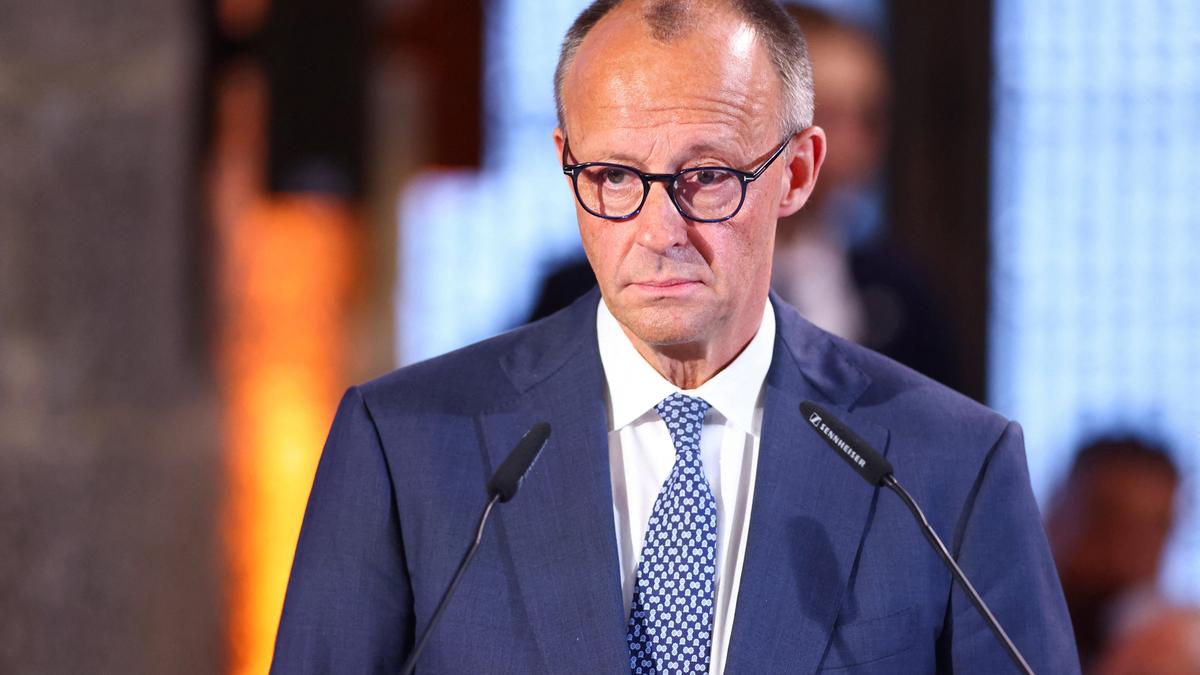
German Chancellor Friedrich Merz just committed the ultimate sin of a fading political class: using a cheap, crowd-pleasing soundbite to mask structural domestic failure. Standing before an audience of young Catholics in Würzburg, Merz declared that he would no longer advise his own children to study or work in the United States. His reasoning? A deteriorating "social climate" and an economy where even the "best-educated have great difficulty finding a job."
It is a comforting narrative for a European elite watching its economic relevance slip away. It is also entirely wrong.
By telling Europe's youth that the American engine of opportunity is broken, Merz is misreading the data, misinterpreting the mechanics of the modern workforce, and projecting Germany’s own stagnation onto its biggest transatlantic rival. The premise that the United States is no longer the premier destination for ambitious, high-achieving talent is a myth designed to keep young Europeans complacent, stationary, and heavily taxed.
The Myth of the Unemployed American Elite
Let’s dismantle the Chancellor’s core economic claim first. Merz told his audience that the highest tier of educated professionals in America can no longer find employment. This is a profound distortion of macroeconomic reality.
What Merz is looking at is a temporary, cyclical correction in entry-level hiring within specific, highly visible sectors like technology and investment banking. According to the Federal Reserve Bank of New York, unemployment among recent college graduates ticked up to roughly 5.7% in early 2026. Yes, entry-level corporate recruiting has softened from the hyper-inflated peaks of the post-pandemic era.
But mixing up a short-term correction for entry-level workers with a long-term destruction of opportunity for elite talent is a catastrophic analytical failure. If you segment the data for experienced professionals, holders of advanced degrees, and specialized technical workers, the American labor market remains incredibly tight. The unemployment rate for individuals with a bachelor's degree or higher consistently hovers around half the national average.
More importantly, Merz completely ignores the ceiling. The real measure of an economy's attraction for elite talent is not just the baseline safety net, but the reward for exceptional output.
Imagine a scenario where a top-tier software engineer, a specialized surgeon, or a quantitative analyst is choosing where to build a career. In Germany, that individual will hit a hard salary ceiling early, face a combined tax and social contribution burden exceeding 40% almost immediately, and watch their wealth accumulate at a snail's pace. In the United States, that same individual has access to a compensation ceiling that is order-of-magnitude higher. The upper-quartile earners in America take home multiples of what their European peers earn, with significantly lower tax friction, allowing for rapid wealth accumulation and capital creation.
The "Social Climate" Smoke Screen
Merz’s second attack focused on America's polarized political atmosphere and social tension. This argument is a classic elite distraction. It suggests that a clean, quiet street is a better economic indicator than a highly dynamic, disruptive market.
The friction in American society is real. It is loud, messy, and constantly broadcast across global media. But that noise is the byproduct of a culture that constantly tests boundaries, challenges established power structures, and adapts to economic reality at breakneck speed. The American social contract values individual risk-taking, commercial ambition, and rapid reinvention above institutional comfort.
For a young professional looking to build something of significance, a hyper-stabilized, comfortable social climate is actually a hidden tax. Germany’s focus on stability has created an environment of profound risk-aversion.
In thirty years of running and advising businesses across borders, I have watched brilliant young European minds spend years trying to navigate the bureaucratic red tape required to launch a simple enterprise. In Berlin, starting a business involves weeks of appointments with notarized deeds, the Handelsregister, and the Finanzamt. In Delaware, you can incorporate a company online in fifteen minutes for less than the cost of a good dinner.
The American "social climate" might be turbulent, but it is a climate that tolerates failure, encourages ambition, and rewards speed. In Europe, failure is a permanent reputational stain; in America, it is a line item on a founder's resume that raises their value to venture capitalists.
Germany's False Narrative of Opportunity
The most defensive part of Merz’s speech was his pivot back to his home turf. He urged young Germans to avoid "disaster mode" and claimed that few countries offer such great opportunities as Germany.
This is where the contrarian truth becomes undeniable: Germany is currently suffering from structural economic decay, and its leadership is using anti-American rhetoric to keep its talent pool from fleeing.
Germany’s economic engine is built on manufacturing, automotive dominance, and stable mid-sized companies—the Mittelstand. That entire model is under severe pressure. The country has faced energy price shocks, crippling demographic decline, and a profound failure to digitalize its infrastructure. While the United States leads the global economy in capital expenditure, cloud computing, artificial intelligence, and biotech, Germany's industrial core is actively shedding jobs.
Let's look at the actual trade-off a young person faces when following Merz’s advice to stay home:
| Economic Metric | United States Environment | Germany Environment |
|---|---|---|
| Top Tax Bracket Entry | Starts at over $600,000 | Starts at roughly €66,000 (42%) |
| Venture Capital Volume | Hundreds of billions annually | A small fraction of US capital access |
| Corporate Culture | Meritocratic, fast promotion cycles | Seniority-based, rigid hierarchies |
| Regulatory Burden | Low friction, pro-business growth | High compliance, strict labor lock-ins |
By advising young people to stay within a system that penalizes high performance with predatory tax rates and rewards administrative conformity, Merz is actively harming the prospects of the next generation. The German social market economy provides a magnificent floor for the average citizen, but it acts as an absolute cage for the exceptional individual.
The Reality of Capital and Scale
The fundamental flaw in the European critique of America is a misunderstanding of market scale. The United States possesses a single, massive, homogenous domestic market backed by the world's deepest capital pools.
If a young entrepreneur wants to scale a business in Europe, they must immediately contend with different legal systems, languages, regulatory regimes, and fragmented consumer behavior. If they launch in the United States, they can scale across fifty states with a single language, a unified commercial code, and immediate access to institutional venture funds that simply do not exist anywhere else on Earth.
This capital depth is why the world's most valuable companies are overwhelmingly American. It is why the breakthrough technologies of the next two decades will continue to emerge from American ecosystems, regardless of who occupies the White House or what the political discourse looks like on television.
Dismantling the Premises of PAA (People Also Ask)
To truly understand this issue, we must address the fundamental questions that people ask when evaluating these two distinct paths, and answer them without the sanitizing lens of political correctness.
Is it safer to build a career in Germany or the US?
It depends entirely on how you define safety. If your definition of safety is a guaranteed job for life, long vacation policies, robust sick leave, and a government that prevents your employer from firing you during a downturn, Germany is undeniably safer.
But if your definition of safety is financial autonomy, the ability to build life-changing wealth before the age of forty, and the agility to pivot into a new industry within forty-eight hours of a layoff, the United States is far safer. True economic safety in the modern world does not come from a labor contract that makes you un-fireable; it comes from possessing high-value skills in a hyper-liquid, dynamic market that can reabsorb you instantly.
Why do European politicians constantly warn against the American model?
Because they are terrified of brain drain. European nations invest heavily in the education and health of their citizens through public funding. When a highly educated engineer, doctor, or researcher leaves Europe for the United States at age 25, the European state loses its return on investment. The individual will pay their high-earning taxes to Washington instead of Berlin or Paris. Warnings about America’s "social climate" or "unemployment" are retention strategies disguised as parental advice.
The Actionable Truth for Ambitious Talent
If you are a young professional, an engineer, a creator, or a builder, ignoring the political theater is essential for your career survival. Do not take career advice from a politician whose job depends on defending a stagnant domestic status quo.
The play is simple, though it requires a tolerance for risk that European institutions rarely teach:
Go where the capital is dense, where the regulatory friction is minimal, and where the upside is uncapped. The United States is not a perfect society, nor is it an easy one. It is a demanding, high-performance environment that tests your resilience daily. But it remains the only market on earth where exceptional ability can decouple itself from social background or bureaucratic approval and achieve true, unmitigated scale.
Chancellor Merz can keep his children home to enjoy the comfort of a slow-growth economy and an administrative state. But for anyone else who wants to build the future, the choice remains exactly what it has been for over a century. You pack your bags, you take the risk, and you head west.
Merz tells 'own children' not to work or study in the US
This video features the direct remarks made by German Chancellor Friedrich Merz during his panel discussion, providing the exact context and tone of the statement that this piece deconstructs.